ICFPro.ca is a division of ICFhome Ontario - Direct Line 1 705 533-1633 - Email: info@icfpro.ca

ICF Foundation Contractor Simcoe County

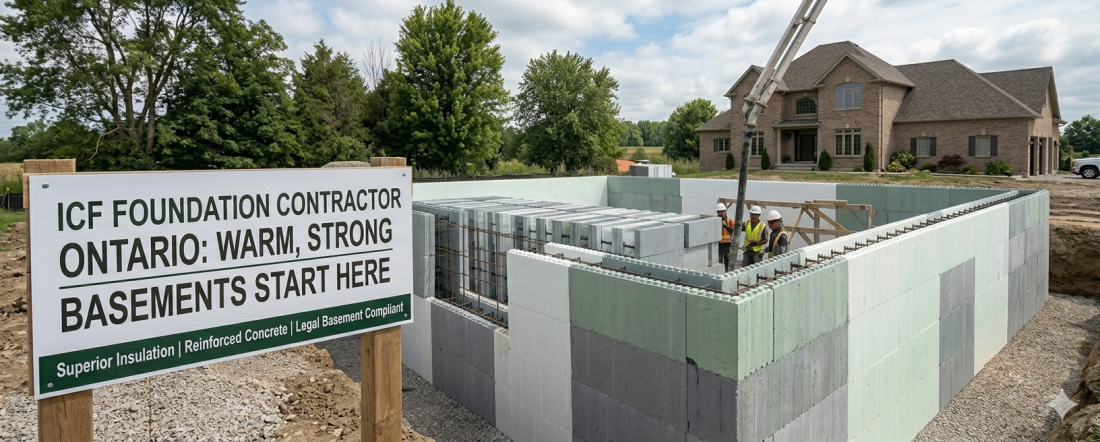
ICFpro.ca · ICF Foundations · Simcoe County
ICF Foundation Contractor Simcoe County: Better Basements That Match Local Soil, Frost, and Code Realities
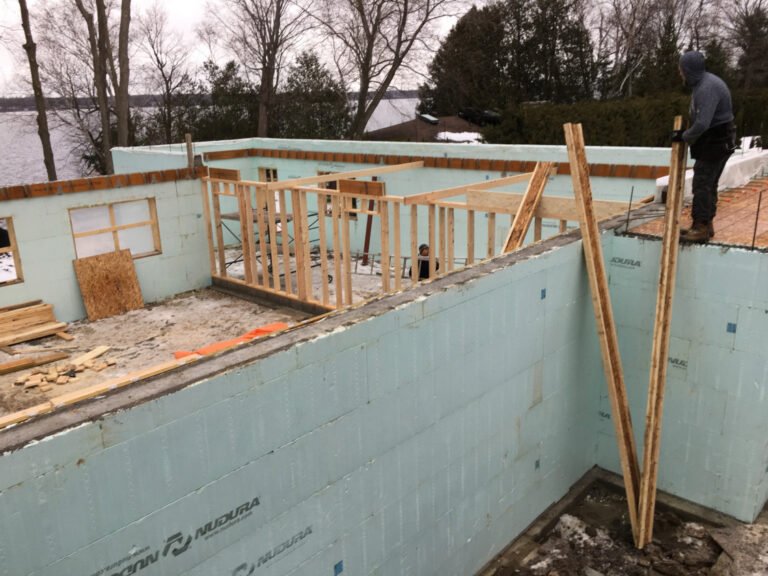
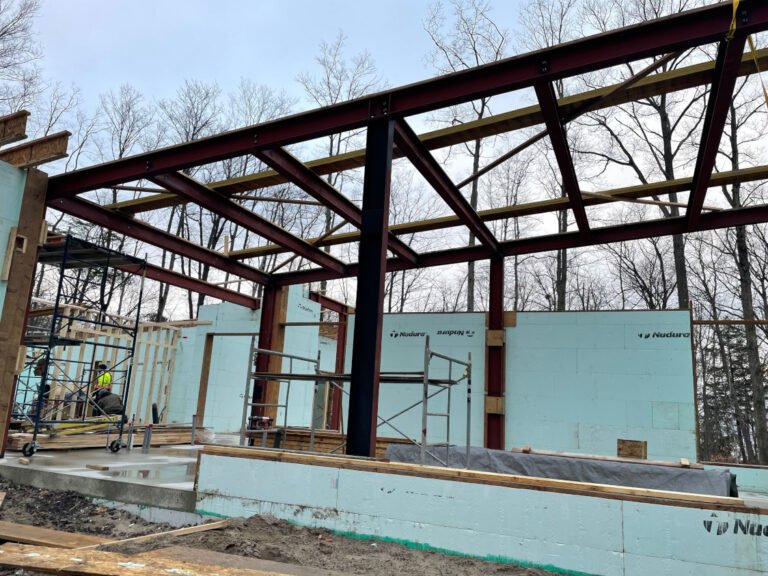
A good house starts where nobody looks: 1.2–1.5 metres below grade. ICFpro has poured ICF foundations across Simcoe County for 30 years (since 1995). We build basements, walkouts, crawlspaces, and garage foundations that respect Ontario’s 2024 OBC, hit the right frost depth for your specific municipality, handle the sandy lakefront soils of Wasaga as confidently as the clay lots of Innisfil, and deliver a basement that’s actually warm, dry, and usable — not just code-compliant. Certified ICF Builder, R2000, Green Builder, Tarion-approved. 300+ projects, ~42 in Tiny Township alone since 2005.
ICF Foundation Contractor
Simcoe County & Georgian Bay
$42–$55/sq ft wall area
Frost Depth 1.2–1.5m
2024 OBC Compliant
✓ Certified ICF Builder
✓ R2000 Certified
✓ Green Builder Certified
✓ Tarion-Approved Builder
What this page covers
ICF foundations done right in Simcoe County mean matching the foundation type to the lot, hitting frost depth for the specific municipality, getting drainage and waterproofing right, and complying with the new 2024 OBC requirements.
- Cost: $42–$55 per square foot of wall area for ICF foundations in Simcoe County 2026. Premium over poured concrete on a typical 1,800–2,400 sq ft home is roughly $8,000–$15,000.
- Frost depth: 1.2m minimum (OBC) but typically 1.2–1.4m in central Simcoe, 1.4–1.5m in Georgian Bay snow belt. Some municipalities require deeper; always verify before excavation.
- 2024 OBC NEW requirements: radon rough-in mandatory for all new homes, full-height basement insulation required (not partway up), MVDS required at permit stage.
- Foundation types we pour: full basement, walkout basement, crawlspace, frost wall, garage foundation, retaining wall, pool walls, and slab-on-grade with thickened edges.
- R-10 underslab insulation recommended for any heated basement — non-negotiable for radiant slab installations.
- Service area: all of Simcoe County (Barrie, Midland, Penetanguishene, Collingwood, Wasaga, Tiny, Tay, Springwater, Oro-Medonte, Innisfil, Bradford, New Tecumseth, Adjala-Tosorontio, Clearview, Essa, Ramara, Severn) plus Orillia and adjacent Georgian Bay communities.
30 years
Pouring ICF foundations in Ontario since 1995
~42 homes
Tiny Township alone since 2005 — concentrated local experience
$42–$55/sf
ICF foundation wall cost per sq ft of wall area, Simcoe 2026
1.2–1.5m
Frost depth — central Simcoe to Georgian Bay snow belt
Why ICF Foundations Work in Simcoe County
ICF foundations combine the structural concrete wall and the insulation in a single pour. For Simcoe County specifically, that combination matters because of three local realities:
1. Most lots want a full basement
Unlike parts of southern Ontario where slab-on-grade is increasingly common, Simcoe County builds overwhelmingly favour full basements — for storage, future finishing potential, mechanical space, and resale expectations in the local market. If the basement is going to be there anyway, the marginal cost of upgrading to ICF (vs poured concrete + separate insulation) lands at a fraction of overall project cost while delivering measurable performance improvements above grade.
2. Heated basement performance matters here
Central Ontario winters demand a basement that holds temperature. ICF foundations deliver effective R-22 to R-25 continuous insulation (vs ~R-12 for typical poured concrete + interior batt). Combined with airtightness of 1.0–1.26 ACH50 (independent RDH Building Science Labs measurements on 49 ICF homes), the basement doesn’t become a thermal sink that the rest of the house has to heat. More on ICF energy performance.
3. Local water and frost conditions reward better walls
Simcoe County has highly variable lot conditions — from sandy fast-draining lakefront soils to clay-rich lots with seasonal water table issues. The continuous concrete core + EPS foam of an ICF wall handles ground moisture and freeze-thaw cycles more forgivingly than block construction and gives waterproofing systems a flat, predictable surface to bond to. After 30 years of local work, we’ve poured ICF in soil conditions that would have failed a block foundation within a decade.
Simcoe County Soil and Frost Realities
“Simcoe County” covers about 4,800 sq km and includes wildly different soil conditions. Foundation strategy that works in Innisfil clay won’t necessarily work on a Wasaga Beach sandy lot. Here’s the regional breakdown we work with:
| Simcoe Sub-Region | Typical Soil | Frost Depth | Foundation Considerations |
|---|---|---|---|
| Western shore Wasaga, Tiny, Tay, Penetanguishene |
Sandy, lake-influenced, some high water table near shoreline | 1.4–1.5m (snow belt) | Excellent drainage usually; watch for water table on lakefront lots; sandy soil can settle if not properly compacted |
| Central highlands Springwater, Oro-Medonte |
Glacial till, well-drained, occasional bedrock | 1.2–1.4m | Generally good bearing soil; rock can appear unexpectedly; sloped sites need drainage plans |
| Southern Simcoe Innisfil, Bradford West Gwillimbury, New Tecumseth |
Clay-rich, slower-draining, perched water tables common | 1.2–1.3m | Drainage tile and proper backfill critical; clay heave on poorly-protected footings is a real problem |
| Eastern Simcoe Ramara, Severn |
Variable: pockets of clay, shield rock close to surface in places | 1.2–1.4m | Rock breaking sometimes needed; bedrock can be a benefit (no settlement) or a problem (no drainage) |
| Western highlands Collingwood, Clearview, Adjala-Tosorontio |
Mixed glacial deposits, generally well-drained on slopes | 1.4–1.5m (snow belt) | Walkout basement opportunities common; ski-country lots often have steep grades requiring engineered design |
| Barrie / Orillia urban | Mostly sandy loam, urban infill on previously-disturbed soil | 1.2–1.3m | Established subdivisions usually predictable; infill lots may need geotech for fill material |
The OBC minimum frost depth is 1.2m (Part 9). But that’s a national baseline — many Simcoe County municipalities require deeper, especially in the snow belt corridor (Collingwood, Wasaga, Blue Mountains adjacent areas). Always verify the specific footing depth requirement with the local building department before excavation. We do this on every project — nothing kills a quote faster than digging the wrong depth.
Frost heave is the #1 cause of foundation failure in Ontario residential construction. If the footings are above the frost line OR sit on inadequately drained soil, freeze-thaw cycles will lift, crack, and damage the foundation over years — sometimes decades, but eventually. An ICF foundation that’s poured at the wrong depth fails the same way a block one does. Hitting the right depth and getting drainage right is foundational (literally) to long-term performance.
2024 OBC Foundation Requirements (What Changed)
The 2024 Ontario Building Code (O. Reg. 163/24) brought several changes that affect foundation construction in Simcoe County. Here’s what’s actually different from older code:
1. Mandatory radon rough-in for all new homes
Every new home in Ontario now requires a sub-floor depressurization rough-in for radon mitigation. This means a sealed pipe stub from beneath the slab to above grade (typically routed through the roof), ready for an active fan if radon levels later test high. Parts of Simcoe County (especially areas with shield bedrock close to surface) have higher radon potential. The rough-in goes in during slab pour — impossible to retrofit cleanly.
2. Full-height basement wall insulation
The 2024 OBC mandates full-height insulation on basement walls — from floor to ceiling, not the partial-height approach that used to be common. For ICF foundations this is automatic because the insulation is built into the wall system. For poured-concrete + framed-and-batted basements, this is now a more substantial wall buildup than older code required.
3. MVDS (Mechanical Ventilation Design Summary) required at permit
Houses built under the 2024 OBC need a Mechanical Ventilation Design Summary submitted with the building permit application. This isn’t a foundation requirement directly — but it affects the foundation because the radon stub, HRV/ERV venting, and any sub-slab depressurization need to be coordinated with the MVDS during design.
4. Underslab insulation expectations
While not strictly mandatory in all cases, current best practice and most performance pathways under SB-12 effectively require R-10 minimum continuous underslab insulation, particularly for heated basements and any slab with radiant in-floor heating. Our full guide to ICF and the 2024 OBC covers code compliance in more depth.
5. Concrete and reinforcement per CSA standards
Concrete materials and methods follow CSA A23.1/A23.2; structural design follows CSA A23.3; reinforcement is per CSA G30.18 (Canadian rebar designations: 10M, 15M, 20M). Typical residential ICF foundation reinforcement: 15M vertical bars every 2 ft (600mm) tied into the footings, 15M horizontal bars every 16″ (400mm) of wall height, more at openings.
Builder note: The 2024 OBC didn’t make ICF foundations harder — in many ways it made them easier, because the integrated insulation already meets the full-height insulation requirement out of the box. Poured concrete foundations with separate interior insulation buildup got more complicated under the new code; ICF’s pre-integrated approach is now a meaningful schedule and trade-coordination advantage.
Four Foundation Types We Pour in Simcoe County
ICF works for nearly every below-grade foundation type. The specifics — wall thickness, footing dimensions, rebar quantity, drainage strategy — vary by what you’re building:
1. Full basement (the workhorse)
| Typical core width | 8″ (200mm), sometimes 10″ for taller walls |
| Wall height | 8′ (2.4m) standard, 9′ (2.7m) for finished basements with high ceilings |
| Footing dimensions | 16″ wide × 8″ deep typical for 8″ wall; engineer may upsize |
| Vertical rebar | 15M @ 600mm o.c., epoxied or hooked into footings |
| Horizontal rebar | 15M @ 400mm o.c. (one every 16″ of wall height) |
| Best for | New custom homes, family homes intending to finish basement |
2. Walkout basement (Georgian Bay specialty)
Walkout basements are extremely common on Simcoe County’s sloped lots — especially in the Collingwood / Blue Mountains corridor, lakefront properties, and on rural lots with natural grade differences. The construction combines below-grade ICF on three sides with a full-exposed ICF wall (often with brick or stone veneer) at the walkout face.
| Below-grade walls | 8″ or 10″ core, full reinforcement, waterproofing system |
| Walkout face | 6″ or 8″ core with brick ledge form if veneer is planned |
| Lintels at door/window openings | Engineered — spans often exceed Part 9 prescriptive tables. See our ICF lintel design guide. |
| Drainage strategy | Critical — water flows downhill to the walkout face; perimeter drainage tile + swale must direct water around the building |
| Best for | Sloped lots, lake-view properties, basement-as-main-living-space designs |
3. Crawlspace foundation
Less common in Simcoe County than full basements but useful for cottage builds, additions, and properties with high water tables that make full basements impractical.
| Wall height | 4′–5′ (1.2–1.5m) typical, just enough for service access |
| Core width | 6″ or 8″ |
| Critical detail | Vapour barrier on floor (typically 6 mil poly sealed at edges), passive or active ventilation, conditioned vs unconditioned strategy decided at design stage |
| Best for | Cottages, additions, sites where deep excavation isn’t practical or worthwhile |
4. Garage foundation / frost wall
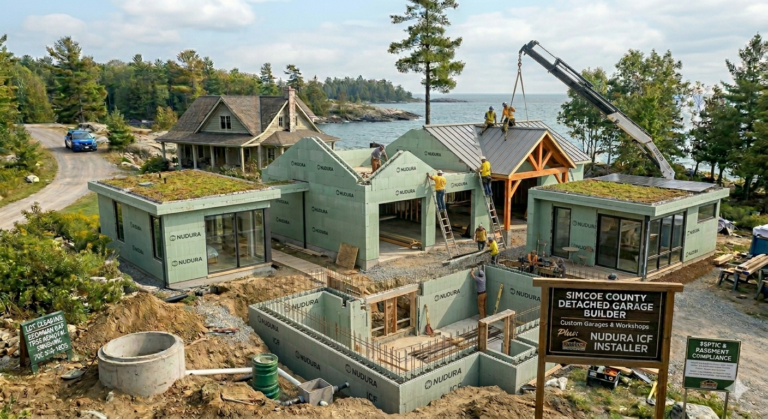
Detached garages and workshops often use shallower foundations — either slab-on-grade with thickened edge (frost wall) or full basement-style foundation if a heated workshop is planned. See our ICF detached garage decision guide.
| Slab-on-grade + frost wall | 6″ ICF frost wall extending to frost depth, monolithic slab with thickened edge under wall load points |
| Full garage foundation | If heated workshop or basement under garage: 8″ ICF, same as house foundation |
| Underslab insulation | R-10 minimum if heated, optional if unheated — but worth adding for future-proofing |
| Best for | Heated detached workshops, garages housing valuable equipment, year-round-use buildings |
ICF vs Poured Concrete vs Concrete Block: The Honest Comparison
ICF isn’t the only way to build a foundation in Simcoe County. The realistic alternatives are poured concrete (forms-and-pour with separate interior insulation) and concrete block (less common in new construction but still used). Here’s how they compare on the factors that matter:
| Factor | ICF | Poured Concrete | Concrete Block |
|---|---|---|---|
| Cost (Simcoe County 2026) | $42–$55/sq ft wall | $35–$45/sq ft wall (then add insulation) | $30–$42/sq ft wall (then add insulation) |
| Effective R-value | R-22 to R-25 | ~R-12 with 2″ XPS interior | ~R-12 with 2″ XPS interior |
| Airtightness contribution | Excellent (continuous concrete + foam) | Good if poured properly | Poor — mortar joints leak |
| Insulation install step | Built-in (single trade) | Separate trade after pour | Separate trade, plus framing for finish |
| 2024 OBC full-height insulation | Automatic | Required additional buildup | Required additional buildup |
| Schedule (foundation phase) | 1–2 weeks on site | 1 week pour + 1–2 weeks insulation later | 2–3 weeks plus insulation |
| Resistance to water/freeze-thaw | Excellent | Good | Poor — mortar joints fail over decades |
| Common in 2026 Simcoe County | Growing, especially custom builds | Standard for tract subdivision builds | Rare in new builds; common in renovation/repair |
For a deeper dive into ICF vs poured concrete economics specifically, see our ICF foundation cost vs poured concrete comparison. The short version: ICF’s upfront premium of roughly $8,000–$15,000 on a typical Simcoe County home is partially or fully offset by built-in insulation, faster schedule, and 2024 OBC compliance simplicity.
Drainage and Waterproofing (The Part That Fails First)
Honest builder reality: most “basement problems” are not wall problems. They’re drainage and waterproofing problems wearing a wall problem’s costume. After 300+ projects across Simcoe County, the failures we’ve seen on other builders’ work almost always trace back to one of these:
The drainage system that every ICF foundation needs
- Perimeter drainage tile (weeping tile) — 4″ perforated pipe at footing level, wrapped in filter sock or geotextile, surrounded by clean stone
- Drainage layer against the wall — dimple membrane (e.g., Platon) or drainage board allowing water to travel down to the weeping tile rather than building hydrostatic pressure against the wall
- Discharge to daylight or sump — weeping tile must drain somewhere; gravity to daylight where grade allows, otherwise a sump pit with reliable pump
- Clean stone backfill (300mm minimum) against the wall before native soil — lets water move down freely
- Compacted granular against the upper portion for grade support, not pure topsoil that holds water against the building
Waterproofing layer (not just dampproofing)
The 2024 OBC distinguishes between dampproofing (basic tar emulsion, OK for occasional moisture) and waterproofing (membrane-based, required where hydrostatic pressure is expected). For Simcoe County lots with clay soils, high water tables, or below-finished-grade walls, waterproofing — not just dampproofing — is the right specification.
Common waterproofing systems for ICF in Ontario: self-adhesive rubberized asphalt membrane, liquid-applied polymer membranes, or pre-formed sheet membranes. NUDURA, AMVIC, and other ICF manufacturers all publish waterproofing system specifications compatible with their forms.
R-10 underslab insulation (for heated basements)
For any basement that will be heated — especially radiant in-slab — R-10 minimum continuous underslab insulation is essential. Without it, the slab loses 30–50% of its heat downward into the soil. Combined with perimeter slab-edge insulation (R-15 typical), the underslab system traps heat where it’s useful.
Grade and surface water management
Even perfect drainage tile and waterproofing fail if the surface around the building doesn’t move water away. The final grade should slope away from the foundation at minimum 5% (about 6″ per 10 ft) for the first 6 ft, with proper roof drainage (eavestrough + downspout extensions discharging at least 6 ft from the building) and any swales or surface drainage planned to move water around the building, not toward it.
The drainage rule we follow on every project
Plan drainage before concrete, not after. The drainage system — weeping tile, drainage layer, waterproofing, backfill strategy, surface grade plan — is part of the foundation, not a finishing-stage afterthought. We coordinate with the excavator and landscaper at design stage so the final grade matches what the drainage tile expects. After 30 years of basement work, this is the single most reliable predictor of whether the foundation stays dry for the long term.
Real Costs for ICF Foundations in Simcoe County (2026)
Specific cost ranges for typical ICF foundation projects in Simcoe County, 2026 pricing:
| Foundation Type | Typical Wall Area | Wall Cost Range | Total Foundation Cost (incl. footings, slab) |
|---|---|---|---|
| Basement, 1,200 sq ft home | ~600 sq ft wall (140 lin ft × 8′) | $25,000–$33,000 | $50,000–$70,000 |
| Basement, 1,800 sq ft home | ~800 sq ft wall (170 lin ft × 8′) | $34,000–$44,000 | $65,000–$90,000 |
| Basement, 2,400 sq ft home | ~1,000 sq ft wall (200 lin ft × 8′) | $42,000–$55,000 | $80,000–$110,000 |
| Walkout basement, 2,000 sq ft home | ~900 sq ft wall (engineered lintels) | $45,000–$60,000 | $90,000–$125,000 |
| Garage frost wall + slab, 2-car | ~150 sq ft wall (50 lin ft × 3′) | $7,000–$11,000 | $18,000–$28,000 |
| Crawlspace, 1,500 sq ft footprint | ~400 sq ft wall (160 lin ft × 2.5′) | $17,000–$22,000 | $32,000–$45,000 |
What’s included in “wall cost”: ICF forms, concrete, vertical and horizontal rebar, labour, bracing, pump truck, and waterproofing on the exterior. What’s included in “total foundation cost”: excavation, footings, ICF walls, drainage tile, waterproofing, underslab insulation, slab on grade, and backfill.
Variance within ranges is driven by: site access difficulty, soil conditions (clay vs sand vs rock), wall height (9′ vs 8′), complex geometry (more corners), engineer-stamped designs for walkouts or unusual lots, and cold-weather work premiums. Our full ICF cost analysis covers the broader picture.
Timeline and Weather Realities for Simcoe County Foundations
Foundation timelines in Simcoe County are weather-dependent in ways that surprise people from southern Ontario. Here’s what to plan for:
Building season (April–November)
Typical foundation project from break-ground to backfill: 2–3 weeks for a standard basement, longer for walkouts or complex sites.
- Week 1: Excavation, footing forms, footing pour, ICF wall setup
- Week 2: ICF wall stack, bracing, opening preparation, rebar placement, pour day
- Week 2–3: Waterproofing, drainage tile, backfill, slab preparation, slab pour
Cold-weather construction (December–March)
ICF foundations can be poured year-round in Simcoe County — the EPS forms actually help cold-weather concrete curing by insulating the concrete from ambient cold. But cold weather adds:
- 1–2 weeks to schedule for concrete curing protection and extended set times
- Heated enclosures or hoarding for slabs poured below freezing
- Concrete admixtures (accelerators, antifreeze) for cold pours
- Premium pricing typically 10–20% on cold-weather work due to additional labour and protection
Snow belt considerations (Collingwood / Wasaga / Tiny / Blue Mountains)
Sites in the Georgian Bay snow belt face additional weather windows during heaviest snow months. We typically prefer to have the foundation complete and backfilled by mid-November to avoid working in heavy snow conditions. If site work extends into deep winter, additional time and cost should be budgeted.
Service Area and Project Process
We pour ICF foundations across all of Simcoe County and the broader Georgian Bay region. Our concentrated work area is the Tiny / Midland / Penetanguishene / Wasaga / Collingwood corridor, but we travel throughout the County and surrounding communities.
Simcoe County coverage by municipality
All 16 Simcoe County lower-tier municipalities plus Barrie and Orillia (separated cities in the region):
Barrie
Orillia
Midland
Penetanguishene
Collingwood
Wasaga Beach
Tiny Township
Tay Township
Springwater
Oro-Medonte
Innisfil
Bradford West Gwillimbury
New Tecumseth
Adjala-Tosorontio
Clearview
Essa
Ramara
Severn
Our foundation project process
What working with ICFpro on a foundation project actually looks like:
- Initial conversation (free) — phone or email to understand scope: full basement, walkout, crawlspace, garage foundation. Project timeline, current stage, budget range.
- Plan review (free) — we review your architectural drawings for ICF buildability and identify any structural questions that need engineer attention.
- Site visit (free within ~90 min of Tiny Township) — access, grade, surrounding context. Better to see it than estimate from the satellite view.
- Written firm quote — scope, schedule, materials, labour, project-specific contingencies. Transparent payment schedule tied to milestones.
- Coordination with excavator — we work with established Simcoe County excavation crews; we’ll coordinate the dig timing with our wall pour schedule.
- Foundation pour (1–2 weeks on site) — footings, ICF wall stack, bracing, pour day, waterproofing, drainage tile, backfill, slab.
- Handoff to next stage — if we’re continuing into shell work, seamless transition. If you’re using us for foundation only, clean handoff to your next builder with documentation.
- 7-year materials and workmanship warranty — longer than Ontario’s typical 1- and 2-year minimums.
Related ICFpro pages
More on ICF foundations, brand selection, local services, and broader construction topics.
★ Provincial pillar
ICF Foundation Contractor Ontario →
★ Cost pillar
ICF Foundation Cost vs Poured Concrete →
Service
ICF Foundations, Pools & Structures →
Service
ICF Installation & Supply →
Service
ICF Custom Home Building →
Code
ICF & the 2024 Ontario Building Code →
Structural
ICF Lintel Design Guide →
Structural
ICF Structural Strength →
Brand
All 8 Ontario ICF Brands Compared →
Local sibling
ICF Foundation Contractor Barrie →
Local sibling
ICF Construction in Tiny Township →
Local sibling
ICF Construction in Collingwood →
Local sibling
ICF Contractors in Midland →
Local sibling
ICF Contractors Near Wasaga Beach →
Local sibling
ICF Homes in Barrie →
Talk to Us About Your Simcoe County Foundation
Direct line: 705-533-1633. Email: info@icfpro.ca. No-cost initial conversation, plan review, and ballpark estimate. Based in Tiny Township; foundation work across all of Simcoe County and Georgian Bay. 30 years pouring ICF, 300+ projects, four certifications, 7-year warranty.
FAQ: ICF Foundation Contractor Simcoe County
How much does an ICF foundation cost in Simcoe County?
Typical ICF foundation walls in Simcoe County run $42–$55 per square foot of wall area in 2026 pricing. For a typical 1,800–2,400 sq ft home footprint, total foundation cost (excavation, footings, ICF walls, drainage, waterproofing, slab) runs $65,000–$110,000. The ICF premium over a poured concrete + interior insulation foundation is roughly $8,000–$15,000 depending on size and complexity — partially offset by faster schedule and built-in 2024 OBC full-height insulation compliance.
What is the frost depth requirement in Simcoe County?
The OBC minimum is 1.2m (4 ft) per Part 9. In practice, footing depth varies by municipality: Central Simcoe (Barrie, Springwater, Oro-Medonte): 1.2–1.4m. Georgian Bay snow belt (Collingwood, Wasaga, Tiny, Penetanguishene): 1.4–1.5m. Southern Simcoe (Innisfil, Bradford): typically 1.2–1.3m. Always verify the specific depth with the local building department before excavation — municipalities can require deeper based on local soil and climate conditions.
What does the 2024 OBC require for new basement foundations?
Several new requirements: (1) Radon rough-in — sub-floor depressurization stub required for all new homes; (2) Full-height basement insulation — floor to ceiling, not partway up (automatic with ICF construction); (3) Mechanical Ventilation Design Summary (MVDS) submitted at permit; (4) Effectively R-10 underslab insulation for heated basements via SB-12 performance pathways; (5) Standard structural compliance per CSA A23.3 (engineered) or Part 9 (prescriptive) for the walls and reinforcement.
Do all Simcoe County lots have the same foundation challenges?
No — conditions vary dramatically. Western shore (Wasaga, Tiny, Tay): sandy, fast-draining, lakefront water table issues. Central highlands (Springwater, Oro-Medonte): glacial till, generally good bearing soil, occasional bedrock. Southern Simcoe (Innisfil, Bradford): clay-rich, slower-draining, perched water tables. Eastern Simcoe (Ramara, Severn): mixed, sometimes shield rock close to surface. Western highlands (Collingwood, Clearview): mixed glacial deposits, often walkout opportunities on sloped lots. Each requires different drainage, waterproofing, and sometimes engineering strategies.
What is the difference between ICF, poured concrete, and concrete block foundations?
ICF: 8″ concrete core + 2-5/8″ EPS foam each side = R-22 to R-25 in one wall assembly. Poured concrete: 8″ bare concrete (~R-2) + separate interior insulation needed for code compliance. Block: 8″ CMU + parging + insulation; mortar joints leak air and water over time. Cost roughly: ICF $42–$55/sq ft wall, poured + insulation $40–$55 finished, block + insulation $35–$50. ICF advantages: single-trade installation, automatic 2024 OBC full-height insulation compliance, better airtightness, faster schedule.
Do you do walkout basements?
Yes — walkout basements are one of our specialties given how common they are in Simcoe County’s sloped lots. Construction combines below-grade ICF on three sides with a full-exposed wall (often brick or stone clad) at the walkout face. Critical details: engineered lintels at door/window openings (often exceed Part 9 prescriptive limits), perimeter drainage tile that directs water around the walkout face (not toward it), and properly graded site to send surface water away from the building. We’ve built dozens of walkout basements in the Collingwood / Blue Mountains / Georgian Bay corridor.
How long does an ICF foundation take to pour?
Standard basement foundation: 1–2 weeks on site from break-ground to backfill ready. Week 1: excavation, footing forms, footing pour, ICF setup. Week 2: ICF wall stack, bracing, opening prep, rebar placement, wall pour, waterproofing, drainage tile, backfill, slab prep, slab pour. Cold-weather builds (Dec-Mar) add 1-2 weeks for concrete curing protection. Walkout basements typically take 2-3 weeks due to complexity. Permit and design phases run separately, typically 2-6 weeks ahead of break-ground.
Can ICF foundations be poured in winter in Simcoe County?
Yes — with caveats. The EPS foam actually helps cold-weather concrete curing by insulating the concrete from ambient cold. We’ve poured ICF walls in -10°C conditions successfully. Requirements: heated enclosures or hoarding for slabs poured below freezing, concrete admixtures (accelerators) for cold pours, extended curing time, and premium pricing typically 10-20% above warm-season work. Sites in the Georgian Bay snow belt face additional weather windows during heaviest snow months; we typically prefer to have foundations complete and backfilled by mid-November when possible.
Why is drainage so important even with ICF walls?
Because most “basement problems” are actually drainage problems wearing a wall problem’s costume. An ICF wall handles ground moisture better than block or bare concrete, but it cannot survive hydrostatic pressure from poorly-drained soil indefinitely. Every ICF foundation needs: perimeter weeping tile at footing level, dimple membrane or drainage board against the wall, clean stone backfill (300mm minimum), discharge to daylight or reliable sump pump, and surface grading at 5% minimum slope away from the building for the first 6 ft. Skipping any of these creates the failure mode that gets blamed on the wall.
How do I get a quote for an ICF foundation in Simcoe County?
Three ways: (1) Phone us at 705-533-1633 for an initial conversation; (2) Email info@icfpro.ca with your project details and any plans; (3) Submit our online quote request form. The initial conversation, plan review, and ballpark estimate are no-cost. For projects within ~90 minutes of Tiny Township, we include a no-cost site visit before final pricing. Bring whatever you have: a rough sketch, an architect’s drawings, a site survey, or just a description of what you’re trying to build — we’ll work with whatever stage you’re at.