ICFPro.ca is a division of ICFhome Ontario - Direct Line 1 705 533-1633 - Email: info@icfpro.ca

2026 Edition · Complete Ontario Brand Comparison
The Complete 2026 ICF Brand Comparison
The Complete 2026 ICF Brand Comparison
for Ontario Builds
Eight ICF brands are available in Ontario in 2026: Nudura, Amvic, Element ICF, IntegraSpec, Fox Blocks, SuperForm, Quad-Lock, and BuildBlock. We install all of them. This is the honest installer's-eye comparison of every brand actually available in Ontario right now — updated for the major industry change in January 2025 (Logix ICF retired, Element ICF replaced it) and the real Ontario distribution status of each system in 2026.
90-Second Summary
In Ontario in 2026, the two dominant ICF brands are Nudura and Amvic. Element ICF (which replaced Logix on January 1, 2025) is the strong third option with deep engineering pedigree. IntegraSpec is a real Kingston-Ontario-based niche option. Fox Blocks, SuperForm, Quad-Lock, and BuildBlock are available in Ontario but with thinner distribution. We install all eight. The "best" ICF brand depends on your project geometry, lot access, timeline, and local supply — not on marketing claims. This guide gives you what you actually need to pick the right one. For 2026 installed cost numbers, see: ICF cost per square foot Ontario 2026.
1. The 2026 Ontario ICF brand landscape
Most ICF brand-comparison articles on the internet are written by people who've never poured an ICF wall, repeated from American sources, and ignore which brands are actually available in Ontario. This one is different. We install all eight brands on Ontario job sites — foundations, full envelopes, walkouts, retaining walls, the works. Here's what's actually on the ground in 2026.
The Ontario ICF market sorts cleanly into three tiers based on real distribution and contractor familiarity, not marketing budget:
| Tier | Brands | Ontario reality 2026 |
|---|---|---|
| Tier 1: Dominant | Nudura, Amvic | Strongest distribution, most contractor experience, fastest lead times |
| Tier 2: Strong specialty | Element ICF, IntegraSpec | Real options with genuine local presence and good niche fit |
| Tier 3: Available but thinner | Fox Blocks, SuperForm, Quad-Lock, BuildBlock | Sourceable in Ontario; lead times longer, fewer experienced installers |
The honest framing
This isn't a "best brand wins" article. There's no single best ICF brand for Ontario. There's a best brand for your project — your lot, your design, your timeline, your local supply. We install all of them so we can recommend the one that actually fits, not the one we'd prefer to sell you.
2. What changed in 2025: the Logix → Element ICF transition
The biggest ICF industry change in the past five years happened on January 1, 2025: Logix ICF retired after 20+ years and was officially replaced by Element ICF, both from the same parent company (Logix Brands Ltd. — a Canadian consortium of five EPS molders).
This matters for Ontario builders and homeowners because Logix had built over 100 million square feet of ICF walls across North America, including some of Canada's largest ICF buildings (a 270,000 sq ft, 4-storey student residence is the biggest). Properties built with Logix between roughly 2002 and 2024 are still standing strong — the brand wasn't retired for performance reasons, but because the manufacturing molds were end-of-life and the parent company chose to launch a new system rather than re-tool the old one.
Element ICF is a hybrid system designed as the successor. It carries forward Logix's engineering pedigree (the LogixICF.com technical library is still online for legacy projects) but introduces new features — "six in one" integration of framing, insulation, air barrier, vapor barrier, attachment points, and concrete formwork in a single product. We install both legacy Logix on completion jobs where the dealer still has inventory, and Element ICF on all new projects from the same family.
What this means for you
If you've been told "use Logix" by a designer, engineer, or YouTube video from before 2025, that recommendation is now Element ICF in 2026. The good news: Element ICF is genuinely well-engineered (built on 20+ years of Logix lessons), and the dealer network was inherited intact. The transition has been clean.
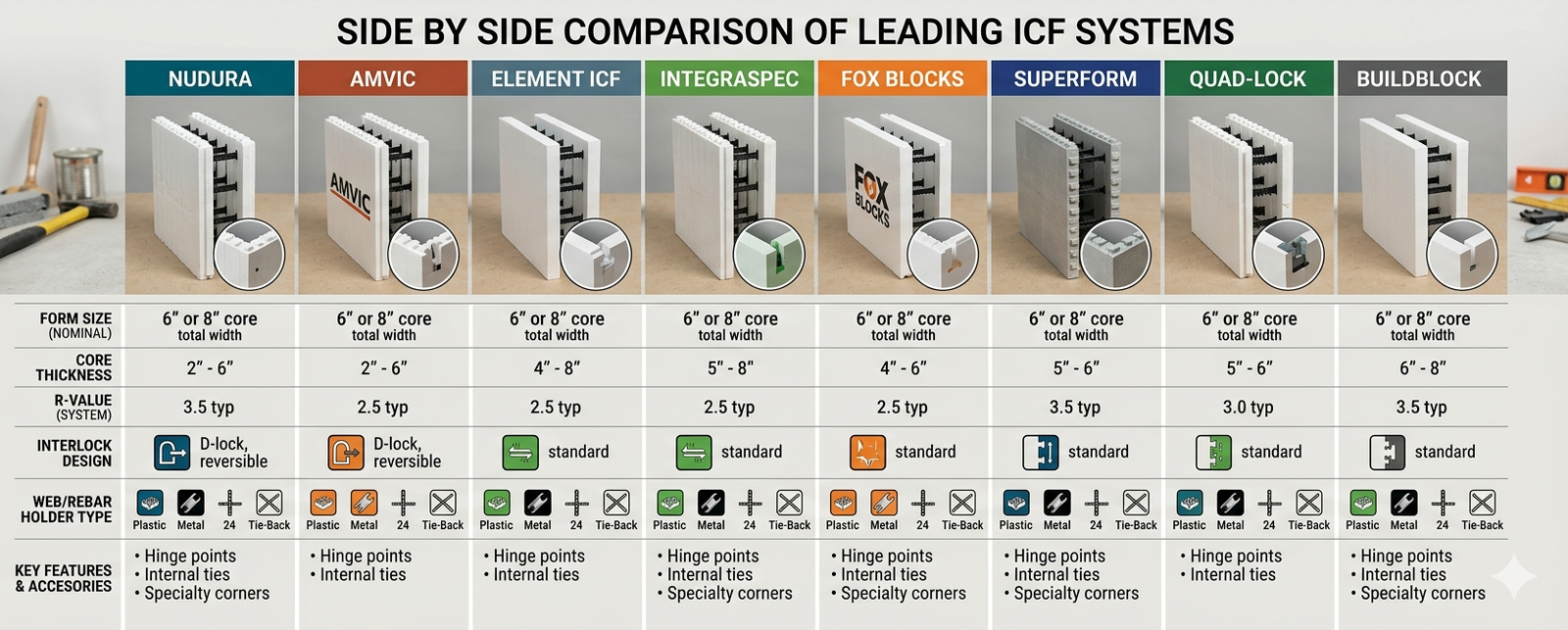
3. Side-by-side specs: all 8 Ontario brands (2026)
Standard 6″ cavity blocks (the most common Ontario residential spec) compared across published manufacturer specifications:
| Brand | Block size | R-value | Core widths | Ontario availability |
|---|---|---|---|---|
| Nudura | 96″ × 18″ (8 ft) | R-23.7 | 4″–12″ | Strongest network |
| Amvic | 48″ × 16″ (4 ft) | R-22 (to R-30) | 4″–12″ | Most local (Paris, ON) |
| Element ICF | 48″ × 16″ (4 ft) | R-23.6 | 4″–12″ | Logix successor network |
| IntegraSpec | 48″ × 12.25″ (panel) | R-22 | 4″–12″+ | Kingston, ON |
| Fox Blocks | 48″ × 16″ (4 ft) | R-23 | 4″–12″ | Limited (Muskoka, online) |
| SuperForm | 48″ × 16″ (4 ft) | R-22 (to R-30) | 4″–12″ | Limited (AB-based) |
| Quad-Lock | 48″ × 12″ (panel) | R-22 (adjustable) | Variable (panels) | Very limited |
| BuildBlock | 48″ × 16″ (4 ft) | R-22 | 4″–8″ | Very limited |
All eight brands meet the 2024 Ontario Building Code (O. Reg. 163/24) when installed to spec. All carry 4-hour fire ratings. R-values cluster between R-22 and R-23.7. STC ratings sit between 45 and 55 across the lineup. On paper, these brands are more similar than different. The real differences are in block format, web design, local supply, and which installers have experience with each.
4. Nudura: the dominant Ontario brand
NUDURA
Tier 1 · Dominant OntarioOriginally founded in 2001 in Barrie, Ontario. Now owned by Tremco Construction Products Group (a subsidiary of RPM International Inc., publicly traded), with HQ in Beachwood, Ohio. Nudura still manufactures in both Canada and the USA, and maintains the strongest distribution network in Ontario — including a major Vaughan distribution center. Defining feature: the 8-foot block, twice the length of the industry-standard 4-foot block.
Block size: 96″ × 18″ (8 ft)
R-value: R-23.7
Web spacing: 8″ o.c., polypropylene
Core widths: 4″, 6″, 8″, 10″, 12″
Fire rating: 4-hour
STC: 50-55
Made in: Canada / USA
Ontario distribution: Strongest of any brand
Where Nudura shines
- Long straight wall runs — the 8-ft block stacks 2x faster than 4-ft brands
- Larger residential — 2,500+ sq ft homes with simple footprints
- Multi-unit and commercial — townhouses, small commercial
- Fold-flat shipping — 50% less storage on tight lots
- Reversible corners — no left/right corner blocks to stock separately
- Locking webs — "Duralok" barbs prevent uplift during the pour
Where Nudura is harder to use
- Complex layouts with many corners — the big block becomes awkward
- Small additions and renos — speed advantage disappears
- Tight lot access — 8-ft blocks need clear maneuvering space
- Cutting waste — cutting an 8-ft block to fit 6-ft spaces wastes material
- Block cost — typically the most expensive per square foot
Best fit: Large residential builds with predominantly straight walls and good site access. If you're building a 2,500+ sq ft custom home with a simple-to-moderate footprint, Nudura's stacking speed is a real time and labour advantage. The default Ontario choice for big jobs.
5. Amvic: the Ontario-manufactured option
AMVIC
Tier 1 · Ontario-madeFounded in 1997 by Victor Amend in Toronto. Manufacturing happens at the Paris, Ontario plant. Now operates under the Alleguard family of EPS brands but remains Canadian-owned and Ontario-manufactured. Amvic has the densest Ontario dealer network and the shortest lead times of any brand — making it the practical default for most Ontario residential ICF projects.
Block size: 48″ × 16″ (4 ft)
R-value: R-22 (to R-30 hybrid)
Web spacing: 8″ o.c., polypropylene
Core widths: 4″, 6″, 8″, 10″, 12″
Fire rating: 4-hour
STC: 45-55
Made in: Paris, Ontario
Ontario distribution: Densest dealer network
Where Amvic shines
- Shortest Ontario lead times — manufactured locally in Paris, ON
- Custom homes with moderate complexity — the sweet spot
- Change orders mid-project — spare blocks available in hours
- Renovations and additions — 4-ft block fits existing conditions
- Cost competitiveness — typically priced slightly below Nudura
- Family of products — pairs with Amvic SilveRboard, Amdeck, AMPEX
Where Amvic is less ideal
- Very long straight runs — loses speed to Nudura's 8-ft block
- Specialty corner blocks — less variety for radius/curved walls
- Storage on tight lots — doesn't fold flat like Nudura
- Brand awareness with homeowners — less marketing visibility
Best fit: Most Ontario residential ICF projects, especially custom homes with moderate complexity and tight timelines. The "you can't go wrong" choice. Amvic is what we recommend when the homeowner has no specific brand preference and the project has no specific reason to pick something else — which describes most builds.
6. Element ICF: the Logix successor
ELEMENT ICF
Tier 2 · Strong specialtyLaunched fall 2024 by Logix Brands Ltd. (Canadian consortium of five EPS molders). Officially replaced Logix ICF on January 1, 2025 after Logix retired following 20+ years and 100+ million sq ft of installed walls. Element ICF is a hybrid system designed as a "six-in-one" integrated solution (framing, insulation, air barrier, vapor barrier, attachment points, and concrete formwork). It inherits Logix's engineering pedigree and existing North American dealer network.
Block size: 48″ × 16″ (4 ft)
R-value: R-23.6 (continuous)
Web spacing: 6″ o.c. (denser than most)
Core widths: 4″, 6″, 8″, 10″, 12″
Fire rating: 4-hour
STC: 50-55
Made in: Canada and USA
Ontario distribution: Inherited Logix network
Where Element ICF shines
- Engineering pedigree — built on 20+ years of Logix data
- Hybrid system features — integrated air/vapor barriers
- Complex projects with openings — 6″ web spacing gives more fastening flex
- Tall walls and walkouts — tighter webs help with engineered rebar layouts
- Heavy cladding (stone, brick) — more attachment points available
- Higher published R-value — R-23.6 vs Amvic's R-22
Where Element ICF has limitations
- Newer product — fewer installers have 5+ years experience yet
- Documentation transition — some specs reference legacy Logix
- Long straight runs — tighter webs mean slightly slower stacking
- Material weight — slightly heavier blocks fatigue crews on big pours
- Ontario availability — growing but less dense than Amvic
Best fit: Complex custom homes with many openings, walkout basements, tall walls, or heavy exterior cladding. Also the right choice for owners who want the newest engineered ICF system from a Canadian manufacturer. If a designer or engineer originally specified Logix on plans drafted before 2025, Element ICF is the direct replacement.
7. IntegraSpec: the Kingston, Ontario option
INTEGRASPEC
Tier 2 · Ontario-based nicheManufactured by Phil'insul Corp, headquartered in Kingston, Ontario. The most underrated Ontario-local option. IntegraSpec uses a unique multi-directional flippable/reversible panel system (not blocks) — a "screen-grid" core that reduces concrete usage while maintaining structural integrity. Real Ontario presence with active dealer support (integraspecontario.com, IntegraSpec ICF Solutions in Stirling, ON). Especially favoured for complex custom designs and multi-family work in Eastern Ontario.
System type: Panel (not block)
Panel size: 48″ × 12.25″
R-value: R-22
Core widths: 4″–12″+
Fire rating: 4-hour
Made in: Kingston, Ontario
Design: Multi-directional, flippable
Ontario distribution: Local Ontario dealer network
Where IntegraSpec shines
- Customizable wall thicknesses — flippable panels adjust on-site
- Complex custom designs — multi-directional panels handle unusual layouts
- Multi-family projects — documented use on 33-unit Quebec apartment build
- Reduced inventory needs — panels reverse, reducing block-type counts
- Eastern Ontario projects — Kingston-based, strong regional support
- Reduced site waste — the reversible design generates less off-cut waste
Where IntegraSpec is harder to use
- Longer install time — panel assembly takes longer than blocks
- Western Ontario availability — thinner outside Eastern Ontario
- Crew familiarity — fewer installers have deep experience
- Different bracing approach — panels need slightly different alignment
Best fit: Complex custom homes, multi-family projects, and Eastern Ontario builds where Kingston-area distribution is closer than Toronto or Paris. If your design has unusual wall thicknesses or panel-driven layouts, IntegraSpec's flippable system has real advantages. The strongest local Ontario alternative to Nudura/Amvic.
Not sure which brand fits your project?
That's exactly the conversation we have weekly. We install all eight Ontario ICF brands. Send drawings (or concept sketches) and lot basics — we'll tell you which brand actually fits your specific design and quote either way. No brand religion, no upsell.
8. Fox Blocks: the U.S. import
FOX BLOCKS
Tier 3 · Limited OntarioManufactured by Airlite Plastics Company, headquartered in Omaha, Nebraska. Canadian plants exist in Alberta, Manitoba, New Brunswick, and Quebec — but none in Ontario. Ontario distribution is real but thinner than the Tier 1 brands: Chamberlain Timber Mart (Muskoka-Gravenhurst) is a notable dealer, and online resellers like Concrete Forms Direct stock Fox Blocks. R-23 (slightly higher than Amvic on paper), with a reputation among DIY builders for being approachable. We pour it where it's the right call for the project.
Block size: 48″ × 16″ (4 ft)
R-value: R-23
Web spacing: 8″ o.c., polypropylene
Core widths: 4″–12″
Fire rating: 4-hour
STC: 45-50+
Made in: USA + Canada (no Ontario plant)
Ontario distribution: Limited (Muskoka, online)
Where Fox Blocks shines
- DIY-friendly design — preassembled reversible blocks reduce waste
- Slightly higher R-value — R-23 published
- Embedded anchors — easy drywall and siding attachment
- Strong technical documentation — well-supported product
- Muskoka availability — viable for some Northern Ontario projects
Where Fox Blocks is harder to use
- No Ontario plant — longer lead times than Amvic or Nudura
- Thinner dealer network — harder to source spare blocks
- Higher delivery costs — shipping from Quebec or Alberta plants
- Branded items often final sale — change orders more expensive
- Less installer familiarity in Southern Ontario specifically
Best fit: Muskoka and Northern Ontario projects where Chamberlain Timber Mart is the most accessible dealer, or specific projects where the design has already specified Fox Blocks. Solid product; the Ontario supply chain just isn't as smooth as the Tier 1 brands.
9. SuperForm: the Alberta import
SUPERFORM
Tier 3 · Limited OntarioManufactured by Plasti-Fab, headquartered in Calgary and Edmonton, Alberta. SuperForm built its reputation in Western Canada (Alberta, BC, Saskatchewan) and has solid engineering. Ontario distribution exists through dealers like ICF Experts (icfexperts.ca) and ICF Solutions (icfsolutions.ca), but inventory and lead times are weaker than the locally-manufactured Ontario brands. Lightweight blocks make it popular among first-time and DIY builders — with the caveat that installer familiarity in Ontario is lower.
Block size: 48″ × 16″ (4 ft)
R-value: R-22 (to R-30)
Web spacing: 8″ o.c.
Core widths: 4″–12″
Fire rating: 4-hour
Made in: Alberta (Plasti-Fab)
Design: Lightweight, simplified install
Ontario distribution: Limited (some specialty dealers)
Where SuperForm shines
- Lightweight blocks — less crew fatigue on big pours
- Simpler installation — reversible ties, easy assembly
- Eco-friendly EPS — some recycled content
- DIY-friendly — first-time builders learn the system quickly
Where SuperForm is harder to use
- Long lead times to Ontario — shipping from Alberta is expensive
- Limited Ontario distribution — few dealers stock it
- Slightly lower strength compared to Nudura on tall walls
- Hard to source spares on Ontario job sites
Best fit: Rare in Ontario. We'll install it if it's already on order or specified, but for typical Ontario projects, you'll have an easier time with Amvic, Nudura, Element ICF, or IntegraSpec.
10. Quad-Lock: the panel specialist
QUAD-LOCK
Tier 3 · Very limited OntarioManufactured by Airfoam (Todd Blyth, CEO as of 2025), originally British Columbia-based. Unlike most ICF brands, Quad-Lock uses a panel-and-tie system rather than blocks. Panels can be cut and configured for unusual layouts, and wall thicknesses are adjustable on-site. Ontario distribution is very limited — mostly specialty engineered projects where the design specifically calls for adjustable thicknesses. We've poured Quad-Lock on a handful of unique Ontario jobs over the years.
System type: Panel + tie (not block)
Panel size: 48″ × 12″
R-value: R-22 (varies by config)
Core widths: Adjustable (4″–12″+)
Fire rating: 4-hour
Made in: Canada/USA
Design: Panelized, customizable thickness
Ontario distribution: Very limited
Where Quad-Lock shines
- Custom wall thicknesses — on-site configuration
- Unusual layouts — panels cut more flexibly than blocks
- Engineered specialty projects — commercial, basement bunkers, retaining walls
- Strong structural integrity — flat-wall design
Where Quad-Lock is harder to use
- Longer install time — panel + tie assembly vs blocks
- Different bracing logic — panels need different alignment approach
- Very limited Ontario availability
- Rare crew familiarity — few installers with deep experience
Best fit: Specialty engineered projects with unusual wall thicknesses or custom cuts. For typical Ontario residential, the panel system's flexibility doesn't usually justify the install-time hit and supply complications. We install it when the project calls for it, but it's rarely the default choice.
11. BuildBlock: the U.S. eco-focused option
BUILDBLOCK
Tier 3 · Very limited OntarioManufactured by BuildBlock Building Systems, headquartered in Oklahoma City. BuildBlock operates 14 manufacturing facilities across North America (some in Canada and Mexico), with strong sustainability messaging — 100% recycled polypropylene webs and recycled EPS content. Ontario distribution is very limited; we've installed BuildBlock on a few projects where the homeowner specifically requested it for sustainability reasons. The product is solid; the Ontario supply chain just isn't there yet.
Block size: 48″ × 16″ (4 ft)
R-value: R-22
Web spacing: 8″ o.c., 100% recycled PP
Core widths: 4″–8″
Fire rating: 4-hour
Made in: USA + Canada (14 plants total)
Sustainability: Recycled webs, recycled EPS
Ontario distribution: Very limited (special order)
Where BuildBlock shines
- Strongest sustainability story — 100% recycled webs
- Integrated cut guides — easier on-site cutting accuracy
- Full-height furring strips — better cladding attachment
- Eco-conscious homeowner appeal
Where BuildBlock is harder to use
- Very limited Ontario availability — often special order
- Smaller core range (only 4″–8″)
- Longer lead times for Ontario projects
- Higher delivery costs — not stocked locally
Best fit: Eco-conscious owner-builders specifically prioritizing recycled-content materials over supply chain efficiency. For everyone else, the Ontario logistics make BuildBlock harder to justify than locally-manufactured alternatives.
12. What an installer actually notices between all 8 brands
Spec sheets are spec sheets. The differences you actually feel on the job site are different from what the brochures emphasize. Here's the installer's-eye honest take:
Stacking speed
Nudura wins on long straight runs (8-ft block stacks 2x faster than 4-ft brands). Amvic and Element ICF are fastest on complex layouts (4-ft block easier to fit around corners, openings, and changes). IntegraSpec and Quad-Lock (panel systems) are slowest to stack but most adaptable. SuperForm blocks are lightweight, which speeds up handling on big pours but trades a bit on strength. On a typical 1,840 sq ft Simcoe basement wall, the stacking-speed difference across all 8 brands is maybe 6-10 hours of labour — real but not project-defining.
Corners and openings
Nudura's reversible corner blocks reduce inventory complexity. Amvic's corner system is the most forgiving for crews still learning ICF. Element ICF's 6″ web spacing gives more flexibility around openings (good for window bucks, service penetrations). IntegraSpec's panel reversibility handles unusual layouts that block systems struggle with. Fox Blocks, SuperForm, BuildBlock all have standard 90° corner blocks that work well; tighter radii get harder.
Bracing requirements
All block systems use similar bracing (Giraffe and Nudura alignment systems are industry standards). Panel systems (IntegraSpec, Quad-Lock) need slightly different alignment thinking. Nudura's 8-ft block needs slightly fewer brace points per square foot. None of these differences materially affect bracing rental cost.
The pour itself
Concrete pour is largely brand-agnostic. Same lift heights (3-4 ft typical), same consolidation (internal vibrator), same pump truck setup. The crew's experience matters far more than the brand. A bad pour wrecks any brand. A good pour delivers the spec on any of them.
Cleanup and finishing
All eight brands provide consistent foam surfaces for drywall, exterior cladding, and finishing. Furring strip placement and density vary slightly — Element ICF and Logix legacy have the densest fastening grid; Fox Blocks and BuildBlock have integrated embedded fastening points. Trades coming in after the pour rarely notice the difference once the foam is in place.
Where the crew actually complains
Honestly? Crews complain about block availability more than block design. A crew that's pouring Nudura on three jobs and Amvic on the fourth notices the switch for about half a day, then it's normal. A crew that arrives to find half their order didn't ship from the supplier — that's the actual problem, regardless of brand. This is why Ontario distribution matters so much in the brand decision.
13. Does brand choice change the cost?
Real-world block pricing in Ontario in 2026 for the standard 6″ cavity:
| Brand | Block cost / sq ft of wall | vs Amvic baseline |
|---|---|---|
| Amvic (Ontario-made baseline) | $7.50–$8.75 | — |
| Nudura | $8.25–$9.75 | +10-12% |
| Element ICF | $8.00–$9.25 | +5-8% |
| IntegraSpec | $7.75–$9.00 | +3-5% |
| Fox Blocks | $8.50–$10.00 | +12-15% (incl. freight) |
| SuperForm | $8.25–$9.75 | +8-12% (incl. freight) |
| Quad-Lock | $9.00–$11.00 | +18-25% (specialty) |
| BuildBlock | $8.75–$10.50 | +15-20% (incl. freight) |
Block cost is roughly 20% of total installed wall cost. The full 5-25% spread between brands works out to a 1-5% impact on total installed wall cost. On a $79,000 basement wall package, that's roughly $800-$4,000 difference between cheapest and most expensive brand. Real money, but rarely the deciding factor — and the extremes (Quad-Lock high, Amvic low) are typically driven by use-case, not random choice.
For full installed-cost analysis including labour, concrete, steel, and overhead: ICF cost per square foot Ontario 2026. For ICF foundation-specific costs and how they compare to traditional poured concrete: ICF foundation cost vs poured concrete Ontario.
14. How to actually choose between Ontario's 8 ICF brands
Skip the brand-comparison rabbit hole. Use this decision framework:
Default Ontario choice: Amvic
If you don't have a specific reason to pick something else, Amvic is what most Ontario residential ICF projects use. Ontario-manufactured (Paris, ON), shortest lead times, strongest dealer network, most installer familiarity, competitive pricing. This is the "can't go wrong" pick.
Pick Nudura if…
- You're building 2,500+ sq ft with predominantly straight walls
- You have good site access (8-ft blocks need clear maneuvering space)
- You're doing multi-unit or small commercial work
- You value fold-flat shipping and tight-lot storage efficiency
Pick Element ICF if…
- Your designer or engineer originally specified Logix on plans from before 2025
- You're building a complex custom home with many openings
- You want the newest engineered Canadian ICF system
- You're planning heavy exterior cladding (stone, brick veneer) and need denser fastening
- You're doing tall walls, walkout basements, or engineered conditions
Pick IntegraSpec if…
- You're building in Eastern Ontario (Kingston area distribution is closer)
- Your design has unusual wall thicknesses or panel-driven layouts
- You're doing multi-family work with complex geometry
- You want to support a genuinely Ontario-made manufacturer
Pick Fox Blocks if…
- You're in Muskoka and Chamberlain Timber Mart is your closest dealer
- The design or engineer specifically called for Fox Blocks
- You're a DIY owner-builder and want the DIY-friendly format
Pick SuperForm, Quad-Lock, or BuildBlock if…
- You have a specific reason (engineering spec, sustainability goal, unusual project)
- You're prepared for longer lead times and special-order logistics
- You have an installer with documented experience on that specific system
For audience-specific guidance, see: ICF brand selection for custom home builders, ICF for owner-builders, or ICF for developers.
Bottom line
For ~80% of Ontario residential ICF projects, the right answer is Nudura or Amvic. For the next ~15%, Element ICF or IntegraSpec. The remaining ~5% have specific reasons to use one of the other four. We install all eight and recommend based on your actual project — not the brand we'd prefer to sell you.
15. Five ICF brand myths to ignore
Myth 1: "Higher published R-value = better wall"
The R-value differences between brands are real but small (R-22 to R-23.7 across the lineup). In Ontario climate, the difference between R-22 and R-24 effective on a basement wall is roughly 1-2% annual heating cost. The wall's airtightness, thermal bridging, and continuous insulation coverage matter more than the published R-value on the block. All eight brands deliver effective R-22 to R-25 in real installations.
Myth 2: "American sources can tell you which ICF is best for Ontario"
American climate priorities, distribution networks, and pricing don't apply to Ontario in 2026. A "Top 5 ICF Brands" article from a U.S. site is largely useless here. The brands that win on American forums (Fox Blocks, BuildBlock) are exactly the brands that are hardest to source in Ontario. Pick based on Ontario reality, not American reviews.
Myth 3: "Logix is still the best ICF" (outdated by 2 years)
Logix ICF retired on January 1, 2025. If a designer, engineer, or older website still recommends Logix, that recommendation now means Element ICF (from the same parent company, Logix Brands Ltd.). The technical library at LogixICF.com remains live for legacy projects, but new builds in 2026 use Element ICF.
Myth 4: "The biggest national brand is automatically the best local choice"
Marketing budget doesn't translate to job-site performance. The "best" brand in Ontario is the one your local installer has the most experience with — which may or may not be the biggest brand nationally. Nudura is the most-marketed brand in North America; Amvic outsells it in Ontario residential because of Ontario manufacturing and dealer density.
Myth 5: "Special features (fold-flat, hybrid foam, etc.) materially change wall performance"
Fold-flat shipping helps the supplier and the crew, not the homeowner. Hybrid foam designs (mixing EPS densities) are interesting on paper, but the actual installed performance difference is hard to detect in real Ontario climate measurements. Pick the brand that fits your project; don't pick based on the most exotic-sounding feature.
Want a real recommendation for your project?
Send drawings (architectural and structural if available) plus the lot basics. We'll tell you which of the eight Ontario ICF brands actually fits your specific build — and quote installation either way. We pour them all. The right brand for your project beats the "best brand" online.
Common questions about ICF brands in Ontario
Which ICF brand is best in Ontario in 2026?+
There's no single "best" brand. For most Ontario residential projects, Amvic (Ontario-manufactured in Paris, ON) is the default choice because of short lead times and dealer density. Nudura wins for large straight-wall builds because of its 8-foot block. Element ICF (the Logix successor as of January 2025) is the strong choice for complex builds with many openings or heavy cladding. IntegraSpec is the underrated Kingston-Ontario option. Fox Blocks, SuperForm, Quad-Lock, and BuildBlock are all installable in Ontario but with thinner distribution. The right brand depends on your specific project.
What happened to Logix ICF? Is it still available?+
Logix ICF retired on January 1, 2025 after 20+ years and over 100 million sq ft of installed walls. Logix Brands Ltd. (the parent company, a Canadian consortium of five EPS molders) launched Element ICF in fall 2024 as the official successor. Element ICF inherited Logix's engineering pedigree and existing dealer network. The LogixICF.com technical library remains live for legacy projects, but new builds in 2026 use Element ICF. If your designer specified "Logix" on older plans, that means Element ICF now.
What's the price difference between ICF brands in Ontario?+
Block prices vary by 5-25% between brands ($7.50-$11.00 per square foot of wall in 2026 Ontario prices). But blocks are only about 20% of total installed wall cost, so brand choice changes total wall package cost by roughly 1-5%. On a typical $79,000 basement wall package, that's $800-$4,000 between cheapest and most expensive. Rarely the deciding factor by itself. See ICF cost per square foot Ontario 2026 for the full installed cost breakdown.
Is Amvic better than Nudura?+
Neither is universally better. Amvic's advantage is Ontario-based manufacturing (Paris, ON) which means shorter lead times, denser local distribution, easier change-order block sourcing, and slightly lower pricing. Nudura's advantage is the 8-foot block size, which stacks 2x faster than Amvic's 4-foot block on long straight wall runs. For most Ontario residential projects with moderate complexity, Amvic is the more practical choice. For larger homes with mostly straight walls, Nudura's stacking speed becomes a real advantage.
Is Element ICF really the same as Logix?+
Same parent company (Logix Brands Ltd.), but Element ICF is a redesigned hybrid system — not just rebranded Logix. The change happened because Logix's manufacturing molds had reached end-of-life after 20+ years. Logix Brands chose to launch an improved next-generation product rather than re-tool the old one. Element ICF carries forward Logix's engineering knowledge (the LogixICF.com technical library is still online for legacy reference) but introduces new "six-in-one" integration features. The dealer network was inherited intact.
Do all ICF brands meet the 2024 Ontario Building Code?+
Yes. All eight major Ontario ICF brands — Nudura, Amvic, Element ICF, IntegraSpec, Fox Blocks, SuperForm, Quad-Lock, and BuildBlock — comply with the 2024 Ontario Building Code (O. Reg. 163/24) when installed to spec. SB-12 energy compliance is achievable with any of them. Fire ratings (4-hour) and structural performance meet residential and small commercial requirements. The wall meets code regardless of brand choice. Installation quality matters more than brand selection.
What about IntegraSpec — isn't it Ontario-made too?+
Yes — IntegraSpec is manufactured in Kingston, Ontario by Phil'insul Corp. It's an underrated Ontario-local option, especially for Eastern Ontario projects where Kingston-area distribution is closer than Toronto or Paris. Uses a unique multi-directional flippable/reversible panel system (not blocks). Strong fit for complex custom designs and multi-family work. For Western Ontario projects, distribution gets thinner; for Eastern Ontario, it's a real Tier 1-2 choice.
Can you mix ICF brands on the same project?+
Technically yes, practically rarely. Different brands have different block dimensions, web spacings, and connector designs. Mixing them creates transition complications at joins and complicates the rebar layout. Some legitimate reasons to mix: one brand has a specific specialty block (radius corner, brick ledge, taper top) the other doesn't carry. In those cases, the bulk of the wall stays in one brand and the specialty block joins through a planned transition.
How do I get an installer recommendation for the right brand?+
Send drawings and lot basics to an ICF contractor experienced with all major Ontario brands. We install all eight (Nudura, Amvic, Element ICF, IntegraSpec, Fox Blocks, SuperForm, Quad-Lock, BuildBlock) on Simcoe County and Georgian Bay projects regularly. Request a quote here or call 705-533-1633. We'll recommend the brand that fits your specific build, lot, and timeline — and quote installation either way. No brand religion.
Why is ICFpro.ca the right choice as a multi-brand installer?+
Brand-tied installers have a financial reason to recommend one specific system regardless of project fit. As a multi-brand ICF contractor with 30 years of pouring experience and 300+ completed projects, we recommend the brand that fits your project — not the brand we'd prefer to sell. We have direct working relationships with all major Ontario ICF dealers, which means we can source spare blocks fast, navigate lead-time issues, and pick the system that genuinely matches your design, lot conditions, and timeline.