ICFPro.ca is a division of ICFhome Ontario - Direct Line 1 705 533-1633 - Email: info@icfpro.ca

ICF vs. SIPs – A Comprehensive Guide to Modern Building Systems:

2026 Edition · Honest Ontario Comparison
ICF vs SIPs in Ontario 2026:
ICF vs SIPs in Ontario 2026:
The Honest Builder Comparison.
Both systems beat code-minimum stick framing on energy, comfort, and durability. But they're not interchangeable, and the Ontario-specific factors that decide between them are different from the U.S. marketing material you'll find everywhere else online. This is the contractor's view after 30 years of building in Southern Ontario — ICF cost, SIPs cost, Ontario suppliers (Insulspan Kitchener, Porter SIPs London, Thermapan, West-Eco), real moisture risks in our climate, and which system actually fits your project.
By Harvey Juric · ICFpro.ca
Updated: June 2026
Read time: 14 minutes
Source: real Ontario builds, both systems
90-Second Summary
ICF wins on structural strength, thermal mass, basement performance, fire rating, soundproofing (STC 45-55), and tolerance for installation imperfection. SIPs win on stacking speed, lower labour hours, slightly higher nominal R-value per inch, and prefab precision. Both meet 2024 OBC and SB-12. Real Ontario installed cost difference is smaller than online articles claim — about 5-10% on the wall package. The biggest decision factor isn't cost: it's moisture risk in Ontario's freeze-thaw climate. SIPs are sensitive to envelope leaks (OSB rots if it gets wet); ICF doesn't care. For most Ontario residential builds, ICF is the safer long-term call. Hybrid approach (ICF foundation + SIPs above) is a real option. For installed ICF cost numbers, see: ICF cost per square foot Ontario 2026.
1. What ICF and SIPs actually are (no marketing language)
Strip away the brochures and both systems are pretty simple to explain to anyone who's stood on a job site:
ICF (Insulated Concrete Forms)
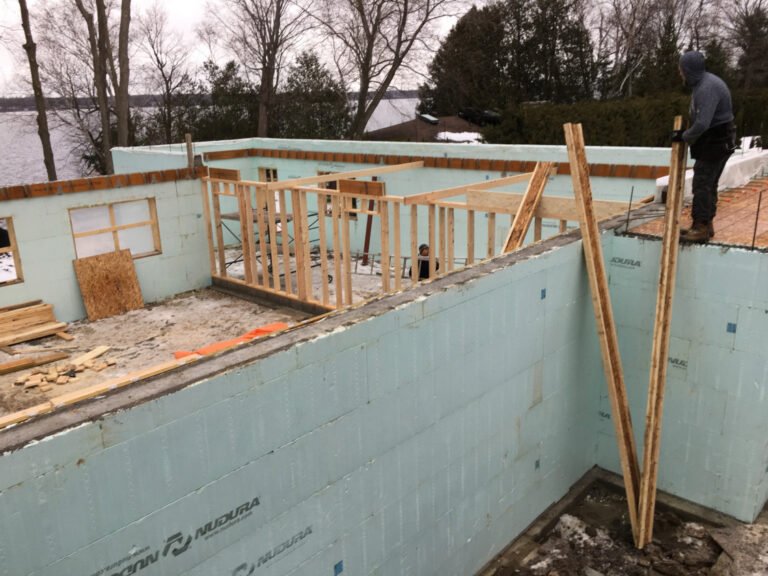
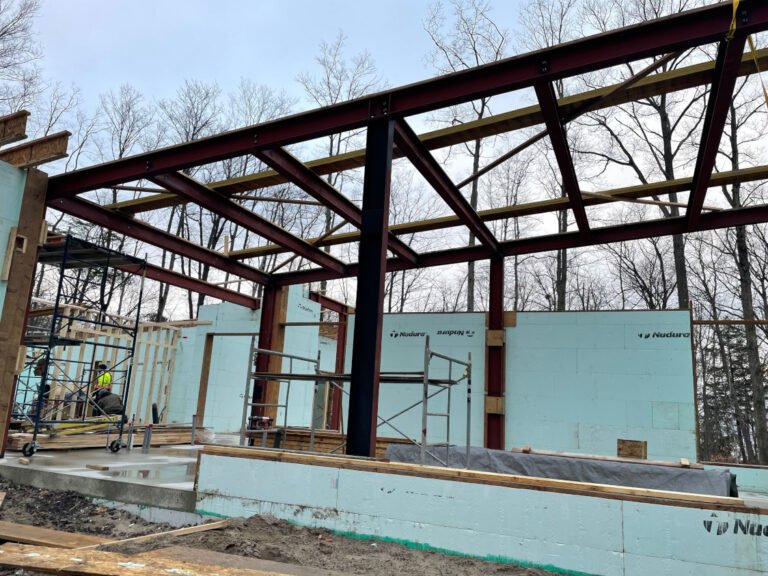
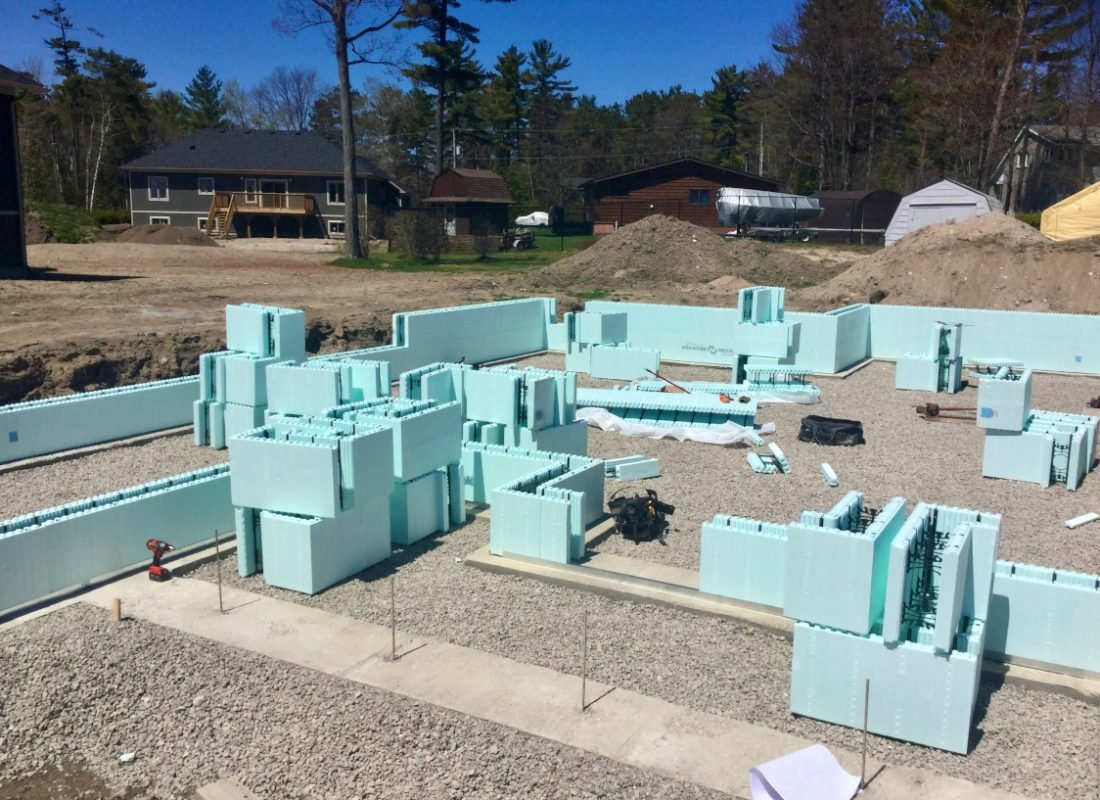
Two parallel panels of EPS foam, connected by polypropylene webs spaced 6-8 inches apart, stacked like blocks to form the wall shape. Once the wall is stacked, braced, and reinforced with steel rebar, concrete is poured into the cavity between the foam panels. The foam stays in place permanently as insulation; the concrete core does the structural work. Result: a continuous wall of insulated reinforced concrete with no thermal breaks. R-22 to R-24 effective. Used in Ontario residential since the 1990s; we've poured 300+ ICF projects since 1995.
SIPs (Structural Insulated Panels)
Factory-built sandwich panels — two sheets of OSB (oriented strand board) with a rigid foam core (usually EPS, sometimes polyurethane or polyiso). Panels are cut to size at the factory based on shop drawings, then shipped to the site and assembled like puzzle pieces using spline connectors at the seams. The OSB is the structural facing; the foam is the insulation. Available wall thicknesses range from 4.5" to 12.25". R-values run R-15 to R-49 depending on core thickness. Used in Ontario since the 1980s; the major Ontario manufacturers (Insulspan, Porter SIPs, Thermapan) have multi-decade track records.
The fundamental difference
ICF is a site-cast structure: the wall doesn't exist until you pour concrete. SIPs are a prefab structure: the wall exists before it arrives. This affects everything downstream — cost, schedule, design flexibility, and especially moisture risk in Ontario's freeze-thaw climate.
2. Ontario suppliers for each system in 2026
This is what most online ICF vs SIPs comparisons miss entirely: where you actually buy the product in Ontario. Both systems require Ontario distribution, and both have real local manufacturers worth knowing about.
ICF brands available in Ontario
Eight major ICF brands distribute in Ontario in 2026: Nudura, Amvic, Element ICF, IntegraSpec, Fox Blocks, SuperForm, Quad-Lock, and BuildBlock. The dominant duo are Nudura and Amvic; Amvic is manufactured in Paris, Ontario and has the densest dealer network. Full breakdown: the complete 2026 ICF brand comparison for Ontario.
SIPs manufacturers active in Ontario
- Insulspan — Kitchener, Ontario plant. Owned by PFB Corp (recently acquired by Carlisle Companies). The largest Ontario-based SIPs operation; widely available across Southern Ontario. RTA (Ready-To-Assemble) SIP system.
- Porter SIPs — London, Ontario. Division of PorterCorp. Ontario-manufactured, full residential and commercial SIP product line.
- Premier SIPS — SIPA member with Ontario distribution. One of the older and more awarded U.S. brands; ships into Ontario through dealers.
- Thermapan — Canadian SIP manufacturer since 1980. Strong track record in cold climates including Canada, Alaska, and the Arctic Circle.
- West-Eco SIPs — described as the largest Structural Insulated Panel company in Canada. Locally-sourced lumber.
- Konstruction Group — Toronto-based SIP installer for builders and general contractors (installation, not manufacturing).
- Atlantic SIP Solutions — sole SIP manufacturer in Atlantic Canada; ships to Ontario for some projects but freight is significant.
The Ontario SIPs supply chain is real but thinner than ICF. Insulspan (Kitchener) and Porter SIPs (London) are the two most accessible Southern Ontario manufacturers. Both have decades of cold-climate Ontario installations.
3. Real Ontario 2026 installed costs — both systems
Let's get the numbers right. ICF marketing inflates ICF benefits; SIPs marketing inflates SIPs speed. Reality is more nuanced.
SIPs panel pricing in Ontario 2026
Based on current Ontario SIPs supplier pricing:
- Standard 4'×8' SIP wall panel (6.5" EPS core): $220–$260 per panel
- Roof SIP panel (8"+ core, thicker OSB): $280–$380 per panel
- Custom-cut panels (window/door openings, pre-routed chases): +15-25%
- Shipping to Ontario job sites: $1,500–$4,000 depending on distance from plant
Per square foot of wall area installed, SIPs run about $24–$36 per sq ft. ICF runs about $42–$52 per sq ft for above-grade walls (full breakdown: ICF cost per square foot Ontario 2026). On the wall package alone, SIPs are cheaper.
Where SIPs lose the cost advantage
The wall-package cost difference narrows when you account for the full Ontario build:
| Cost component | ICF | SIPs |
|---|---|---|
| Above-grade wall package (installed) | $42–$52 / sq ft | $24–$36 / sq ft |
| Foundation (ICF or poured concrete + framed sill) | Same wall | Separate system needed |
| Crane / lift equipment | Pump truck only | +$2,500–$5,000 rental |
| Skilled installer premium | Standard ICF crew | +15-25% for SIPs-trained crew |
| Air sealing labour and detailing | Inherent in pour | $3,000–$8,000 in seam detailing |
| Insurance during build | Standard rate | May require moisture coverage |
| Full-build cost (2,500 sq ft mid-tier custom) | $325–$500 / sq ft | $310–$470 / sq ft |
The honest 2026 Ontario reality: SIPs typically run 3-8% less per square foot of finished area than ICF for a comparable build. That's $20,000-$50,000 on a $1.2M custom home. Real money, but not the dramatic difference some SIPs marketing suggests. And the savings shrink fast if the SIPs install has any moisture-detailing rework, schedule delays, or custom-cut change orders.
4. Performance side-by-side: R-value, airtightness, STC, fire
| Performance metric | ICF | SIPs |
|---|---|---|
| R-value (effective wall) | R-22 to R-25 (6″ cavity) | R-15 to R-49 (depending on core thickness) |
| Airtightness (measured, real builds) | 1.0-1.26 ACH50 (RDH Labs study, 49 homes) | 0.5-1.5 ACH50 when properly seam-sealed |
| Thermal bridging | None — continuous insulation both sides | Minimal — OSB joints can be slight thermal bridges |
| Thermal mass | High — concrete core stabilizes temperature | Low — no thermal mass |
| Sound transmission (STC) | STC 45-55 | STC 35-45 |
| Fire rating | 4-hour (ASTM E119) | 1-hour typical (OSB-skin SIPs) |
| Structural span (roof) | Requires separate roof system | Up to 18 ft clear span possible |
| Wind resistance | Engineered for hurricane-level loads | Engineered for high winds with proper attachment |
The R-value question
SIPs marketing emphasizes "up to R-50" panels. True — if you specify a 10″+ polyurethane-core roof panel. The standard wall SIP in Ontario is 6.5" EPS core at about R-25 effective. ICF runs R-22 to R-25 effective on a standard 6″ cavity. The honest comparison on typical Ontario residential walls: R-values are similar. Where SIPs pull ahead is on roof panels where thicker cores are practical.
The airtightness question
Both systems can hit 1.0-1.5 ACH50 on well-built projects. ICF's airtightness comes from the continuous concrete pour — airtight by design. SIPs airtightness comes from seam sealing detailing during assembly — airtight by execution. This is the key difference: ICF tolerates imperfect installation better. A mediocre ICF crew still delivers an airtight wall. A mediocre SIPs crew can deliver a leaky envelope that looks identical to a good one until you blower-door test it — or until moisture problems show up years later.
The soundproofing question
ICF wins decisively on STC. Concrete is dense; foam is dense; the combination blocks sound. SIPs are lighter and have less mass — sound travels through them more readily. For lakefront properties, highway-adjacent lots, or buildings near commercial activity, ICF is the better envelope. For sheltered rural sites where outdoor noise isn't a factor, the difference is academic.
The fire rating question
ICF carries a measured 4-hour ASTM E119 fire rating. SIPs OSB-skin panels typically rate 1-hour. In wildfire-prone areas (parts of Northern Ontario, dry rural Southern Ontario), ICF's fire performance matters. In typical residential builds where the fire risk is interior origin, the difference is less critical — both meet OBC residential fire requirements.
5. The Ontario-specific factor: moisture risk
This is the section that's missing from every SIPs vs ICF article written for U.S. audiences. Ontario's climate is a moisture management challenge — long winters with heavy frost, spring/fall freeze-thaw cycles, humid summers, and a significant heating degree-day count. How each system handles moisture is the single most important Ontario-specific factor in this decision.
How ICF handles moisture
Concrete and EPS foam don't rot. Water can sit against an ICF wall for years without structural degradation. The foam is closed-cell and doesn't wick moisture; the concrete is impervious. Below grade, a properly-applied waterproofing membrane keeps the foam dry, but even if the membrane fails locally, the wall doesn't rot. Above grade, rain penetration through cladding doesn't cause structural damage — just requires the cladding to dry out. ICF is moisture-tolerant by design.
How SIPs handle moisture (the honest version)
SIPs are OSB sandwiches. OSB rots when it gets wet. Documented SIPs failures across cold climates (the well-known Juneau, Alaska case where mushrooms grew through asphalt shingles after seam-sealing defects let interior air leak to the exterior OSB) prove this isn't theoretical — it's the dominant SIPs failure mode. The Premier SIPs and SIPA literature both acknowledge this; their solution is meticulous moisture-management detailing: ventilated rainscreen claddings, semi-permeable house wraps, perfect flashing, perfect seam sealing.
None of that is impossible. But it requires:
- An installer who actually executes the detailing. Not "knows it should be done" — actually does it on every panel joint, every penetration, every transition.
- Designers who plan for it. Ventilated rainscreen requires furring strips, vented overhangs, proper flashings at every transition.
- Cladding choices that allow drying. No barrier siding directly against OSB. Cement board, brick, stucco all need rainscreen detailing.
- Long-term inspection. Periodic checking that cladding hasn't trapped moisture; periodic checking of attic/roof spaces for early signs of OSB darkening.
The Ontario-honest answer on moisture
SIPs can work in Ontario's climate — Insulspan, Porter SIPs, and Thermapan have decades of successful Ontario installations to prove it. But the margin for error is much smaller than with ICF. A SIPs build done by a meticulous crew with proper detailing performs beautifully for 50+ years. A SIPs build with corner-cutting on moisture details can develop expensive problems within 5-15 years. ICF doesn't punish you for installer imperfection the way SIPs can.
What moisture failures actually look like with SIPs
Don't take this as theoretical. Real documented SIPs failure modes in cold/wet climates:
- Roof panel rot at seams — warm humid interior air leaks through imperfect seam seals, condenses against cold exterior OSB, OSB rots. Visible as soft spots, then mushrooms growing through shingles, then collapse of the OSB structural skin.
- Wall panel rot at window/door perimeters — flashing imperfection lets bulk water reach OSB, OSB swells then rots. Often hidden behind cladding until cladding is removed for repair.
- Cladding-direct-contact rot — cladding installed without rainscreen gap traps moisture against OSB, OSB rots from the outside in.
Insurance carriers know about these failure modes. Some Ontario carriers price SIPs builds higher than ICF; some require specific detailing documentation before issuing dwelling coverage. Get insurance quotes in writing for both systems before deciding.
6. Structural strength and resilience
ICF structural reality
A 6″ ICF wall with proper rebar is engineered reinforced concrete. The published wind resistance figures (some marketing claims 200+ mph) are misleading — what matters is that ICF walls easily meet or exceed Ontario Building Code wind loading requirements and routinely qualify for hurricane and tornado zones in U.S. markets. For Ontario, where typical design wind speeds are 90-110 mph, ICF is well over-engineered. Real structural advantages: doesn't degrade over time, doesn't develop cracks from settling, doesn't lose strength when temperature cycles, doesn't lose strength when wet.
SIPs structural reality
SIPs derive strength from the OSB-foam-OSB sandwich (similar in principle to an I-beam, where the OSB skins act like the flanges and the foam acts like the web). The system is genuinely strong — SIPs roofs routinely span 18 feet without intermediate supports, and SIPs walls easily handle code-required lateral loads. The vulnerability is loss of OSB strength when wet. A SIPs wall with rotted OSB skin loses much of its structural capacity. ICF doesn't have an analogous vulnerability.
Long-term durability
Properly-detailed SIPs buildings have 50+ year track records (Thermapan has installations from the 1980s still performing). Properly-poured ICF buildings have 100+ year theoretical lifespans — concrete and EPS don't have known degradation modes within century timescales. For Ontario homeowners thinking generationally, ICF has the structural edge.
7. Build timeline: where SIPs save time, where ICF catches up
"SIPs is 25-30% faster" is the kind of marketing claim that doesn't hold up under honest accounting. Here's the realistic Ontario 2,500 sq ft custom build comparison:
| Phase | ICF (days) | SIPs (days) |
|---|---|---|
| Foundation (poured concrete or ICF) | 10-14 | 10-14 (same; SIPs uses standard foundation) |
| Shop drawings + factory cutting (SIPs only) | 0 | 15-25 (off-site, sometimes parallel) |
| Wall stacking / panel placement | 8-12 | 4-8 |
| Wall concrete pour and cure (ICF only) | 3-5 | 0 |
| Seam detailing and air sealing (SIPs) | 0 (built-in) | 3-6 |
| Roof system | 8-12 (separate framing) | 4-8 (if SIP roof) |
| Total envelope to weatherproof | 29-43 days | 36-61 days |
The dirty secret: SIPs aren't always faster on the actual Ontario calendar. The site work is faster, but the upfront design and factory cutting time often more than offsets the gain. SIPs really pull ahead when:
- The design is panelized from the start (rectilinear floor plan, standard openings, repeated panel sizes)
- The factory has capacity (peak season can mean 6-8 week lead times to cut and ship)
- The crew has SIPs-specific experience (untrained crews lose the speed advantage)
For most Ontario custom homes with non-trivial design complexity, real timeline difference is 2-4 weeks — not 25-30%.
8. Design flexibility and renovation reality
ICF design flexibility
ICF handles curves, angles, varying wall thicknesses, and unusual geometry well — specialty radius blocks and brick ledge blocks are stocked by the major brands. Change orders during the build are inexpensive (cut foam, adjust rebar, pour). Mid-life renovations (cutting a new window) require diamond-blade saw work — more expensive than wood frame, but routine.
SIPs design flexibility
SIPs are most efficient on rectilinear plans with standard panel sizes. Complex geometry can be done but increases waste, factory cutting cost, and panel-fitting time. Change orders are expensive — panels are factory-cut to spec, so a mid-build design change usually means ordering a new panel ($400-$1,200) and waiting for delivery. Mid-life renovations are theoretically easier than cutting concrete (just remove and replace panels), but the moisture-management detailing has to be re-executed perfectly at every cut transition, which is non-trivial.
9. Where ICF wins, where SIPs win
ICF wins
Insulated Concrete Forms
Strongest case for ICF
- Basements and foundations — warm dry living space below grade
- Walkout basements and exposed lower walls — engineered for soil loads
- Lakefront and exposed lots — wind, weather, and noise resilience
- Long-term ownership (15+ years) — 100+ year structural lifespan
- Wildfire-prone rural Ontario — 4-hour fire rating
- Highway-adjacent or noisy sites — STC 45-55 sound isolation
- Climate zone 6-7 (Central/Northern Ontario) — thermal mass benefit largest
- Owners who value installer-tolerance — performs well even with average crews
Weaker case for ICF
- Short-term ownership (under 5 years; payback doesn't accumulate)
- Very tight budgets where 5-8% premium can't be absorbed
- Sheltered urban infill where envelope advantages are smaller
SIPs wins
Structural Insulated Panels
Strongest case for SIPs
- Roof systems with long clear spans — 18+ ft without intermediate support
- Rectilinear panelized designs — the system's natural strength
- Tight construction deadlines — site assembly is fast (if factory is ready)
- Higher nominal R-value targets — thicker cores push R-30+ practical
- Light-weight upper floors — lower seismic and bearing loads
- Designers who finalize before construction — no field changes
- Above-grade-only projects with experienced SIPs crew
Weaker case for SIPs
- Below-grade walls (SIPs aren't designed for soil contact)
- Climates with heavy freeze-thaw and humidity (Ontario qualifies)
- Projects without experienced moisture-detailing installers
- Designs that change mid-build (panels are factory-cut)
- Sites where rainscreen and ventilated cladding aren't planned
Want a real comparison for your specific project?
Send drawings (or concept sketches) plus the lot basics. We'll tell you honestly which system fits your build — ICF, SIPs, or hybrid. We've poured both for Ontario clients across Simcoe County and Georgian Bay since the 1990s. No brand religion, no system religion.
10. The hybrid approach (and when it makes sense)
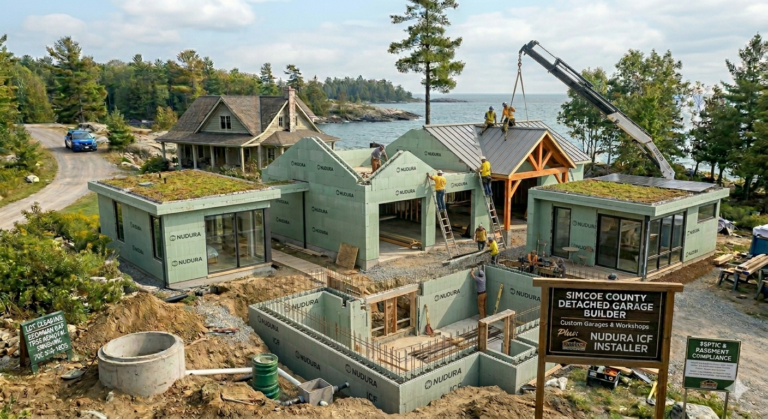
A real Ontario option that gets less attention than it deserves: ICF foundation + SIPs above-grade walls and roof. This captures the strongest case for each system.
Why hybrid works
- ICF for the foundation — below-grade work where moisture tolerance, structural strength, and warm basement performance matter most. SIPs aren't designed for below-grade applications; ICF is. This is the clearest case where the two systems don't compete — ICF wins below grade, period.
- SIPs above grade — faster site assembly above grade, higher R-value on roof panels, lighter loads. With above-grade SIPs, the moisture risk is manageable when properly detailed (rainscreen cladding, ventilated overhangs).
- Cost split — ICF foundation captures basement comfort and durability; SIPs above grade captures cost savings on walls and roof.
Why hybrid sometimes doesn't work
- Coordinating two trades — ICF crew and SIPs crew aren't the same people. Schedule coordination adds complexity.
- Transition detailing — the ICF wall → SIPs wall transition at first floor needs careful flashing and air sealing to avoid moisture issues at the junction.
- Two warranty providers — ICF wall warranty and SIPs wall warranty are separate; troubleshooting boundary issues can be messier.
For Ontario custom homes where the homeowner wants ICF basement performance but is rate-sensitive on above-grade walls, hybrid is a legitimate middle path. We've built several this way in Simcoe County over the past decade.
11. How to actually choose between ICF and SIPs
Skip the generic pros-and-cons lists. Use these decision questions:
Question 1: How long will you own the home?
15+ years → ICF. Operating savings, durability, and moisture-failure-protection compound. Under 5 years → SIPs is more cost-competitive if the local market values the energy performance at resale.
Question 2: Is your design panelized-friendly?
Rectilinear floor plan, repeated panel sizes, standard openings → SIPs is in its wheelhouse. Curves, varying wall thicknesses, custom geometry → ICF handles it better.
Question 3: Do you have an experienced installer for each system?
Strong ICF installer + average SIPs installer → ICF wins. Strong SIPs installer + average ICF installer → SIPs is competitive. Installer experience matters more than system choice on either side — especially for SIPs moisture detailing.
Question 4: How exposed is your lot?
Lakefront, escarpment, exposed Northern Ontario, high winds, wildfire risk → ICF. Sheltered urban infill, modest climate exposure → either works.
Question 5: Will the design change during the build?
Yes → ICF. ICF tolerates field changes cheaply. SIPs panels are factory-cut; changes mean new panels and delays.
Question 6: Are you risk-averse on the envelope?
If a 30-year hidden moisture problem would be catastrophic to you → ICF. If you're confident in the moisture-management detailing and willing to inspect the envelope periodically → SIPs is fine.
Bottom line
For typical Ontario residential custom builds — mixed-complexity design, 15+ year ownership, climate zone 6 conditions, moderate budget — ICF is the safer choice. SIPs is competitive on faster builds with strong design discipline, experienced crews, and meticulous moisture detailing. Hybrid (ICF foundation + SIPs above) is a real Ontario middle path. Don't pick based on which system has flashier marketing.
12. Five myths about ICF vs SIPs that need to die
Myth 1: "SIPs are 25-30% faster than ICF"
Not in real Ontario builds. SIPs site work is faster, but the design + factory cutting time often offsets the gain. Honest envelope-to-weatherproof difference on typical 2,500 sq ft custom: 2-4 weeks, not "25-30% faster" of the total project. SIPs marketing compares site-assembly time only; ICF marketing compares total project time only. Both are misleading.
Myth 2: "SIPs hit R-50; ICF only hits R-25"
True for thickest polyurethane roof panels; misleading for standard walls. Typical Ontario residential SIPs wall is 6.5" EPS core at R-25 effective — essentially the same as a 6″ ICF wall. SIPs has a higher ceiling on roof panels; on walls, R-values are similar.
Myth 3: "ICF withstands 200 mph winds"
Misleading. ICF easily meets Ontario design wind speeds (typically 90-110 mph) with substantial margin, and ICF buildings have survived Category 4 and 5 hurricane events in U.S. installations. But Ontario doesn't get 200 mph winds — tornado wind speeds peak around 200 mph in extreme events, but that's a localized point load, not a sustained design condition. ICF's real Ontario advantage is structural overcapacity for typical design conditions, not theoretical max-wind survival.
Myth 4: "SIPs have moisture problems; SIPs don't have moisture problems"
Both extreme positions are wrong. SIPs can have catastrophic moisture failures if detailing is wrong (documented in Juneau, Alaska and many cold-climate projects). SIPs can perform beautifully for 50+ years if detailing is right (Thermapan and Insulspan have proof). The honest position: SIPs have higher consequences for installer error than ICF in cold/humid Ontario climate. Plan accordingly — don't ignore the risk, don't catastrophize it either.
Myth 5: "U.S. ICF vs SIPs comparisons apply to Ontario"
They don't. American comparisons focus on hurricane resistance (Florida, Gulf Coast) and dry climates (Arizona, Texas) where SIPs' moisture vulnerability is less acute. Ontario's climate (Climate Zone 5-7, heavy freeze-thaw, humid summers, long heating season) puts more stress on SIPs envelope detailing than American climates do. Use Canadian sources for Canadian decisions.
Need a real Ontario builder's take on your project?
We've built ICF, SIPs, and hybrid envelopes across Simcoe County, Georgian Bay, and Muskoka since the 1990s. Send drawings or concept sketches plus the lot basics — we'll tell you honestly which system fits your build and quote either way. No system religion.
Common ICF vs SIPs questions for Ontario builders
Is ICF or SIPs better for Ontario climate?+
For most Ontario residential projects, ICF is the safer long-term choice. The reason: Ontario's freeze-thaw climate with humid summers puts significant stress on SIPs' OSB skins if envelope detailing isn't meticulous. ICF (concrete + EPS foam) is moisture-tolerant by design and doesn't punish installer imperfection the same way. SIPs can perform beautifully in Ontario with experienced crews and proper detailing, but the margin for error is smaller. The hybrid approach (ICF foundation + SIPs above-grade) captures the strongest case for each.
Are SIPs cheaper than ICF in Ontario?+
On the wall package alone, yes — SIPs run about $24-$36 per sq ft installed vs ICF at $42-$52. On total build cost, the difference shrinks to 3-8% on a 2,500 sq ft custom home (roughly $20,000-$50,000 savings on a $1.2M build). Savings shrink further if SIPs requires custom panel cutting, moisture rework, or schedule delays from factory lead times. For full installed ICF cost numbers, see ICF cost per square foot Ontario 2026.
What Ontario SIPs manufacturers should I consider?+
The main Southern Ontario SIPs manufacturers are Insulspan (Kitchener, ON — owned by PFB Corp/Carlisle Companies) and Porter SIPs (London, ON — division of PorterCorp). Both have decades of Ontario installations and full residential and commercial product lines. Thermapan (Canadian SIP manufacturer since 1980) and West-Eco SIPs (largest Canadian SIPs company) also ship into Ontario. Konstruction Group (Toronto) is a SIPs installer working across Ontario with builders and GCs.
Do SIPs have moisture problems in cold climates?+
Documented moisture failures of SIPs in cold/humid climates do happen when seam sealing, flashing, or rainscreen detailing is inadequate. The well-known Juneau, Alaska case involved warm interior air leaking through imperfect seam seals and condensing on cold exterior OSB — mushrooms eventually grew through the asphalt shingles. With proper moisture-management detailing (ventilated rainscreen claddings, semi-permeable house wraps, perfect flashing, perfect seam sealing), SIPs perform well in cold climates. The risk is installer execution, not the system itself. ICF doesn't have an analogous moisture vulnerability.
Can SIPs be used for the foundation?+
No — SIPs aren't designed for below-grade applications. The OSB skins would be in direct contact with soil moisture, leading to rot. Below-grade walls require either ICF, conventional poured concrete with exterior insulation, or block construction. This is why the "ICF foundation + SIPs above-grade" hybrid is a real and growing Ontario approach — it lets you use SIPs only where SIPs is appropriate.
Is ICF really 4-hour fire rated vs SIPs at 1-hour?+
Yes, on standard wall assemblies. ICF carries a measured 4-hour ASTM E119 fire rating. Standard OSB-skin SIPs walls rate at 1-hour typical. Both meet OBC residential fire requirements for typical single-family construction, but for wildfire-prone rural Ontario sites or buildings near fire risk, ICF's fire performance is genuinely superior. For most Southern Ontario residential builds where fire risk is interior-origin, the difference is less critical.
Is SIPs faster than ICF on the build schedule?+
SIPs site assembly is faster (walls go up in days, not weeks), but factory cutting time and shop drawings often offset most of the gain. Realistic Ontario envelope-to-weatherproof difference on a typical 2,500 sq ft custom build is 2-4 weeks, not the "25-30% faster" some marketing claims. SIPs pulls ahead clearly on rectilinear panelized designs with experienced crews. On complex custom designs, the schedule advantage shrinks.
What about the hybrid approach — ICF foundation with SIPs above?+
Real and increasingly common Ontario approach. ICF handles the foundation (below grade, where SIPs can't go), and SIPs handles the above-grade walls and roof (where SIPs site speed and R-value advantages apply). Captures the strongest case for each system. Watch the ICF-to-SIPs transition detailing at the first floor — flashing and air sealing at that junction needs careful execution. We've built several hybrid envelopes in Simcoe County and Georgian Bay with good long-term performance.
Does ICF or SIPs have better resale value?+
Both command resale premiums vs code-minimum wood frame in performance-conscious Ontario markets (Simcoe, Georgian Bay, Northern Ontario). ICF tends to have stronger brand recognition with Ontario buyers; SIPs awareness is lower. In informed markets, both can command 5-10% premiums over comparable wood-frame builds. The premium isn't dramatically different between systems — what matters more is the home's overall energy performance and how it's marketed to buyers.
How do I get a real recommendation for my Ontario project?+
Send drawings (architectural and structural if available) plus lot basics to a contractor experienced with both systems. We've built ICF, SIPs, and hybrid envelopes across Simcoe County, Georgian Bay, and Muskoka since the 1990s. Request a quote here or call 705-533-1633. We'll tell you honestly which system fits your specific build, lot, and timeline — and quote installation either way. No brand religion, no system religion.
Keep reading — the rest of the ICF decision picture
Three companion pieces that complete the picture for your Ontario ICF build.
★ The cost pillar
ICF Cost Per Square Foot Ontario 2026 →
What ICF actually costs per square foot in Ontario in 2026 — honest breakdown by wall area, foundation, and full envelope.
Brand comparisonAll 8 Ontario ICF Brands Compared →
Honest 2026 comparison of every ICF brand actually available in Ontario, from a multi-brand installer.
Decision frameworkIs ICF Worth It in 2026? →
An Ontario contractor's honest answer on whether ICF actually pays back for your specific situation. The fit framework.