ICFPro.ca is a division of ICFhome Ontario - Direct Line 1 705 533-1633 - Email: info@icfpro.ca


ICFpro.ca · The Complete ICF Foundation Guide
ICF Foundation: The Complete Ontario Guide — Anatomy, Cost, Code, and How It’s Built
An ICF foundation combines structural concrete, continuous insulation, and reinforcement in a single integrated wall system. For Ontario homeowners and builders, that combination means a basement that’s warmer, drier, quieter, and longer-lasting than poured concrete with separate insulation — at a 3-8% premium over conventional construction. This guide explains what an ICF foundation actually is, how it’s built (day by day, in Ontario conditions), what it costs in 2026, how it complies with the 2024 OBC, and when it’s the right choice (and when it’s not). After 30 years of pouring ICF foundations across Ontario, here’s the honest version.
ICF Foundation Guide
Ontario 2026 Pricing
$42–$55/sq ft wall
R-22 to R-25 effective
2024 OBC Compliant
The complete guide in 30 seconds
An ICF foundation is a reinforced concrete wall sandwiched between two layers of EPS foam insulation, formed in place using interlocking blocks. For Ontario, it delivers integrated structure + insulation in one trade, faster schedule than block, and automatic 2024 OBC code compliance.
- Components: EPS foam (2-5/8″ each side, R-22 to R-25 effective), reinforced concrete core (20-30 MPa per CSA A23.1), Canadian rebar (15M typical, per CSA G30.18), polypropylene web ties.
- Foundation types: Full basement (most common), walkout basement, crawlspace, frost wall, garage foundation, retaining wall, pool walls.
- Real Ontario 2026 cost: $42–$55/sq ft of wall area for the wall portion; $65,000–$110,000 total foundation cost on a typical 1,800–2,400 sq ft home (excavation + footings + walls + drainage + slab).
- Construction timeline: 1-2 weeks on site for a typical basement; 2-3 weeks for a walkout; add 1-2 weeks in winter.
- 2024 OBC requirements: Frost depth (1.2–1.5m in Ontario), radon rough-in (new requirement, all new homes), full-height basement insulation (automatic with ICF), MVDS at permit, CSA A23.3 structural design.
- When it makes sense: Full custom homes, walkouts, finished basements, properties where energy and comfort matter long-term. When it doesn’t: Short ownership horizons, basic unheated outbuildings, tight budgets that would compromise other priorities.
R-22 to R-25
Effective insulation built into the ICF wall — no separate step
$42–$55/sf
Ontario 2026 cost per sq ft of wall area
1–2 weeks
On-site timeline for a typical basement foundation
1.0–1.26
ACH50 airtightness measured (RDH Labs, 49 ICF homes)
What an ICF Foundation Actually Is
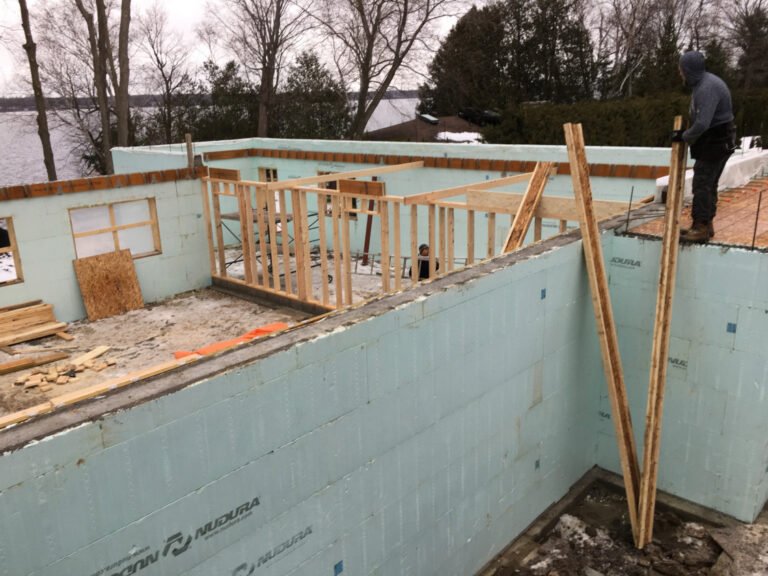
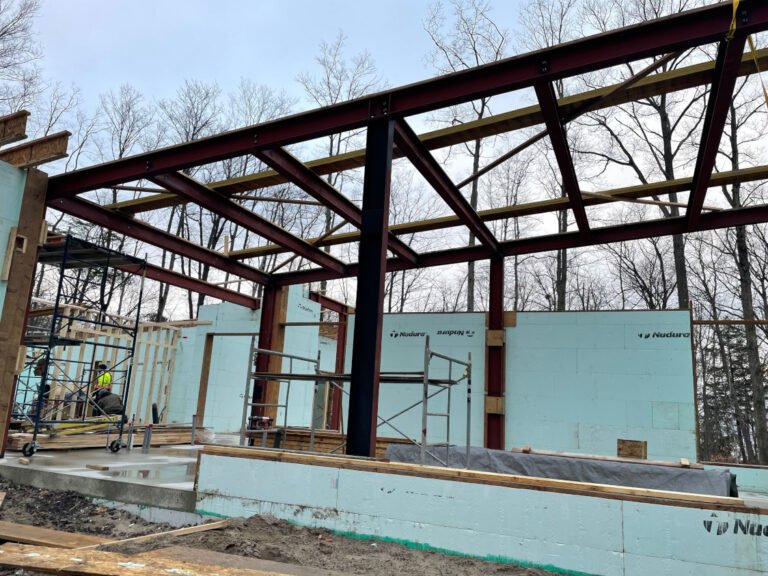
An ICF foundation is a permanent-form concrete wall system. Hollow lightweight foam blocks — called Insulated Concrete Forms — are stacked like Lego to create the shape of the foundation walls, reinforcing steel is placed inside them, and concrete is poured into the hollow core. Unlike traditional formwork, the foam stays in place permanently after the pour, becoming the wall’s integrated insulation layer on both sides.
The result: a single wall assembly that delivers structural concrete, continuous insulation, and a backing surface for finishes — all in one trade visit, instead of the multi-trade sequence required by poured concrete + interior insulation + framing.
The simple way to think about it
Imagine an 8″ concrete wall with 2-5/8″ of EPS foam permanently bonded to each side. That’s essentially what an ICF foundation is. The foam isn’t a separate add-on after the concrete cures — it’s the formwork the concrete was poured into, so it’s fully integrated, continuous, and never installed wrong because it can’t fall off, sag, or develop the air gaps that interior batt insulation suffers from.
Why this matters for Ontario foundations specifically
Ontario’s 2024 Building Code (O. Reg. 163/24, in force since January 1, 2025) now requires full-height basement insulation — floor to ceiling, not partway up. With poured concrete, this means a substantial multi-step buildup: pour the wall, wait, frame an interior wall, install vapour barrier, batt insulate, drywall. With ICF, the full-height insulation is built into the wall the moment the concrete is poured. That code requirement is essentially the reason ICF foundations have shifted from “niche premium option” to “mainstream sensible choice” in Ontario over the past 24 months.
The Anatomy of an ICF Foundation: 4 Components Broken Down
An ICF foundation has four parts that work together. Understanding each helps you ask the right questions when evaluating ICF for your project.
1. EPS foam insulation (the permanent formwork)
The foam blocks are made from expanded polystyrene (EPS), typically Type 2 modified with fire retardants per CAN/ULC S102 surface burning standards. Density runs 1.5 to 2.5 lb/ft³ for standard ICF blocks — dense enough to handle concrete hydrostatic pressure during the pour without deformation.
Each side of the wall has approximately 2-5/8″ of foam in a standard ICF block (NUDURA standard form factor; AMVIC and other brands vary slightly). Together, the two foam layers deliver an effective insulation value of R-22 to R-25 for the complete wall assembly — significantly higher than the nominal R-value of the foam alone because of how continuous installation eliminates thermal bridging. For higher-performance builds, NUDURA’s R-Value Plus inserts or thicker-foam blocks (like NUDURA’s XR35 with 4″ foam each side) can deliver up to R-48.
Major Ontario brands stocking standard EPS ICF blocks: NUDURA, AMVIC, ELEMENT ICF, INTEGRASPEC, FOX BLOCKS, SUPERFORM, QUAD-LOCK, BUILDBLOCK. See our full Ontario ICF brand comparison for specs and tier rankings. Note: LOGIX was retired January 1, 2025, replaced by ELEMENT ICF — older articles still referencing Logix should be read with that update in mind.
2. Reinforced concrete core (the structural element)
The concrete poured into the ICF cavity provides the actual structural strength. Specifications:
- Strength grade: 20 MPa minimum per Ontario residential code; 25-30 MPa more common for foundation walls (per CSA A23.1)
- Slump: typically 150–200 mm for ICF pours — flowable enough to fill the form without honeycombing, not so wet that hydrostatic pressure deforms the foam
- Aggregate size: 10–14 mm typically — matches the form cavity geometry without bridging at rebar locations
- Air entrainment: 5–8% for freeze-thaw resistance, important for any concrete exposed to soil moisture
- Maximum lift height: usually 4′ (1.2m) per lift to manage hydrostatic pressure on the foam
Concrete is pumped into the cavity in multiple controlled lifts, vibrated lightly (internal pencil vibrators or external vibration of the form) to eliminate voids, and allowed to set between lifts. A complete wall pour for a typical 1,800-2,400 sq ft home foundation runs roughly 50-80 cubic metres of concrete — usually accomplished in a single day of pumping.
3. Reinforcing steel (rebar grid)
Canadian rebar designations per CSA G30.18 — the standards are different from American (US uses #4/#5/#6 etc., Canada uses 10M/15M/20M). For typical Ontario ICF foundations:
| Rebar Designation | Diameter | Typical Foundation Use |
|---|---|---|
| 10M | 11.3 mm | Light reinforcement, secondary steel, ties |
| 15M | 16.0 mm | Primary vertical and horizontal foundation wall reinforcement — the workhorse |
| 20M | 19.5 mm | Engineered designs, walkout lintels, heavy load applications |
| 25M | 25.2 mm | Commercial / multi-storey / heavy structural |
Standard Ontario residential ICF basement foundation reinforcement:
- Vertical bars: 15M @ 600mm (24″) on-centre, lapped into footing dowels and continuous to wall top
- Horizontal bars: 15M @ 400mm (16″) on-centre vertically (typically every second course of an 18″-high block)
- Extra reinforcement at openings: 2–3 bars top and bottom of windows and doors, plus diagonal corner bars
- Concrete cover: 40mm minimum from the rebar surface to the concrete face per CSA A23.1 (important for the lintel/header design too)
For engineered designs (walkouts, taller walls, unusual conditions), a structural engineer specifies the exact reinforcement schedule per CSA A23.3 Design of Concrete Structures. For prescriptive Part 9 designs (most residential), OBC tables specify the reinforcement based on soil retention height.
4. Web ties and form integration
Within each ICF block, polypropylene web ties (sometimes steel) connect the two foam panels together, hold them at the correct spacing during the pour, and support the rebar above them. Most major brands use webs at 8″ on-centre (NUDURA standard) for tight cladding-fastening grid. The webs also extend slightly into the foam surface, creating fastening strips the full height of the wall — convenient for attaching drywall, cladding, or strapping after the wall is complete.
The choice of web tie material matters: polypropylene is non-thermally-conductive (no thermal bridging through the wall), corrosion-immune, and lightweight. Steel ties (used in some older systems) are stiffer but create minor thermal bridges and rust over time if exposed.
Foundation Types ICF Handles Well
ICF works for nearly every below-grade foundation type. Here’s how it’s typically applied to each:
Full basement (the most common ICF application)
8″ concrete core with 15M @ 600mm vertical / 400mm horizontal reinforcement. Wall height 8′ (2.4m) standard, 9′ (2.7m) for finished basements with high ceilings. Footing dimensions typically 400mm wide × 200mm deep reinforced with 15M longitudinal bars. This is the workhorse application that 70%+ of Ontario ICF foundation projects fall into. Best for new custom homes, properties where the basement will be finished and lived in, and any build where heating cost matters long-term.
Walkout basement (Georgian Bay specialty)
Common on Simcoe County’s sloped lots, especially the Collingwood / Blue Mountains corridor, lakefront properties, and rural lots with natural grade differences. Construction combines below-grade ICF on three sides with a full-exposed ICF wall (often brick or stone clad) at the walkout face. Critical details: engineered lintels at door/window openings (spans often exceed Part 9 prescriptive limits), perimeter drainage tile directing water around the walkout face, and properly graded site to send surface water away. See our ICF lintel design guide for the structural details.
Crawlspace foundation
Less common than full basements in Ontario but useful for cottages, additions, and properties with high water tables that make full basements impractical. Wall height typically 1.2–1.5m (just enough for service access). 6″ or 8″ ICF core. Critical detail: vapour barrier on the floor (typically 6 mil poly sealed at edges), and a decision early about conditioned vs unconditioned crawlspace — the modern best practice in Ontario is conditioned (sealed and insulated to the same standard as living space) for moisture management.
Frost wall (for shallow foundations and garages)
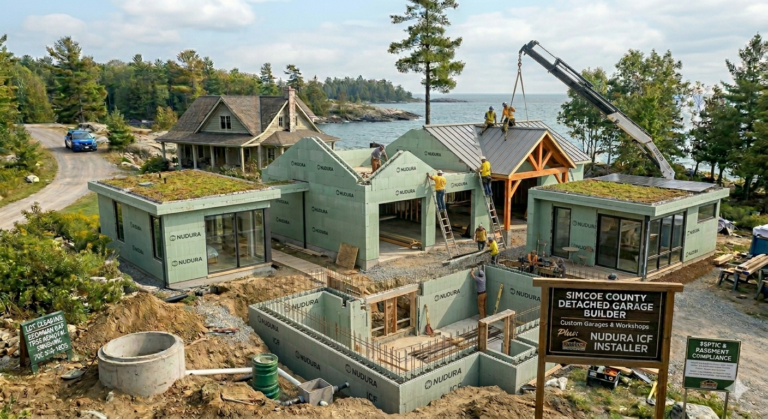
For slab-on-grade construction or detached garages, a frost wall extends from the slab edge down to frost depth (1.2–1.5m in Ontario), with the slab pour either monolithic with the wall or done in a separate stage. ICF frost walls deliver insulated thermal break that prevents heat loss to the soil at the slab edge — particularly important for heated garages or workshops.
Retaining walls (engineered)
Engineered ICF retaining walls handle significant soil loads with appropriate reinforcement. Cores typically 8″ or 10″ with heavy 15M or 20M vertical rebar at tighter spacing (300mm o.c. or less). Engineering design required per CSA A23.3 for any retaining wall over 1.2m of retained soil. Common applications: walkout basement walls (which are essentially retaining walls on three sides), terraced site retention, slope stabilization.
Pool walls (in-ground concrete pools)
ICF concrete pool walls have gained traction in Ontario for in-ground pool construction. The integrated insulation reduces heating costs significantly (10-15% reduction on a typical Ontario in-ground pool), and the EPS foam provides a thermal break between the pool water and the surrounding soil. Cores typically 6″ or 8″ with engineered reinforcement; waterproofing system is critical (different specification than typical basement waterproofing).
Construction Process Day by Day in Ontario Conditions
What an ICF foundation project actually looks like from break-ground to backfill, for a typical 1,800-2,400 sq ft Ontario home in normal building-season conditions (April-November):
Days 1–3: Site preparation and excavation
- Site survey confirmation; setbacks staked; utility locates verified
- Excavation to depth: top of footing typically 1.4–1.5m below finished grade in central Simcoe County (deeper in snow belt areas)
- Excavator over-digs by approximately 1m beyond foundation lines for working space
- Bottom of excavation graded level and compacted; geotech inspection if required by engineer or municipality
- Drain rock placed where weeping tile will sit; sump pit prep if applicable
Days 4–5: Footings
- Footing forms set: typically 400mm wide × 200mm deep for an 8″ ICF wall, dimensions per engineer or Part 9 tables
- Footing reinforcement: 15M longitudinal bars (typically 2-3 bars depending on footing width), 10M ties at corners
- Vertical dowels for ICF wall connection set at correct spacing (matching the ICF vertical rebar schedule)
- Footing pour: 25 MPa concrete typical; allowed to cure 24-48 hours before wall stacking begins
- Underslab vapour barrier prep on the floor area; radon stub installation per 2024 OBC requirements
Days 6–8: ICF wall assembly
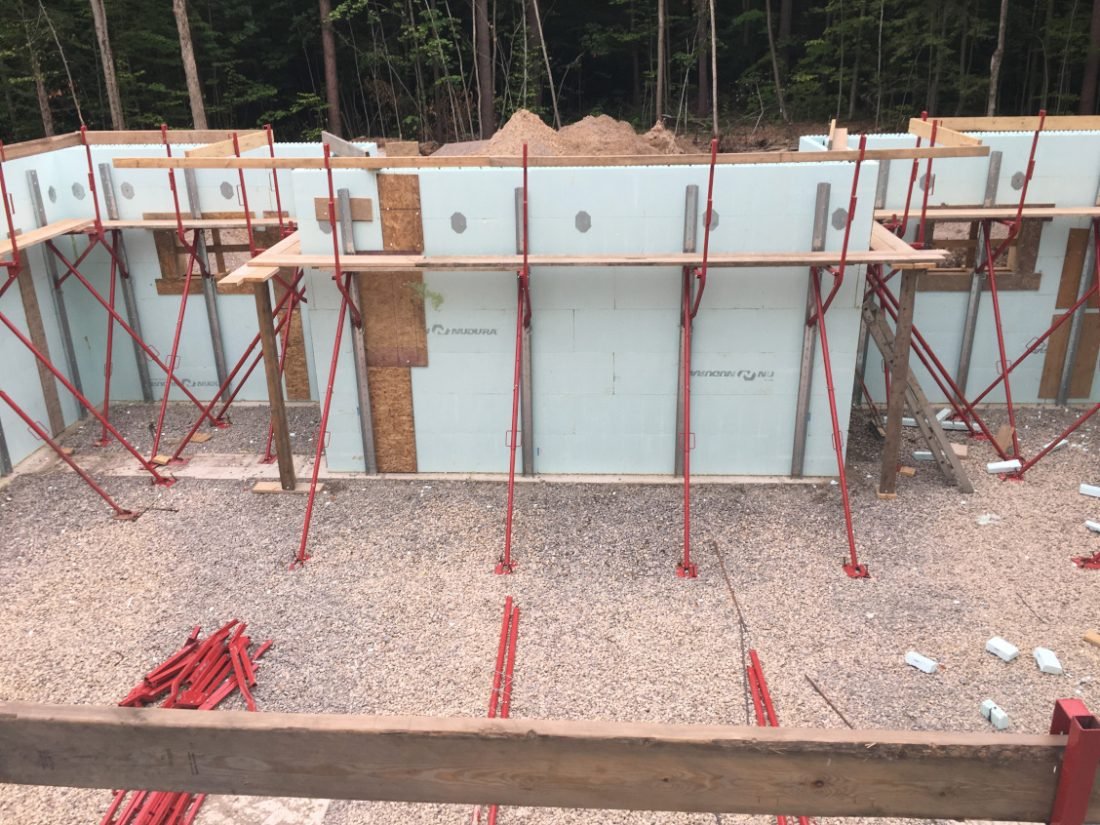
- First course: Interlocking blocks placed on the footing, aligned to chalk lines, leveled with shims as needed
- Additional courses: Stacked in standard running-bond pattern, with cuts for openings (window bucks, door frames, service penetrations)
- Window and door bucks: Wood or metal frames installed in openings, integrated with the ICF webs for concrete bonding
- Rebar placement: Vertical bars inserted through web slots, horizontal bars laid in web tops per spec
- Bracing system installation: Steel or wood bracing every 4′ (1.2m) along the wall, with adjustable turnbuckles for plumbing the wall
- Service rough-ins: Electrical conduits, plumbing penetrations, mechanical service openings — all installed before the pour
Days 9–10: Concrete pour
- Pre-pour checklist: All bracing verified, rebar in correct positions, openings properly bucked, pump truck staged, concrete truck schedule confirmed
- Pour begins: Concrete pumped through a hose into the form, typically starting at corners and working outward
- Lift sequence: Wall poured in 4′ (1.2m) lifts to manage hydrostatic pressure; brief pause between lifts to let lower lift begin set
- Vibration: Light internal vibration (pencil vibrators) ensures concrete fills around rebar and around openings without honeycombing
- Top finish: Wall top struck off level for sill plate or anchor bolts; anchor bolts set per spec while concrete is still plastic
- Total pour time: Usually 4-6 hours for a typical 1,800-2,400 sq ft home foundation
Days 11–14: Waterproofing, drainage, backfill, slab
- Bracing removal after concrete reaches initial set (typically 24-48 hours after pour)
- Exterior waterproofing: Self-adhesive membrane or liquid-applied system on exterior foam surface
- Drainage tile: 4″ perforated pipe at footing level, surrounded by clean stone, draining to daylight or sump
- Drainage board / dimple membrane: Applied over waterproofing to allow water to travel down to the weeping tile
- Backfill: Clean stone (300mm minimum) against the wall, then compacted granular and final native soil to grade
- Underslab insulation and prep: R-10 minimum continuous foam, vapour barrier, slab reinforcement
- Slab pour: 100mm typical residential slab with mesh or fiber reinforcement; finished smooth or broom-textured per use
Total on-site time for a typical Ontario ICF foundation
1-2 weeks from break-ground to backfill ready, depending on size and complexity. Walkout basements add 1-2 weeks for the additional engineering and detailing. Winter pours add 1-3 weeks for concrete curing protection and cold-weather work premiums. Permit and design phases run separately, typically 2-6 weeks ahead of break-ground for new construction.
Real Performance Specs (R-Value, Airtightness, Structure)
Marketing materials throw lots of numbers at ICF foundations. Here are the verified Ontario-relevant performance specs:
Thermal performance
| Metric | ICF Foundation | Poured Concrete + 2″ XPS Interior | Real-World Impact |
|---|---|---|---|
| Effective R-value | R-22 to R-25 | ~R-12 | 2x more thermal resistance — basement stays warmer |
| Airtightness (whole-home ACH50) | 1.0–1.26 ACH50 (RDH Labs) | ~4 ACH50 typical | ~4× tighter; reduces heating load 15-30% |
| Thermal bridging at studs | None (continuous foam) | Limited (interior framing) | ICF eliminates a known heat-loss path |
| Annual heating savings (vs basic wood frame) | 25–40% | Baseline | $500–$1,000/year on a 2,400 sq ft Ontario home |
Structural performance
- Compressive strength: 20-30 MPa concrete core (CSA A23.1 standard), with rebar reinforcement per CSA A23.3
- Lateral load capacity: With proper 15M @ 600mm vertical reinforcement, handles soil retention up to ~3m height without engineered design (Part 9 prescriptive)
- Snow load tolerance: Easily handles Georgian Bay snow belt loads of 2.5–3.5 kPa per OBC SB-1
- Frost heave resistance: When footings are at correct depth (1.2–1.5m), ICF foundation is essentially immune to seasonal frost movement
- Fire rating: 4-hour ASTM E119 wall assembly rating with 5/8″ Type X drywall on living-space side
- STC sound rating: 50–55 for 6–8″ core (vs ~33-38 for wood-frame demising walls)
Durability
- Service life: 100+ years typical for properly-built ICF foundations — comparable to bare concrete
- Mold/rot resistance: Concrete core is non-organic; EPS foam doesn’t support mold growth
- Pest resistance: EPS foam is not a food source for termites/insects, but some pest professionals recommend pest-resistant termite-tested foam for high-risk locations (rarely an issue in central Ontario)
- Maintenance schedule: Effectively none for the wall structure itself; exterior waterproofing reapplication generally not needed within typical service life if installed correctly
2024 OBC Requirements for ICF Foundations
The 2024 Ontario Building Code (O. Reg. 163/24, in force January 1, 2025) brought several updates that affect ICF foundation construction in Ontario. Here’s the relevant set:
1. Radon rough-in (NEW — all new homes)
Every new home in Ontario now requires a sub-floor depressurization rough-in for radon mitigation — a sealed pipe stub from beneath the slab to above grade (typically through the roof), ready for an active fan if radon levels later test high. Parts of Ontario (especially areas with shield bedrock close to surface) have elevated radon potential. The rough-in goes in during slab pour — impossible to retrofit cleanly later.
2. Full-height basement wall insulation (NEW)
The 2024 OBC mandates full-height insulation on basement walls — from floor to ceiling, not the partial-height approach that used to be common. For ICF foundations this is automatic because the insulation is built into the wall system. For poured-concrete + framed-and-batted basements, this is now a more substantial wall buildup than older code required — one of the practical reasons ICF has become more competitive on basements specifically.
3. Mechanical Ventilation Design Summary (MVDS) at permit
Houses built under the 2024 OBC need an MVDS submitted with the building permit application. Not strictly a foundation requirement, but it affects the foundation because the radon stub, HRV/ERV venting, and any sub-slab depressurization need to be coordinated with the MVDS during design.
4. Underslab insulation expectations (effective requirement)
While not strictly mandatory in all cases, current best practice and most performance pathways under SB-12 effectively require R-10 minimum continuous underslab insulation, particularly for heated basements and any slab with radiant in-floor heating. Without it, the slab loses 30-50% of its heat downward into the soil.
5. Structural compliance (Part 4 vs Part 9)
Foundation design follows either:
- OBC Part 9 (prescriptive) — tables specifying wall thickness, reinforcement, and other parameters based on soil retention height and building size. Suitable for most single-family residential.
- OBC Part 4 / CSA A23.3 (engineered) — structural engineer stamps the design. Required for walkouts, taller walls, unusual conditions, multi-storey, or any structure exceeding Part 9 prescriptive limits.
For more detail on OBC compliance, see our complete ICF and the 2024 Ontario Building Code guide.
ICF vs Poured Concrete vs Concrete Block: The Honest Comparison
Ontario has three realistic foundation wall systems in 2026. Here’s how they compare on the factors that matter most:
| Factor | ICF | Poured Concrete | Concrete Block (CMU) |
|---|---|---|---|
| Wall cost (Ontario 2026) | $42–$55/sq ft | $35–$45/sq ft (then add insulation) | $30–$42/sq ft (then add insulation) |
| Cost with full-height insulation buildup | $42–$55/sq ft (integrated) | $45–$58/sq ft (insulation buildup added) | $42–$55/sq ft (insulation buildup added) |
| Effective R-value | R-22 to R-25 | ~R-12 with 2″ XPS interior | ~R-12 with 2″ XPS interior |
| Airtightness | Excellent (continuous foam + concrete) | Good when poured properly | Poor — mortar joints leak |
| 2024 OBC full-height insulation | Automatic | Requires additional buildup | Requires additional buildup |
| Schedule (foundation phase) | 1–2 weeks | 1 week pour + 1–2 weeks insulation later | 2–3 weeks plus insulation |
| Resistance to water/freeze-thaw | Excellent | Good | Poor — mortar joints fail over decades |
| Skilled labour required | Specialized ICF crew | Conventional forming crew | Mason crew — increasingly scarce in Ontario |
| Common in Ontario new builds 2026 | Growing, especially custom | Standard for tract subdivision | Rare in new builds; common in repair |
For deeper analysis of ICF foundation cost specifically vs poured concrete, see our ICF foundation cost vs poured concrete comparison.
The honest bottom line: Once the full-height insulation requirement of the 2024 OBC is added to poured concrete or block foundations, the cost gap with ICF narrows or disappears. ICF’s key advantages today: single-trade installation, faster schedule, and automatic code compliance — not just the raw thermal performance numbers.
Real Ontario 2026 Costs for ICF Foundations
Specific cost ranges by foundation type and size, based on current Ontario builder pricing:
| Foundation Project | Typical Wall Area | Wall Cost Range | Total Foundation Cost (incl. footings + drainage + slab) |
|---|---|---|---|
| 1,200 sq ft home basement | ~600 sq ft wall | $25,000–$33,000 | $50,000–$70,000 |
| 1,800 sq ft home basement | ~800 sq ft wall | $34,000–$44,000 | $65,000–$90,000 |
| 2,400 sq ft home basement | ~1,000 sq ft wall | $42,000–$55,000 | $80,000–$110,000 |
| Walkout basement, 2,000 sq ft home | ~900 sq ft wall (engineered lintels) | $45,000–$60,000 | $90,000–$125,000 |
| Garage frost wall + slab (2-car detached) | ~150 sq ft wall | $7,000–$11,000 | $18,000–$28,000 |
| Crawlspace, 1,500 sq ft footprint | ~400 sq ft wall | $17,000–$22,000 | $32,000–$45,000 |
What drives cost variation within the range
- Site access difficulty — tight access lots, long drives, restricted truck routes add cost
- Soil conditions — clay, sand, rock all affect excavation cost and may require additional drainage
- Wall height — 9′ walls cost more per sq ft than 8′ walls (extra blocks, extra bracing)
- Complex geometry — more corners and angles = more block cutting and waste
- Engineered designs — walkouts, unusual conditions add engineering fees and special detailing
- Cold-weather work premiums — 10-20% surcharge on winter pours due to protection requirements
For the complete cost picture including build types beyond foundations alone, see our full ICF cost analysis Ontario 2026.
When ICF Foundations Make Sense (And When They Don’t)
Honest section most ICF marketing skips: there are situations where ICF foundations are clearly the right choice, and there are situations where the premium isn’t worth it.
When ICF foundations clearly make sense
New custom homes
Long ownership horizon, full integration into the home’s thermal envelope, basement intended for living space.
Finished basements
If the basement will be heated and finished, the energy and comfort benefits compound over decades.
Walkout basements
Engineered conditions where ICF’s integration of structure + insulation simplifies the build sequence.
Snow belt / cold microclimates
Collingwood, Tiny, Wasaga, Blue Mountains adjacent areas where heating loads are above provincial average.
Sloped or challenging sites
Walkouts, retaining walls, basements with one or two exposed faces — ICF’s structural performance matters more.
Properties where resale matters less than ownership comfort
Forever homes, multigenerational properties, builds where lifestyle benefits dominate the decision.
When ICF foundations don’t make sense
- Short ownership horizons (under 7 years) — you won’t recover the premium through energy savings or resale
- Tight budgets that would force compromises elsewhere — spend money where it’s visible and usable, not just where it’s hidden in the wall
- Basic unheated outbuildings — storage sheds, unheated detached garages where the energy advantage doesn’t apply
- Small accessory structures (under 50 m²) — ICF setup costs hurt the economics of small builds
- Renovation/addition projects where ICF doesn’t integrate cleanly with existing wood-frame structure
- Mid-market properties in cost-sensitive subdivisions where the resale premium doesn’t materialize
Common ICF Foundation Myths Corrected
Myth: “ICF foundations are 50% more expensive than poured concrete”
Reality: ICF foundation walls run roughly $42-$55/sq ft vs $35-$45/sq ft for poured concrete walls. But poured concrete still needs interior insulation buildup to meet 2024 OBC full-height insulation requirements — which closes most of the gap. Once both walls are at code-compliant insulation buildup, the cost difference is typically 5-15%, not 50%.
Myth: “ICF foundations save 70% on heating costs”
Reality: Realistic savings vs current-code wood frame or poured concrete + minimum interior insulation are 25-40%, not 70%. The higher claims compare modern ICF to older, leakier construction built to 1990s-2000s codes — an unfair benchmark. On a 2,400 sq ft Ontario home, that’s roughly $500-$1,000/year in heating savings.
Myth: “ICF foundations can’t be modified later”
Reality: ICF walls can be cut and modified, but the process is more involved than wood frame — concrete sawing required for openings, and any load-bearing modification needs engineer verification. The kind of modifications homeowners care about (electrical, plumbing routing) are normally handled during initial construction. Post-construction wall modifications are rare for typical residential.
Myth: “ICF foundations need special architects/designers”
Reality: Any architect or designer familiar with Ontario construction can specify an ICF foundation. The structural details (rebar schedule, wall thickness, opening reinforcement) follow CSA A23.3 design standards used for any reinforced concrete construction. Most Ontario residential designers are comfortable with ICF.
Myth: “EPS foam in ICF is a fire hazard”
Reality: The EPS foam used in ICF is Type 2 modified with fire retardants, tested per CAN/ULC S102 surface burning standards. In a completed wall, the foam is contained between concrete (on one side) and drywall or cladding (on the other) — not directly exposed to flames. The complete wall assembly carries a 4-hour ASTM E119 fire rating — among the most fire-resistant residential wall systems available. See our complete ICF fire resistance article.
Myth: “ICF foundations don’t need waterproofing because the concrete is sealed”
Reality: All foundation walls need waterproofing — ICF included. Hydrostatic pressure from saturated soil will eventually push water through any concrete given enough time. ICF foundations require the same drainage system (perimeter weeping tile, dimple membrane, clean stone backfill, surface grading away from the wall) and exterior waterproofing membrane as poured concrete. The integrated foam doesn’t replace waterproofing; it provides thermal insulation and a flat surface for waterproofing to bond to.
Related ICFpro pages
Deeper into specific aspects of ICF foundations, costs, code, brands, and local service.
★ Provincial service
ICF Foundation Contractor Ontario →
★ Cost comparison
ICF Foundation vs Poured Concrete Cost →
Local service
ICF Foundation Contractor Simcoe County →
Local service
ICF Foundation Contractor Barrie →
Service hub
ICF Foundations, Pools & Structures →
Code
ICF & the 2024 Ontario Building Code →
Cost
ICF Cost Per Square Foot Ontario 2026 →
Brands
All 8 Ontario ICF Brands Compared →
Structural
ICF Lintel Design Guide →
Structural
ICF Structural Strength →
Energy
ICF Energy Efficiency →
Fire
ICF Fire Resistance Deep Dive →
Service
ICF Installation & Supply →
Service
ICF Custom Home Building →
Decision
Is ICF Worth It in 2026? →
Ready to Discuss Your ICF Foundation Project?
We’ve been pouring ICF foundations in Ontario for 30 years — basements, walkouts, crawlspaces, garages, and full custom homes. 300+ projects, four certifications (Certified ICF Builder, R2000, Green Builder, Tarion-Approved), 7-year warranty. Initial conversation, plan review, and ballpark estimate are no-cost.
FAQ: ICF Foundations
What is an ICF foundation?
An ICF (Insulated Concrete Form) foundation is a permanent-form concrete wall system. Hollow lightweight EPS foam blocks are stacked to form the shape of foundation walls; reinforcing steel is placed inside; concrete is poured into the cavity. The foam remains in place permanently, becoming integrated insulation on both sides of the structural concrete core. The result is a single wall assembly delivering structure, continuous insulation, and a finish-ready surface in one trade.
How much does an ICF foundation cost in Ontario in 2026?
ICF foundation walls run $42-$55 per sq ft of wall area in Ontario 2026 pricing. Total foundation cost (excavation + footings + walls + drainage + slab) on a typical 1,800-2,400 sq ft home runs $65,000-$110,000. The premium over poured concrete + interior insulation buildup is typically 5-15% once both walls reach 2024 OBC full-height insulation compliance — significantly less than the 50% premium that older articles often cite.
What is the R-value of an ICF foundation wall?
R-22 to R-25 effective for the complete wall assembly. The standard ICF wall has approximately 2-5/8 inch EPS foam on each side of the concrete core, delivering continuous insulation without thermal bridging. For higher-performance builds, manufacturers offer thicker-foam blocks (NUDURA XR35 with 4 inch foam each side) or R-Value Plus inserts that can deliver up to R-48 effective.
What rebar is used in ICF foundations in Ontario?
Canadian rebar designations per CSA G30.18: 10M (11.3mm), 15M (16mm), 20M (19.5mm). Standard Ontario residential ICF basement reinforcement uses 15M @ 600mm vertical and 400mm horizontal, with additional bars at openings. Engineered designs (walkouts, retaining walls, multi-storey) may specify 20M or tighter spacing per CSA A23.3 structural design. Concrete cover from rebar surface to wall face: 40mm minimum per CSA A23.1.
How long does it take to build an ICF foundation?
Typical Ontario timeline from break-ground to backfill-ready: 1-2 weeks for a standard basement, 2-3 weeks for a walkout. Phases: site prep and excavation (2-3 days), footings (1-2 days), ICF wall stacking and bracing (3 days), concrete pour (1 day), waterproofing/drainage/backfill/slab (3-4 days). Cold-weather construction adds 1-2 weeks for concrete curing protection. Permit and design phases run separately, typically 2-6 weeks ahead of break-ground.
What is the frost depth requirement for ICF foundations in Ontario?
OBC minimum frost depth is 1.2m (4 feet) per Part 9. In practice, municipalities require deeper based on local conditions: Central Ontario (Barrie, Peterborough, Kingston) typically 1.2-1.4m; Georgian Bay snow belt (Collingwood, Wasaga, Tiny, Penetanguishene) 1.4-1.5m; Ottawa Valley 1.4-1.5m; Northern Ontario 1.5-1.8m. Always verify with the local building department before excavation.
Do ICF foundations need waterproofing?
Yes. All foundation walls need waterproofing — ICF included. Standard requirements: perimeter weeping tile at footing level (4 inch perforated pipe wrapped in filter sock, surrounded by clean stone), dimple membrane or drainage board against the wall, exterior waterproofing membrane (self-adhesive rubberized asphalt or liquid-applied), clean stone backfill 300mm minimum, surface grading at 5% minimum slope away from the building. The integrated foam provides thermal insulation, not waterproofing.
Can ICF foundations be poured in winter in Ontario?
Yes, with caveats. The EPS foam actually helps cold-weather concrete curing by insulating the concrete from ambient cold — we’ve poured ICF walls successfully in -10C conditions. Requirements: heated enclosures or hoarding for slabs poured below freezing, concrete admixtures (accelerators) for cold pours, extended curing time, and a typical 10-20% premium pricing on cold-weather work. Snow belt sites often have the foundation completed and backfilled by mid-November to avoid working in heaviest snow conditions.
What ICF brands are used in Ontario?
Major brands stocked in Ontario as of 2026: NUDURA, AMVIC (manufactured in Paris, Ontario), ELEMENT ICF (replaced Logix as of January 2025), INTEGRASPEC (Kingston, Ontario), FOX BLOCKS, SUPERFORM, QUAD-LOCK, BUILDBLOCK. NUDURA and AMVIC are Tier 1 brands with the widest dealer networks and most established Ontario presence. See our full Ontario ICF brand comparison for detailed specs, R-values, form sizes, and tier rankings.
When does an ICF foundation make sense (and when doesn’t it)?
ICF makes sense: new custom homes, finished basements, walkout basements, snow belt or cold microclimate locations, sloped or challenging sites, properties with long ownership horizons, builds where heating cost and comfort matter long-term. ICF doesn’t make sense: short ownership horizons (under 7 years), tight budgets that would force compromises elsewhere, basic unheated outbuildings, small accessory structures under 50 m², renovation/addition projects where ICF doesn’t integrate cleanly with existing wood-frame structure.