ICFPro.ca is a division of ICFhome Ontario - Direct Line 1 705 533-1633 - Email: info@icfpro.ca

ICF Forms for Basements

ICFpro.ca · ICF Product Selection Guide
ICF Forms for Basements: Form Types, Core Widths, and Brands That Work for Ontario
Basement applications ask more of an ICF form than above-grade walls do. Higher hydrostatic pressure, frost depth, drainage detailing, and brick ledge transitions at grade all influence which specific forms and brands work best below grade. After 30 years pouring ICF basements across Ontario (since 1995, 300+ projects), here’s the product-focused guide: the form variants you’ll see on a real ICF basement project, which core widths fit which applications, how the major Ontario brands stack up on basement-specific products, and what to look for when selecting forms.
Standard / Taper Top / Brick Ledge
4″ to 12″ Core Widths
R-22 to R-48 Options
NUDURA / AMVIC / ELEMENT ICF
Ontario 2026 Selection
The form selection version in 30 seconds
For a typical Ontario basement, you’re looking at an 8″-core standard ICF form with R-22 insulation, supplemented by brick ledge forms at grade, taper top forms at the wall cap, and corner forms at all four corners. Brand choice (NUDURA, AMVIC, ELEMENT ICF) affects details but not the fundamentals.
- Standard form variants for basements: Standard block, taper top, brick ledge, one-sided (against existing walls), and corner forms. Each handles a specific basement detail.
- Core width selection: 8″ (200mm) is the workhorse for Ontario basements. 6″ for crawlspaces and lower-load conditions. 10″ for taller walls or engineered designs. 4″ for non-structural frost walls. 12″ for commercial/multi-storey.
- R-value baseline: R-22 to R-25 standard. Higher with thicker-foam variants (NUDURA XR35 with 4″ foam each side) or R-Value Plus inserts — up to R-48 effective.
- Major Ontario brands stocking basement forms: NUDURA, AMVIC (Paris, ON), ELEMENT ICF (replaced LOGIX Jan 2025), INTEGRASPEC (Kingston, ON), FOX BLOCKS, SUPERFORM, QUAD-LOCK, BUILDBLOCK.
- Typical block size: 8′ (2.4m) long × 18″ (450mm) high — NUDURA and most major brands. Sizing matters for course-counting and waste estimation.
- Quantity math: For a typical 1,800 sq ft Ontario home basement (~170 lin ft of wall, 8′ high), you’re looking at roughly 100–120 standard ICF blocks plus brick ledge and corner variants.
8′ × 18″
Typical block size NUDURA and major brands — ~12 sq ft per block
8″ core
Standard Ontario basement core width for typical residential
R-22 std
Baseline thermal performance with standard EPS foam
8 brands
Major brands stocked in Ontario 2026 — NUDURA, AMVIC, ELEMENT, etc.
What “ICF Forms” Actually Are
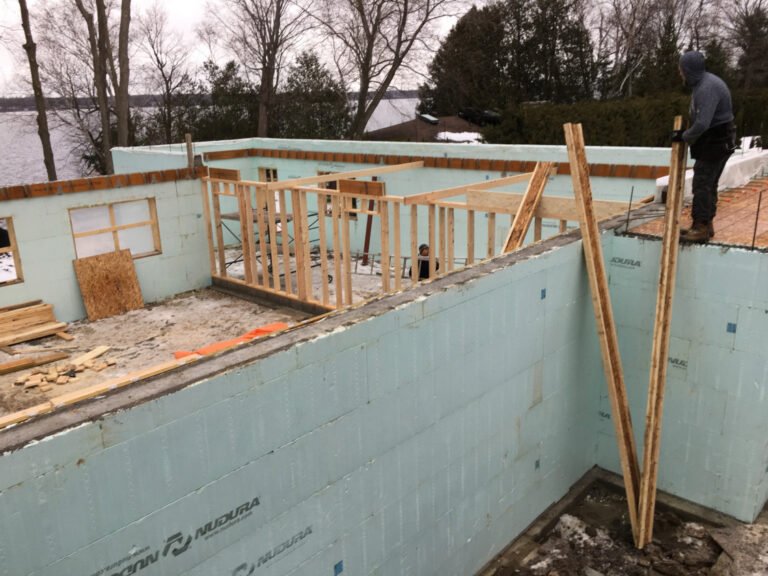
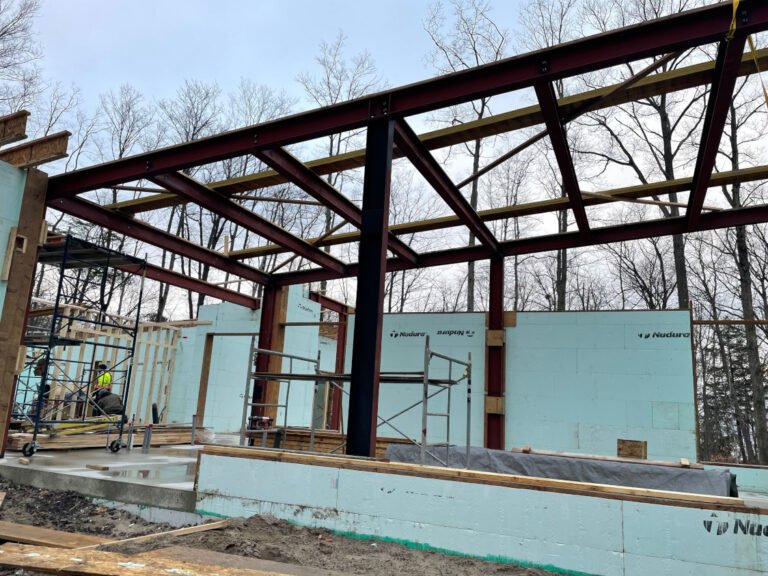
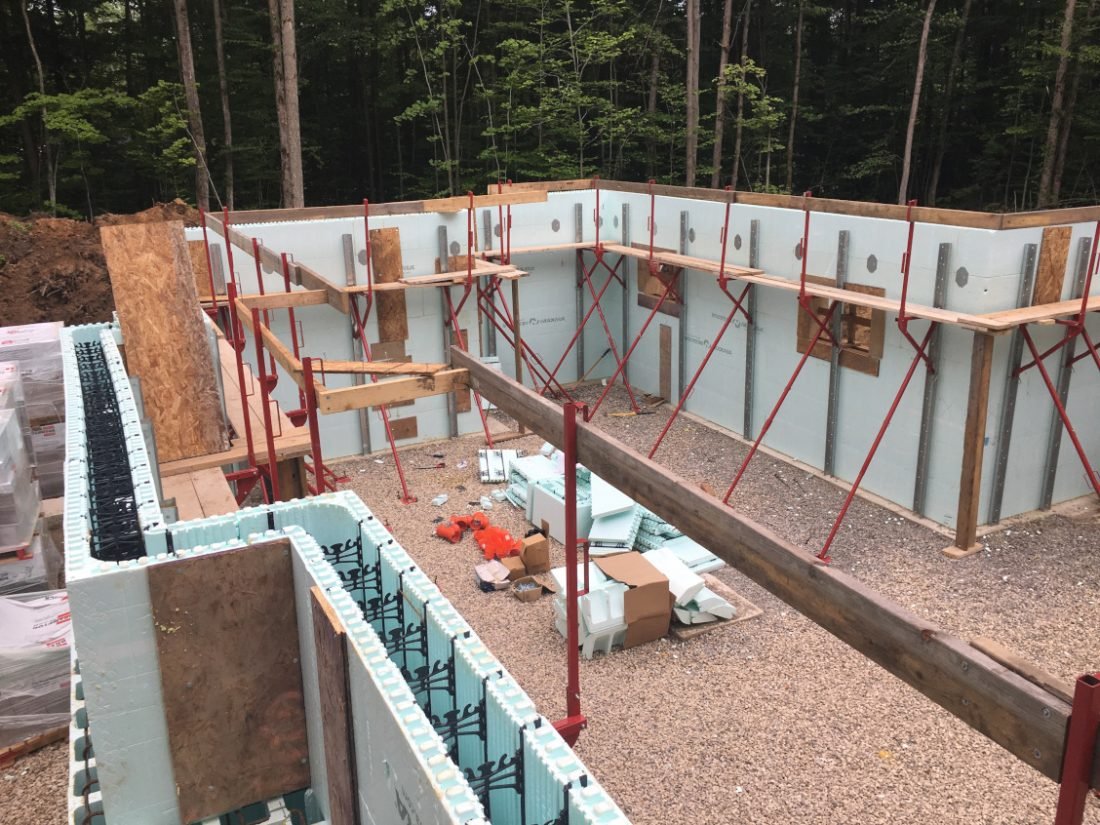
An ICF form is the hollow, lightweight foam block that gives Insulated Concrete Form construction its name. Each block consists of two EPS foam panels held apart at a fixed distance by polypropylene web ties. Blocks interlock to form continuous wall sections; rebar is placed inside the hollow cavity; concrete is poured in. After the concrete cures, the foam stays permanently in place — it’s integrated insulation, not just temporary formwork.
The standard block anatomy
- Foam panels (interior and exterior): Typically 2-5/8″ (67mm) thick on each side. Made from Type 2 modified EPS with fire retardants per CAN/ULC S102.
- Concrete cavity (core): The hollow space between the foam panels where structural concrete is poured. Cavity width = the “core width” spec (4″, 6″, 8″, 10″, 12″).
- Polypropylene web ties: Internal connectors holding the two foam panels at the correct spacing. Major brands use 8″ on-centre webs with full-height fastening strips.
- Interlock geometry: Top and bottom edges of each block mate with adjacent blocks — like Lego — preventing horizontal slip during the pour.
For more on the broader ICF foundation system, see our complete ICF foundation guide. This article focuses specifically on the form selection question for basement applications.
Why Basement Applications Have Unique Form Demands
Above-grade ICF walls and below-grade ICF basements use similar core systems, but basements ask more from the forms in four specific ways:
1. Hydrostatic pressure during the pour
Basement walls are usually full height (8 ft or 9 ft), often poured in a single continuous concrete operation. The full column of liquid concrete from top to bottom exerts significant lateral pressure on the foam — up to roughly 1,400 kg/m² (300 psf) at the base of a 9 ft pour. The forms must resist this without deforming, bowing, or blowing out.
What this means for form selection: density of EPS matters, web tie strength and spacing matters, and your installer’s bracing system matters. Major brands like NUDURA and AMVIC engineer their forms specifically to handle full-height residential pours without supplementary measures. Cheaper or lower-quality forms can deform under hydrostatic pressure, producing bulged or out-of-plumb walls.
2. Soil load against the wall after backfill
Once the basement is backfilled, the wall must resist lateral soil pressure for the life of the building. The structural performance comes from the reinforced concrete core, not the foam — but the form variant must accommodate the rebar placement and concrete cover required by the structural design.
3. Drainage and waterproofing integration
Basement walls need exterior waterproofing (membrane or liquid-applied) and a drainage layer (dimple membrane or drainage board) bonded to the exterior foam surface. Some ICF brands offer compatible waterproofing systems; the form’s foam surface must accept membrane adhesion without separation. For NUDURA, that means systems like their compatible waterproofing membranes; AMVIC has its own approved systems.
4. Brick ledge transitions at grade
If the home has brick or stone veneer above grade, the basement wall typically needs a brick ledge form at the transition point (usually at the top of the foundation wall, where above-grade cladding starts). The brick ledge form has an extended foam profile that creates a horizontal surface for brick veneer to bear on. This isn’t a basement-only feature, but it’s nearly universal on basements where brick continues above.
ICF Form Variants for Basement Work
A real ICF basement project uses several form variants — not just standard blocks. Here’s the full set you’ll see on a typical Ontario basement:
1. Standard block
The workhorse of any ICF wall. 8′ (2.4m) long × 18″ (450mm) high × varying core width (typically 6″, 8″, or 10″ for basements). Foam thickness 2-5/8″ each side. Webs at 8″ on-centre.
Used for: Most of the wall area — runs between corners, with cuts for openings.
2. Taper top block
A specialized block placed at the top of the wall. The interior of the block has a tapered profile that covers the interlock teeth, preventing concrete from intruding into the interlock during the final pour. Critical for getting a clean, level wall top for sill plate installation.
Used for: Top course of the basement wall only — usually one course-worth (about 18″ height of wall) at the top.
3. Brick ledge block
Adds an extended foam profile that creates a horizontal ledge for brick veneer bearing. The brick ledge typically projects 3-7/8″ (about 100mm) beyond the wall face, providing the bearing surface for brick veneer above.
Used for: Transition course between foundation and above-grade wall when brick or stone cladding is planned. Usually one course-worth at the grade line.
4. Corner block
Pre-formed 90° corner blocks. Some brands also offer 45° corners and adjustable-angle corners. Corner blocks reduce on-site cutting and ensure consistent corner geometry.
Used for: All four corners of a rectangular basement, plus any additional inside corners on irregular floor plans.
5. One-sided form (against existing or shoring)
Has foam only on one side instead of both. Used when concrete is poured against an existing wall, shoring, or a finished surface that doesn’t need foam on the back side. NUDURA offers a one-sided form; other brands have equivalents.
Used for: Additions to existing foundations, basement extensions against existing house walls, or specialized retaining wall conditions.
6. Thick-foam variant (NUDURA XR35 or equivalent)
Standard block geometry but with thicker foam panels — typically 4″ (100mm) each side instead of 2-5/8″. Higher effective R-value (up to R-48 with full Plus+ system); larger overall block width.
Used for: High-performance builds, passive-house range projects, walls in extreme cold microclimates where thermal performance matters most. NUDURA’s XR35 is the Ontario reference; other brands have equivalents.
| Form Variant | Position in Wall | Typical Use | How Often on a Typical Basement |
|---|---|---|---|
| Standard block | Wall body | Most of wall area | ~85% of forms |
| Corner block | Wall corners | All 4 corners + interior corners | ~5–8% of forms |
| Brick ledge | Grade transition | One course at grade line, if brick veneer above | ~5% of forms |
| Taper top | Wall top | Top course of wall | ~3% of forms |
| One-sided | Against existing structure | Additions or specialized conditions | 0% (only when needed) |
| Thick-foam (XR35) | Whole wall | High-performance builds only | 0% (or replaces standard if used) |
Core Width Selection by Application
The single most important spec decision is the core width — how thick the concrete inside the form is. Major brands offer 4″ through 12″ cores in single product lines. Here’s how to match the core to the application:
| Core Width | Concrete Volume | Typical Application | When to Use for Basements |
|---|---|---|---|
| 4″ (102mm) | Lowest concrete use | Non-structural frost walls, light retaining | Garage frost walls; never load-bearing basement walls |
| 6″ (152mm) | Lower-volume residential | Crawlspaces, short-height walls, partition walls | Crawlspaces (4-5 ft wall height); above-grade residential walls in some cases |
| 8″ (203mm) | Standard residential basement | Full basement walls, walkout below-grade portions | The Ontario standard for most residential basements — 8 ft to 9 ft walls, typical soil loads |
| 10″ (254mm) | Heavier residential | Tall basements (9 ft+), walkouts, engineered conditions | 9-10 ft basement walls, sites with elevated soil pressure, deeper foundations |
| 12″ (305mm) | Engineered / commercial | Multi-storey, commercial, heavy structural | Foundations supporting 2+ storeys above; commercial; some Part 4 engineered designs |
The Ontario rule of thumb
- Standard 8 ft (2.4m) basement, single-storey or 1.5-storey home above: 8″ core
- 9 ft (2.7m) tall basement with finished ceiling: 8″ or 10″ (engineer’s call based on soil)
- Walkout basement, three sides below grade: 8″ on buried sides, 6″ on walkout face
- Tall basement supporting 2-storey above: 10″ for safety margin, or 8″ with engineered design
- Crawlspace at 1.2–1.5m height: 6″
- Garage frost wall: 4″ or 6″
For specific structural design, the wall thickness and reinforcement schedule follow either OBC Part 9 prescriptive tables (typical residential) or an engineered design per CSA A23.3 (walkouts, taller walls, unusual conditions).
R-Value Options and Insulation Upgrades
The standard ICF form delivers R-22 to R-25 effective with 2-5/8″ EPS each side of the concrete. For most Ontario basements that’s well above 2024 OBC minimum and delivers excellent thermal performance. But there are upgrade paths if the project calls for higher performance:
| Configuration | Foam Thickness Each Side | Effective R-Value | When Worth It |
|---|---|---|---|
| Standard ICF | 2-5/8″ EPS | R-22 to R-25 | Most Ontario residential basements — exceeds 2024 OBC minimum easily |
| NUDURA + R-Value Plus inserts | 2-5/8″ EPS + insert layer | R-30 to R-35 | R2000-targeting builds, high-performance Ontario homes |
| NUDURA XR35 (thick-foam variant) | 4″ EPS each side | R-35 to R-40 | Cold-climate microclimates, snow belt premium builds |
| XR35 + R-Value Plus inserts | 4″ EPS + insert | R-45 to R-48 | Passive-house range builds, net-zero targets |
For most Ontario basements, the standard configuration is plenty. R-22 to R-25 continuous insulation outperforms typical wood-frame + interior batt construction by a meaningful margin without any additional cost. The R-Value Plus and XR35 upgrades are worth considering for whole-house ICF builds targeting high-performance certifications (R2000, Net Zero, Passive House range), but they add cost that’s harder to justify on a basement-only basis.
Brand-by-Brand Basement Form Availability in Ontario
Eight major ICF brands have meaningful Ontario presence in 2026. Here’s how they stack up on basement-specific products:
NUDURA (Tier 1)
One of the two leading Ontario ICF brands. Full product line for basement work: standard ICF Series (4″-12″ cores), Brick Ledge, Taper Top, XR35 (thick foam), one-sided forms, corner forms, and R-Value Plus inserts. Standard block 8′ × 18″ with polypropylene webs 8″ o.c. Locally stocked through several Ontario dealers including Simcoe Building Centre (authorized NUDURA supplier since 2014).
AMVIC (Tier 1)
Manufactured in Paris, Ontario — the only major ICF brand actually made in Ontario. Full basement product range including standard forms, brick ledge, corners, and various core widths (4″ to 12″). Comparable performance specs to NUDURA. Strong Ontario distribution network. R-22 to R-30 R-value range depending on configuration.
ELEMENT ICF (Tier 2 — replaced LOGIX)
Important update: LOGIX Insulated Concrete Forms was retired on January 1, 2025 and replaced by ELEMENT ICF. Same parent company, same general product line, new branding. If you see older articles referencing Logix Platinum or Logix Pro, those products are now sold under the Element ICF name. Element ICF carries standard blocks, brick ledge, taper top, and corner variants for Ontario basement work. Older Logix product is no longer in production but completed walls don’t require any retrofit — the system is identical.
INTEGRASPEC (Tier 2)
Manufactured in Kingston, Ontario. Distinctive panel-based system (separate foam panels rather than monolithic blocks) that offers some advantages for unusual geometries and on-site flexibility. Used by some Ontario builders for specialized residential and commercial work. Less common for typical residential basements.
FOX BLOCKS, SUPERFORM, QUAD-LOCK, BUILDBLOCK (Tier 3)
These brands have presence in Ontario but with less local distribution depth than NUDURA, AMVIC, or ELEMENT. Each offers competent basement form products. Selection often comes down to local dealer availability rather than fundamental product differences. For typical Ontario basement work in 2026, sticking with NUDURA or AMVIC simplifies supply, support, and consistency.
For a deeper brand comparison covering all 8 brands across multiple factors (cost, R-value, market share, distribution), see our complete Ontario ICF brand comparison.
Honest take on brand selection: For a typical Ontario residential basement, the brand choice matters less than people think. NUDURA and AMVIC are both excellent. ELEMENT ICF works fine. INTEGRASPEC is good for specialized work. What matters more: your installer’s experience with the specific brand they propose, local supply availability, and the form variants available for your specific basement details (brick ledge, walkout face, etc.). A great installer using AMVIC will produce a better wall than a mediocre installer using NUDURA.
Sizing and Quantity Calculations for a Typical Basement
How many ICF blocks does a typical Ontario basement actually need? Here’s the math:
Standard block coverage
A standard NUDURA block measures 8′ (2.4m) long × 18″ (450mm) high. That’s 12 sq ft of wall area per block. For other major brands the block sizes are similar though not identical — AMVIC blocks are also approximately 8 ft long, ELEMENT/Logix blocks similar.
Basement size to block count
| Home Footprint | Wall Perimeter (Approx.) | Wall Height | Wall Area | Approx. Standard Blocks |
|---|---|---|---|---|
| 1,200 sq ft | ~140 lin ft | 8 ft | 1,120 sq ft | ~95 blocks |
| 1,800 sq ft | ~170 lin ft | 8 ft | 1,360 sq ft | ~115 blocks |
| 2,400 sq ft | ~195 lin ft | 8 ft | 1,560 sq ft | ~130 blocks |
| 3,000 sq ft | ~220 lin ft | 9 ft | 1,980 sq ft | ~165 blocks |
Plus the supporting variants
Standard block counts above don’t include the supporting form variants. Typical additions for a basement:
- Corner blocks: typically 4-8 per project (4 corners × 1-2 courses to cover full height needed for corner forming)
- Brick ledge blocks: if brick veneer is planned, one full course at grade transition — roughly 12-15% of standard block count by linear footage at that course
- Taper top blocks: top course of the entire wall — roughly the same linear footage as standard blocks but only one course tall
- Concrete volume: for an 8″ core, 8 ft basement on a typical 1,800-2,400 sq ft home, approximately 50-80 cubic metres of concrete — usually delivered and pumped in a single day
Waste factor
Always order with a waste factor for cuts at openings, irregular geometry, and the inevitable in-construction adjustments. Most installers add 5-10% over the calculated block count. NUDURA recommends 5% standard, more for complex geometries.
What to Look For When Comparing ICF Forms
If you’re comparing brands or quotes that specify different ICF forms, here are the spec details that actually matter (and the ones that don’t):
What matters
Foam density
Standard density 1.5-2.5 lb/ft³ for residential basement applications. Higher density resists hydrostatic pressure during the pour without deforming.
Web tie material and spacing
Polypropylene preferred (non-thermally-conductive). 8″ on-centre spacing typical for major brands. Closer spacing = better cladding fastening grid.
Fastening strip availability
Full-height fastening strips on the foam surface make drywall and cladding attachment easier. Most modern brands include this.
Core width options
Single product line covering 4″ through 12″ cores means consistency across foundation, walls, and any commercial work. NUDURA and AMVIC both deliver this.
Form variants available
Does the brand offer brick ledge, taper top, one-sided, and the various form variants your specific project needs? Don’t pick a brand that forces field-cut workarounds.
Code/CCMC/ICC-ES report
Reputable brands have current CCMC (Canadian Construction Materials Centre) or ICC-ES evaluation reports referencing their products. Ask for the report number.
What matters less
- Marketing claims about thermal performance — effective R-value is similar (R-22 to R-25) across all major brands at standard configuration; the meaningful differences come at the upgrade level (R-Value Plus, XR35, etc.)
- Block color — cosmetic only; the foam stays buried or covered in finished construction
- Country of origin — NUDURA, AMVIC (Ontario), and major U.S. brands all deliver code-compliant performance; choose based on availability and installer familiarity, not flag
- Premium “exclusive” product names — marketing labels for products that are essentially the same as competitors’ standard offerings
Form Costs and What Drives the Variance
ICF forms aren’t typically purchased separately by homeowners — they’re bundled into the ICF contractor’s wall pricing. But understanding the cost structure helps when evaluating quotes:
Approximate form material cost (Ontario 2026)
| Form Type / Configuration | Approximate Material Cost (per block) | Cost per Sq Ft Wall Area |
|---|---|---|
| Standard 6″ core block | $28-$36 | $2.30-$3.00/sq ft |
| Standard 8″ core block | $32-$42 | $2.60-$3.50/sq ft |
| Standard 10″ core block | $36-$48 | $3.00-$4.00/sq ft |
| Brick ledge block | $38-$50 | 10-15% premium over standard |
| Taper top block | $34-$45 | Similar to standard |
| NUDURA XR35 thick-foam | $50-$70 | 40-60% premium over standard |
| R-Value Plus inserts (per linear ft of wall) | $6-$10/lin ft of wall | Add-on to standard block cost |
Material costs are roughly 25-35% of the total wall installation cost. Labour, concrete, rebar, pump truck, bracing, and waterproofing make up the rest. For a typical Ontario basement, ICF wall installation runs $42-$55 per square foot of wall area all-in. See our detailed ICF foundation cost comparison for the broader picture.
What drives material cost variance
- Form type complexity — brick ledge and one-sided forms cost 10-20% more than standard
- Thicker foam variants — XR35 and equivalent thick-foam forms cost 40-60% more than standard
- Order size discount — full-house quantity orders often get 5-10% better pricing than small jobs
- Local supply — freight costs from manufacturer to job site can vary $1-$2 per block in rural areas
- Brand premium — modest variation between brands, less than 10% across major Ontario brands at equivalent specs
Related ICFpro pages
More on ICF foundations, brand comparison, code compliance, and local service.
★ System guide
Complete ICF Foundation Guide →
★ Brand pillar
All 8 Ontario ICF Brands Compared →
Service
ICF Foundation Contractor Ontario →
Local service
ICF Foundation Contractor Simcoe County →
Cost
ICF Foundation Cost vs Poured Concrete →
Cost
ICF Cost Per Square Foot Ontario 2026 →
Service hub
ICF Foundations, Pools & Structures →
Service
ICF Installation & Supply →
Brand-specific
NUDURA Installer Ontario →
Structural
ICF Lintel Design Guide →
Structural
ICF Structural Strength →
Code
ICF & the 2024 Ontario Building Code →
Energy
ICF Energy Efficiency →
Decision
Is ICF Worth It in 2026? →
Need Help Selecting ICF Forms for Your Basement?
We’ve been pouring ICF basements in Ontario for 30 years with NUDURA, AMVIC, and other major brands. We can help you match the right forms to your specific project — basement size, soil conditions, cladding plans, performance targets. No-cost initial conversation and plan review.
FAQ: ICF Forms for Basements
What size ICF blocks are used for basements?
Standard ICF blocks for residential basements measure 8 ft (2.4m) long × 18″ (450mm) high with core widths typically 6″, 8″, or 10″. The 8″ core is the Ontario workhorse for most residential basement walls. Each block covers approximately 12 sq ft of wall area. For a typical 1,800 sq ft Ontario home basement, you’ll use roughly 100-120 standard blocks plus supporting variants (corners, brick ledge, taper top).
What is the difference between standard, brick ledge, taper top, and one-sided ICF forms?
Standard block - the workhorse used for most of the wall area. Brick ledge block - has an extended foam profile creating a bearing ledge for brick veneer above grade (one course at transition). Taper top block - placed at the top of the wall to cover the interlock and produce a clean level surface for sill plates (one course at top). One-sided form - foam only on one side, used when pouring against existing walls or shoring. Corner block - pre-formed 90-degree corners for clean geometry. Thick-foam variants (NUDURA XR35) - higher R-value through thicker EPS panels.
What core width should I use for an Ontario basement?
The Ontario standard for residential basements is 8″ (200mm) core width. Use 6″ for crawlspaces and shorter walls (4-5 ft height). Use 10″ for tall basements (9-10 ft walls) or sites with elevated soil pressure or engineered conditions. Use 4″ only for non-structural frost walls (garage applications). Use 12″ for commercial or multi-storey foundations. The wall thickness and reinforcement follow either OBC Part 9 prescriptive tables or an engineered design per CSA A23.3.
What R-value do standard ICF basement forms deliver?
Standard ICF forms with 2-5/8″ EPS foam each side deliver R-22 to R-25 effective for the complete wall assembly. Higher performance is available through R-Value Plus inserts (R-30 to R-35), NUDURA XR35 with 4″ foam each side (R-35 to R-40), or XR35 combined with R-Value Plus inserts (R-45 to R-48). For most Ontario basements, the standard configuration easily exceeds 2024 OBC minimum requirements.
Which ICF brand should I use for an Ontario basement?
For typical Ontario residential basements, the two leading brand choices are NUDURA and AMVIC (Paris, Ontario). Both deliver excellent products with strong Ontario distribution and full basement form variant lineups. ELEMENT ICF (which replaced LOGIX in January 2025) is also a solid choice with widespread Ontario availability. INTEGRASPEC (Kingston, Ontario) works well for specialized applications. Brand choice matters less than installer experience with the specific brand — a skilled installer using AMVIC will produce a better wall than a mediocre installer using NUDURA.
What happened to LOGIX ICF?
LOGIX was retired on January 1, 2025 and replaced by ELEMENT ICF. Same parent company, similar product line, new branding. If you see articles or older quotes referencing Logix Pro, Logix Platinum, or other Logix product names, those products are now sold under the Element ICF name. Completed walls built with Logix forms don’t require any retrofit — the underlying system is unchanged. New construction should reference Element ICF product names.
How many ICF blocks do I need for a typical basement?
Rough math: 1,200 sq ft home (~140 lin ft wall, 8 ft height) needs ~95 standard blocks; 1,800 sq ft home (~170 lin ft wall) needs ~115 blocks; 2,400 sq ft home (~195 lin ft wall) needs ~130 blocks; 3,000 sq ft home with 9 ft walls (~220 lin ft) needs ~165 blocks. Add 5-10% waste factor for cuts and openings. Plus supporting variants: corner blocks (4-8 per project), brick ledge blocks (one course at grade if brick veneer above), taper top blocks (top course of wall).
What is the difference between NUDURA Standard and NUDURA XR35?
NUDURA Standard has 2-5/8″ (67mm) of EPS foam on each side of the concrete core, delivering R-22 to R-25 effective. NUDURA XR35 has 4″ (100mm) of foam on each side, delivering R-35 to R-40 effective. The XR35 is wider overall, costs 40-60% more than standard, and is used for high-performance builds targeting R2000, Net Zero, or passive-house-range certifications. For most Ontario basements, Standard is more than adequate.
Do I need different forms for a walkout basement vs a standard basement?
Yes, walkouts typically need additional form variants. Below-grade walls (the three buried sides) use standard 8″ or 10″ core forms. Walkout face (the exposed wall) often uses 6″ or 8″ core with brick ledge forms at grade transition if brick or stone veneer is planned above. Openings (walkout doors and windows) require engineered lintels often with concrete cover and additional reinforcement — see our ICF lintel design guide. Corner blocks handle the transition between walkout face and below-grade walls.
How much do ICF forms cost in Ontario in 2026?
Approximate material cost per block: Standard 6″ core: $28-$36. Standard 8″ core: $32-$42. Standard 10″ core: $36-$48. Brick ledge: $38-$50. Taper top: $34-$45. NUDURA XR35: $50-$70. These are roughly $2.30-$4.00 per square foot of wall area for material alone. Complete installed wall cost runs $42-$55 per sq ft, with materials being roughly 25-35% of the total. ICF foundations aren’t typically purchased separately by homeowners — forms are bundled into the installer’s wall pricing.