ICFPro.ca is a division of ICFhome Ontario - Direct Line 1 705 533-1633 - Email: info@icfpro.ca

ICF Wall Systems

ICFpro.ca · ICF System Architecture Classification
ICF Wall Systems: Flat Wall, Grid/Waffle, and Post & Beam Compared for Ontario 2026
The Insulating Concrete Form Association (ICFA) classifies ICF construction into three structural wall system types: Flat Wall, Grid (Waffle), and Post & Beam. Each describes a different way concrete is shaped inside the foam forms. This article explains all three honestly — what they are, where they came from, where each still fits, and why Flat Wall accounts for essentially 100% of Ontario residential ICF construction in 2026. After 30 years of pouring ICF in Ontario (since 1995, 300+ projects), here’s the system-architecture reference.
3 System Classifications
Flat Wall: ~100% Ontario 2026
Grid/Waffle: Specialty / Historical
Post & Beam: Rare
ICFA Framework
The system classification reference in 30 seconds
Three ICFA-recognized ICF wall system types exist, but only one matters for Ontario residential construction in 2026. Understanding the framework helps you read industry literature and ask better questions.
- Flat Wall System: Continuous monolithic concrete core sandwiched between EPS foam panels. The modern Ontario standard. Used by NUDURA, AMVIC, ELEMENT ICF, INTEGRASPEC, and essentially all major brands.
- Grid / Waffle System: Concrete poured in a waffle pattern (vertical and horizontal “ribs”) with thinner sections between. Uses ~15-20% less concrete. Older / specialty system; rare in modern Ontario residential.
- Post & Beam System: Discrete concrete columns and beams with insulated infill panels in between. Architectural / historical use. Rarely seen in modern construction.
- Ontario 2026 reality: Flat Wall is essentially the only ICF wall system used in residential and most commercial work. Grid and Post & Beam appear primarily in industry literature, training materials, and a small number of specialty applications.
- Why Flat Wall dominates: Cleaner structural performance, simpler engineering, easier code compliance, broader brand support, better insurance treatment, and easier finishing.
3
ICFA-recognized system types Flat Wall, Grid, Post & Beam
~100%
Ontario 2026 share of residential ICF using Flat Wall system
15–20%
Concrete savings Grid/Waffle vs Flat Wall (real number, not 30%)
8 brands
Ontario brands all use Flat Wall as their primary system in 2026
What “ICF Wall Systems” Actually Means
The phrase “ICF wall systems” refers to the structural architecture of how concrete is shaped inside the foam forms — not to the foam blocks themselves or to specific brand product lines. The Insulating Concrete Form Association (ICFA) classifies ICF construction into three system types based on the resulting concrete geometry.
This is different from block variants (covered in our ICF blocks reference) or brand comparisons (covered in our Ontario ICF brand comparison). The system classification describes the underlying structural approach — how the concrete actually fills the form and what it looks like once cured.
Why the distinction matters
For most Ontario homeowners and builders in 2026, the distinction is largely historical — the Flat Wall system has essentially absorbed all residential and most commercial ICF work. But understanding the framework is useful because:
- Industry literature still uses the three-system framework — ICFA materials, training documents, manufacturer documentation, and academic engineering references
- Some specialty applications still use Grid/Waffle — small-scale or budget-constrained projects in certain markets
- Reading older articles becomes easier when you understand what system they’re describing
- Engineering specifications sometimes reference the system type explicitly for structural calculation purposes
The Three Wall Systems at a Glance
| Factor | Flat Wall | Grid / Waffle | Post & Beam |
|---|---|---|---|
| Concrete geometry | Continuous monolithic core | Waffle pattern of ribs | Discrete columns + horizontal beams |
| Concrete volume | Baseline (most concrete) | 15-20% less than Flat Wall | 30-40% less than Flat Wall |
| Structural performance | Excellent (uniform load distribution) | Adequate with proper design | Variable; depends entirely on engineering |
| Code compliance ease | Easiest (well-supported by OBC tables, CSA A23.3) | Requires more engineering specification | Always requires engineered design (Part 4) |
| Insurance treatment | Standard concrete construction discount | Often classified as concrete construction | Mixed — depends on infill panel rating |
| Thermal performance | R-22 to R-25 effective (best) | Lower — concrete ribs create minor thermal bridges | Lowest — infill panel performance varies |
| Brand support in Ontario 2026 | All 8 major brands | Rare — specialty distribution only | Custom / engineered builds only |
| Ontario 2026 market share | ~100% of residential | <1% | Rare exceptions |
The takeaway: for any Ontario residential project in 2026, you’re effectively choosing Flat Wall. The other two systems exist in industry literature but are essentially unavailable through normal Ontario supply channels.
Flat Wall System — The Modern Ontario Standard
★ The Ontario 2026 Standard
Flat Wall: Continuous Monolithic Concrete Core
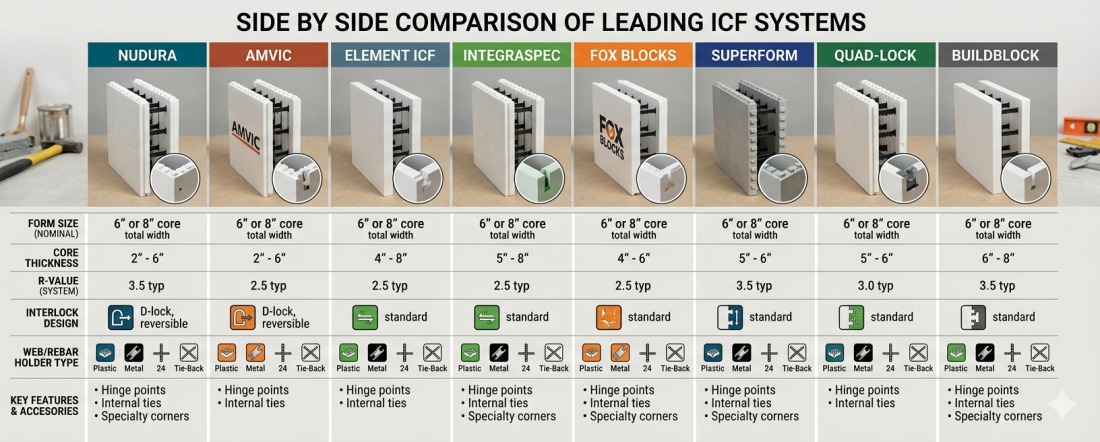
The Flat Wall system uses a continuous, uniform-thickness concrete core poured between two flat panels of EPS foam. The concrete forms a single monolithic wall — flat on both sides, consistent thickness from top to bottom and end to end. This is what virtually every modern ICF brand (NUDURA, AMVIC, ELEMENT ICF, INTEGRASPEC, FOX BLOCKS, SUPERFORM, QUAD-LOCK, BUILDBLOCK) sells as their primary system.
Core width range4″, 6″, 8″, 10″, 12″
Effective R-valueR-22 to R-25 (standard)
Concrete volume per sq ft wall0.67 to 1.00 cu ft (8″ core)
Structural designOBC Part 9 or CSA A23.3
Ontario brands stockingAll 8 major brands
2026 cost (per sq ft wall)$42–$55 installed all-in
Why it dominates
- Cleanest structural performance — uniform load distribution
- Simplest engineering — OBC Part 9 tables cover most residential
- Best thermal performance — no concrete ribs creating bridges
- Strongest brand and dealer support across Ontario
- Easiest code compliance and inspection
- Standard concrete construction insurance treatment
Tradeoffs
- Uses more concrete than Grid/Waffle (~15-20%)
- Standard 8-12″ wall thickness consumes some interior floor area
- Block material cost slightly higher per sq ft than waffle alternatives (historically)
- None of these tradeoffs are meaningful for most Ontario residential projects
What you actually get with a Flat Wall ICF
In practical terms, when you build with Flat Wall ICF in Ontario:
- R-22 to R-25 effective continuous insulation, no thermal bridging
- 1.0 to 1.26 ACH50 airtightness (RDH Labs measured across 49 ICF homes)
- STC 50-55 sound rating with 6-8″ core (vs ~33-38 wood frame)
- 4-hour ASTM E119 fire rating for the complete wall assembly
- 100+ year service life
- 5-15% insurance discount on dwelling portion from most Ontario insurers
- 3-8% cost premium over wood frame on full custom home builds
For more on performance details: ICF energy efficiency, ICF fire resistance, ICF soundproofing, ICF structural strength.
Where Flat Wall is used
- Foundations and basements — the most common application (see our ICF foundation guide)
- Above-grade walls — single and multi-storey custom homes
- Detached garages and workshops
- Pools and water-retaining structures
- Multi-unit residential — townhouses, semi-detached, low-rise apartments
- Commercial buildings — low-rise commercial, mixed-use
- Engineered retaining walls
Essentially anywhere you’d use ICF in Ontario, you’re using Flat Wall.
Grid / Waffle System — Historical and Specialty
Historical / specialty
Grid / Waffle: Ribbed Concrete Pattern
The Grid (or Waffle) system pours concrete in a ribbed pattern that looks like a waffle when cured. Vertical and horizontal concrete “ribs” cross at regular intervals; the spaces between the ribs are thinner foam-only sections with no concrete. The result uses approximately 15-20% less concrete than Flat Wall for the same wall area.
Concrete geometryRibbed waffle pattern
Concrete savings~15-20% vs Flat Wall
Rib thickness4-6″ in horizontal & vertical bands
Engineering complexityHigher — specific structural design required
Ontario availability 2026Very limited — specialty distribution only
Status in Ontario 2026Rare; historical / niche use
Where it had advantages
- Lower concrete cost (15-20% material savings)
- Lighter wall weight for foundation design
- Sometimes used for non-load-bearing walls historically
Why it has faded
- Concrete ribs create minor thermal bridging through the foam
- Structural performance more variable — engineered design required
- Concrete savings rarely justify added engineering complexity
- Inconsistent inspection acceptance — some Ontario authorities unfamiliar
- Insurance treatment sometimes ambiguous (concrete construction vs other?)
- Almost no current Ontario brand support
Brand examples (historical)
Some ICF brands historically offered waffle-grid systems, including Reward Wall System in earlier product generations. Most have transitioned to flat-wall offerings as their primary product. Even where a brand still lists waffle as available, Ontario distribution and installer familiarity are minimal in 2026.
Where you might still encounter Grid/Waffle
- Older articles and industry literature referencing “ICF systems” in general terms
- Engineering reference materials covering the full ICFA classification framework
- Specialty commercial projects with specific structural or budget constraints
- Pre-2010 ICF projects in Ontario — some early builds used waffle systems
For typical Ontario homeowners and builders in 2026, the Grid/Waffle system is essentially a historical reference, not a practical option.
Post & Beam System — Architectural and Historical
Architectural / engineered specialty
Post & Beam: Discrete Columns and Beams
The Post & Beam system uses discrete concrete columns (vertical) and beams (horizontal) at structural intervals, with insulated infill panels in the bays between. Unlike Flat Wall (where the entire wall is structural concrete) or Grid (where ribs cross continuously), Post & Beam has structural concrete only at the columns and beams — significantly reducing total concrete volume.
Concrete geometryDiscrete columns + horizontal beams
Concrete savings~30-40% vs Flat Wall
Column spacing typical4-8 ft (1.2-2.4m) on-centre
Engineering complexityAlways engineered (Part 4)
Infill panel R-valueVaries — depends on panel system
Status in Ontario 2026Very rare; mostly architectural
Where it has merit
- Maximum concrete savings (30-40% less than Flat Wall)
- Allows large unobstructed spans between columns
- Compatible with mixed-material architectural designs
- Some commercial applications with specific column-spacing needs
Why it’s rare in Ontario
- Always requires engineered design (no Part 9 path)
- Air leakage potential at column-to-panel joints
- Thermal performance variable depending on infill panels
- Insurance treatment unclear — not standard concrete construction
- Few Ontario installers experienced with the system
- Concrete savings rarely justify engineering and complexity premium
- No major Ontario brand markets a residential Post & Beam ICF product line
Where Post & Beam still appears
- Custom architectural designs with specific aesthetic requirements (exposed concrete columns as design features)
- Some commercial projects requiring large clear spans between structural elements
- Historical reference in industry literature and engineering academic materials
- Engineered custom solutions where Flat Wall or conventional construction don’t fit a specific structural problem
For typical Ontario residential construction in 2026, Post & Beam ICF is essentially never used. If you see a quote referencing a Post & Beam ICF system for a residential project, ask careful questions about the engineering basis and code compliance pathway.
Why Flat Wall Dominates Ontario 2026
Several factors explain why Flat Wall has essentially absorbed the entire Ontario ICF residential market:
1. Structural performance is cleanest
A continuous monolithic concrete core distributes loads uniformly. Walls behave predictably under vertical and lateral loads. Failure modes are well-understood and conservative. Engineers can design Flat Wall ICF with high confidence using OBC Part 9 prescriptive tables or CSA A23.3 engineered design. Grid and Post & Beam systems require more variable engineering analysis and have less margin for installation error.
2. Code compliance is simplest
The 2024 Ontario Building Code Part 9 prescriptive tables cover Flat Wall ICF construction for most single-family residential applications without requiring engineered design. Grid/Waffle and Post & Beam typically require Part 4 engineering for any but the simplest applications. The difference between “use the table” and “hire a structural engineer” is significant for residential project economics.
See our complete ICF and 2024 OBC guide for the full code compliance picture.
3. Thermal performance is best
Flat Wall delivers continuous concrete with continuous foam on each side — no concrete bridges through the foam, no joints between panels, no thermal short circuits. Grid/Waffle systems have concrete ribs that cross through the foam, creating minor thermal bridges. Post & Beam has variable performance depending on infill panel quality. The 2024 OBC SB-12 energy compliance pathways are easier to meet with Flat Wall.
4. Manufacturing scale and brand support
All major Ontario ICF brands (NUDURA, AMVIC, ELEMENT ICF, INTEGRASPEC, FOX BLOCKS, SUPERFORM, QUAD-LOCK, BUILDBLOCK) sell Flat Wall systems as their primary product. Decades of manufacturing optimization, dealer networks, installer training, and engineering data all built around Flat Wall. Grid and Post & Beam don’t have the same depth of support.
5. Insurance treatment is standard
Insurance underwriters treat Flat Wall ICF as standard concrete construction, qualifying for typical concrete construction discounts (5-15% in Ontario). Grid/Waffle and Post & Beam can sometimes confuse insurance classification, leading to underwriting friction or smaller discounts.
6. Installer familiarity
Ontario ICF installers train on Flat Wall systems. NUDURA Trained Installer certification, the AMVIC Installer Card program, and other certification paths all focus on Flat Wall. Finding an installer experienced with Grid/Waffle or Post & Beam in Ontario is genuinely difficult.
The honest summary on ICF wall system selection
For any Ontario residential ICF project in 2026, you’re building with the Flat Wall system. The other two classifications exist in industry literature but aren’t practical options through normal Ontario supply channels. The remaining decisions are about block variants (standard / corner / brick ledge / etc.), core width (6″ / 8″ / 10″), R-value upgrades (standard / Plus / XR35), and brand (NUDURA, AMVIC, ELEMENT, etc.) — not system architecture.
How to Know Which System You’re Getting
When reading ICF quotes, specifications, or design documents, here’s how to identify which system is being proposed:
Default assumption: Flat Wall
If a quote references “ICF construction,” “Insulated Concrete Forms,” or specific brand product lines (NUDURA Standard, AMVIC ICF, ELEMENT ICF, etc.) without specifying a system type, it’s essentially certain to be Flat Wall. The other systems are rare enough that they’d be specified explicitly if used.
Signals it might be Grid/Waffle
- The specification mentions “waffle pattern” or “ribbed concrete” explicitly
- The brand name is rare (not one of the 8 major Ontario brands)
- The price is unusually low for ICF (15-20% below typical Ontario pricing)
- The product literature describes “concrete savings” as a primary feature
Signals it might be Post & Beam
- The specification mentions “concrete columns at X feet on-centre” with infill panels between
- An engineer’s seal is required even for simple residential applications
- The brand name is unfamiliar or describes a custom engineered system
- The architectural design features exposed concrete columns as visible elements
Questions worth asking
Whether you’re evaluating a quote or designing a project:
- What ICF system is being proposed? (Should be Flat Wall for residential)
- What brand is being used? (NUDURA, AMVIC, ELEMENT, INTEGRASPEC, etc.)
- What core width is specified? (4″-12″)
- What R-value configuration? (Standard, R-Value Plus, XR35)
- Does the design path follow OBC Part 9 prescriptive or Part 4 engineered?
- What CCMC or ICC-ES evaluation report supports the system?
2024 OBC Compliance Considerations
The 2024 Ontario Building Code (O. Reg. 163/24, in force January 1, 2025) treats Flat Wall ICF as standard reinforced concrete construction. Key compliance points:
Part 9 prescriptive (most residential)
OBC Part 9 tables cover Flat Wall ICF foundation and above-grade walls for most single-family residential. Standard 15M @ 600mm vertical / 400mm horizontal reinforcement covers typical soil retention and structural conditions. No engineer required for most prescriptive applications.
Part 4 engineered (walkouts, taller walls, multi-storey, commercial)
Conditions exceeding Part 9 limits require engineered design per CSA A23.3:2024 Design of Concrete Structures. Walkouts, basements over 9 ft, multi-storey above grade, and commercial all typically need Part 4 design.
Energy compliance (SB-12)
Flat Wall ICF easily exceeds 2024 OBC SB-12 minimum wall R-value requirements for all Ontario climate zones. The standard R-22 to R-25 effective is well above prescriptive paths and performs strongly in performance-path modeling. Easier to hit higher EnerGuide ratings and Net Zero Ready certifications with Flat Wall ICF than with wood frame.
Fire separations (multi-unit residential, commercial)
Flat Wall ICF carries a 4-hour ASTM E119 wall assembly rating, automatically meeting OBC fire separation requirements for demising walls in multi-unit residential (typically 1-hour minimum required) and most commercial applications.
Radon rough-in and full-height insulation (2024 OBC updates)
All new Ontario homes require radon rough-in. Flat Wall ICF basements automatically include full-height wall insulation as part of the wall system — satisfying the 2024 OBC requirement without additional buildup. Grid and Post & Beam may have variable thermal performance that requires careful design to meet full-height insulation effectively.
Common Myths About ICF Wall Systems Corrected
Myth: “All three ICF systems are equally viable choices”
Reality: In Ontario 2026, Flat Wall is essentially the only practical option for residential construction. The other two classifications exist in industry literature and rare specialty applications, but you can’t walk into an Ontario ICF supplier and order a Grid/Waffle or Post & Beam system — they aren’t stocked, installer familiarity is minimal, and engineering support is limited.
Myth: “Grid systems save 30% concrete vs Flat Wall”
Reality: Real concrete savings for Grid/Waffle systems are approximately 15-20% less concrete than equivalent Flat Wall, not 30%. The 30% claim circulates in some marketing materials but isn’t supported by typical specification data. Post & Beam systems can save 30-40% concrete but require engineered design and have other trade-offs.
Myth: “Flat Wall ICF is 12 inches thick and steals 5% of floor space”
Reality: Standard Flat Wall ICF total wall thickness ranges from 9-1/4″ (4″ core + foam each side) to 17-1/4″ (12″ core), with most residential basements using 8″ core blocks totalling roughly 13-1/4″ overall. The floor space impact on a typical home is 1-3%, not 5%. And the “lost” floor area is mostly outside the conditioned envelope (in the wall thickness) — the difference between a wood-frame 6″ wall and an ICF 13″ wall is real but not as dramatic as some marketing claims suggest.
Myth: “Grid systems have better seismic performance”
Reality: All three ICF wall systems can be designed for seismic loads in seismic zones with proper engineering. The notion that Grid systems “laugh at earthquakes” is marketing nonsense. In Ontario’s low-seismic zones (most of Southern Ontario per OBC SB-1), seismic design isn’t a major driver of wall system selection. For high-seismic regions in Canada (parts of British Columbia, the St. Lawrence Valley), Flat Wall with proper engineering performs well; specialty Grid or Post & Beam systems would also be engineered to suit.
Myth: “ICF wall systems can withstand 250+ mph winds”
Reality: Lab testing of ICF walls to EF5 tornado wind speeds (250+ mph) is real and documented. However, Ontario design wind under SB-1 is 80-110 km/h (55-70 mph) sustained — well within what properly-built wood frame handles. The 250 mph testing data is impressive but not particularly relevant for typical Ontario residential design. Cottage country, snow belt, and Georgian Bay sites all use standard SB-1 design wind values.
Myth: “Post & Beam ICF is good for architectural creativity”
Reality: Modern Flat Wall ICF accommodates nearly any architectural design Ontario builders encounter — large openings, cantilevered features, curved walls, complex floor plans, multi-storey. Post & Beam adds engineering complexity without meaningful design freedom over what Flat Wall already supports through good architectural and structural design. The “design freedom” argument was more relevant in earlier ICF generations; modern Flat Wall systems handle creative design well.
Myth: “ICF wall system choice significantly affects insurance treatment”
Reality: Flat Wall ICF is recognized as standard concrete construction by Ontario insurers, qualifying for the 5-15% concrete construction discount available from most carriers. Grid and Post & Beam systems may face underwriting friction because of their atypical structural configuration — not because they perform worse, but because insurers don’t have established categories for them. For most homeowners, this is a moot point because you’ll be building Flat Wall anyway.
Related ICFpro pages
Deeper into specific aspects of ICF construction, brands, code, and cost.
★ System primer
ICF Building: Complete Ontario Primer →
★ Block reference
ICF Blocks: All Types & Variants →
Foundation
Complete ICF Foundation Guide →
Products
ICF Forms for Basements →
Brand
All 8 Ontario ICF Brands Compared →
Cost
ICF Cost Per Sq Ft Ontario 2026 →
Code
ICF & the 2024 Ontario Building Code →
Decision
Is ICF Worth It in 2026? →
Structural
ICF Structural Strength →
Structural
ICF Lintel Design Guide →
Energy
ICF Energy Efficiency →
Fire
ICF Fire Resistance Deep Dive →
Sound
ICF Soundproofing STC 50-55 →
Service
ICF Installation & Supply →
Service
ICF Custom Home Building →
Building With ICF in Ontario in 2026?
We’ve been pouring Flat Wall ICF in Ontario for 30 years (since 1995) using NUDURA, AMVIC, ELEMENT, and other major brands. 300+ projects, three credentials, 7-year warranty. We can help you select the right brand, core widths, R-value targets, and variants for your specific build. No-cost initial conversation, plan review, and ballpark quote.
FAQ: ICF Wall Systems
What are the three ICF wall system types?
The Insulating Concrete Form Association (ICFA) classifies ICF construction into three system types: Flat Wall (continuous monolithic concrete core, the modern Ontario standard), Grid / Waffle (concrete poured in a waffle pattern using ~15-20% less concrete, historical/specialty), and Post & Beam (discrete concrete columns and beams with infill panels, rare and engineered specialty). In Ontario 2026 residential construction, essentially 100% of builds use Flat Wall.
What is the Flat Wall ICF system?
Flat Wall is the dominant ICF construction system — a continuous, uniform-thickness concrete core poured between two flat panels of EPS foam. The concrete forms a single monolithic wall with consistent thickness throughout. Available in 4″, 6″, 8″, 10″, and 12″ core widths. Used by all major Ontario brands: NUDURA, AMVIC, ELEMENT ICF, INTEGRASPEC, FOX BLOCKS, SUPERFORM, QUAD-LOCK, BUILDBLOCK. Delivers R-22 to R-25 effective insulation, 4-hour ASTM E119 fire rating, and STC 50-55 sound performance.
What is the Grid (Waffle) ICF system?
The Grid or Waffle system pours concrete in a ribbed pattern resembling a waffle when cured — vertical and horizontal concrete ribs crossing at regular intervals with thinner foam-only sections between. Uses approximately 15-20% less concrete than Flat Wall. Historical and specialty system — rare in modern Ontario residential construction. Has tradeoffs including thermal bridging through the concrete ribs and more variable engineering requirements.
What is the Post & Beam ICF system?
Post & Beam uses discrete concrete columns (vertical) and beams (horizontal) at structural intervals, with insulated infill panels between. Uses 30-40% less concrete than Flat Wall but always requires engineered design. Very rare in Ontario residential 2026 — primarily found in custom architectural designs, some commercial work, and engineering literature.
Which ICF wall system should I use for my Ontario build?
For any Ontario residential ICF project in 2026, the practical answer is Flat Wall. All major Ontario brands sell Flat Wall systems; OBC Part 9 prescriptive tables cover residential applications; installer familiarity is high; insurance treatment is straightforward; thermal performance is best. The other two classifications (Grid/Waffle, Post & Beam) aren’t practical options through normal Ontario supply channels.
Why has Flat Wall come to dominate the ICF market?
Several factors: (1) Cleanest structural performance with uniform load distribution; (2) Simplest code compliance via OBC Part 9 prescriptive tables; (3) Best thermal performance with no concrete bridges through foam; (4) Manufacturing scale — all major brands focused production on Flat Wall; (5) Standard insurance treatment as concrete construction; (6) Installer training built around Flat Wall systems.
Does ICF system type affect insurance discounts?
Yes, indirectly. Flat Wall ICF is recognized as standard concrete construction by Ontario insurers, qualifying for the 5-15% concrete construction discount typical from most carriers. Grid/Waffle and Post & Beam systems can sometimes confuse insurance classification because of their atypical structural configuration, potentially leading to underwriting friction or smaller discounts. For most Ontario homeowners this is moot because you’ll be building Flat Wall regardless.
How does ICF wall system affect R-value?
Flat Wall delivers the best continuous-insulation performance because the EPS foam runs continuously without concrete bridges through it — R-22 to R-25 effective for standard configuration, up to R-48 with thick-foam variants and R-Value Plus inserts. Grid/Waffle systems have minor thermal bridging through the concrete ribs that crosses the foam layer. Post & Beam thermal performance varies with infill panel quality and joint sealing.
What about wind resistance — is Flat Wall ICF really tested to 250 mph?
Yes, lab testing of ICF walls to EF5 tornado wind speeds (250+ mph) is documented and real. However, Ontario design wind under SB-1 is 80-110 km/h (55-70 mph) sustained — well within what properly-built wood frame handles. The 250 mph testing is impressive engineering data but not particularly relevant for typical Ontario residential design where the actual design wind is much lower.
Can I tell from a quote which ICF wall system is being used?
If a quote references “ICF construction” or specific brand product lines (NUDURA Standard, AMVIC ICF, ELEMENT ICF) without explicitly specifying a system type, it’s essentially certain to be Flat Wall. Signals that something else might be proposed: specifications mentioning “waffle pattern” or “concrete columns at X feet on-centre,” unusually low pricing (15-20% below typical), unfamiliar brand names, or requirements for engineering seal on simple residential applications. Always ask your contractor to confirm the system if it’s not clear.
More From the ICFPro Library