ICFPro.ca is a division of ICFhome Ontario - Direct Line 1 705 533-1633 - Email: info@icfpro.ca

What is ICF Construction? A Homeowner’s Guide to Insulated Concrete Forms

ICFpro.ca · Homeowner's Guide
What is ICF Construction? A 2026 Homeowner’s Guide for Ontario
If you’re a homeowner researching ICF (Insulated Concrete Form) construction, this guide answers the questions you actually care about: what it is, why it matters for your home, what it costs, what it’s like to live in one, and whether it’s the right choice for your project. Written from the perspective of 30 years pouring ICF in Ontario (since 1995, 300+ projects), with real 2026 numbers instead of marketing inflation.
Plain-language homeowner guide
Real Ontario 2026 numbers
No marketing inflation
Decision-aid included
The homeowner’s 30-second version
ICF construction is a wall system that combines insulation and reinforced concrete in one integrated assembly. For Ontario homeowners with 15+ year ownership horizons, it delivers measurable advantages over wood frame — at a real cost premium of 3-8% on full custom builds.
- What it is: Reinforced concrete walls sandwiched between two layers of EPS foam insulation, all in one integrated assembly that delivers structure, insulation, and air-sealing in one step.
- Why homeowners care: 25-40% lower heating costs, dramatically quieter interior (STC 50-55 vs 33-38 wood frame), 4-hour fire resistance, 100+ year service life, lower maintenance, 5-15% insurance discount.
- The real cost: 3-8% premium on full custom Ontario builds. On a $700K home, that’s $19K-$50K extra upfront. Pays back in 15-30 years on operating savings.
- The real tradeoffs: Window/door openings fixed at the pour, slightly thicker walls (1-3% floor space), fewer experienced ICF contractors available, harder to renovate later.
- Honest verdict: Right for long-term owners, cold-climate sites, exposed lots, fire-prone areas, noise-sensitive sites, multi-unit residential. Less ideal for short-hold spec builds or ultra-curved architectural designs.
25-40%
Real energy savings vs comparable wood frame (not 40-60%)
3-8%
Real cost premium on full custom Ontario builds
7-12 yrs
Honest payback on combined energy + insurance + maintenance
100+ yrs
Service life with minimal maintenance
What ICF Actually Is (Simple Version)
In plain language: ICF is a wall system that combines insulation and reinforced concrete into one integrated assembly. Instead of building a wood-frame wall and then adding insulation, vapour barrier, and air sealing separately, ICF builds them all together in one step.
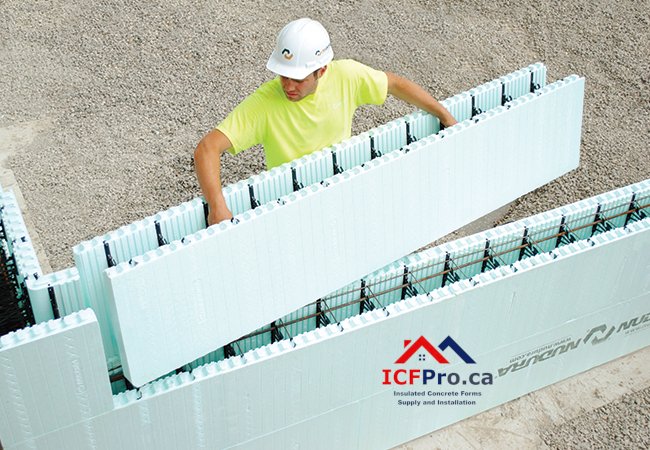
An ICF block looks like a giant rigid foam block with a hollow centre. The two foam panels are held together at a fixed distance by plastic connectors. Crews stack these blocks like building a wall — one course at a time — with reinforcing steel placed in the cavity. Then concrete is pumped into the hollow centre. The concrete fills the cavity and cures into a solid reinforced concrete wall. The foam stays in place permanently as the wall’s insulation.
From the outside, finished ICF homes look identical to wood frame — the same brick, stone, stucco, vinyl, or siding goes on the exterior. The difference is all on the inside of the wall.
The key idea: ICF doesn’t replace one wall component — it replaces the entire multi-trade approach to wall construction with a single integrated assembly. That’s why it performs better than wood frame: there’s no thermal bridging through studs, no separate vapour barrier to install poorly, no air sealing gaps at trade transitions. It’s all built into the wall itself.
Why ICF Matters for Your Home
For homeowners, ICF translates to a list of measurable practical benefits over the home’s service life. Not marketing claims — documented Ontario field data:
Lower heating bills25-40% reduction vs comparable wood frame. On a typical 1,800-2,400 sq ft Ontario home: $500-$1,000/year saved.
Dramatically quieterSTC 50-55 sound rating vs STC 33-38 wood frame. Highway noise, neighbours, weather all attenuated significantly.
4-hour fire ratingASTM E119 tested. Among the most fire-resistant residential walls available. Important for wildfire-exposed cottage country sites.
Insurance discount5-15% off the dwelling portion. On a $1M home, that’s $125-$375/year — $4,500-$18,000 over 30 years.
Lower maintenanceNo settling repairs, no wood rot, no pest control, no insulation degradation. $10,500-$33,000 less over 30 years vs wood frame.
100+ year service lifeReinforced concrete + EPS foam don’t rot, settle, or degrade. Compare to 60-80 year typical wood frame.
Comfort & stable temperaturesThermal mass + continuous insulation = even temperatures, no cold corners, no drafts at outlets or window edges.
Better indoor air qualityTighter envelope means controlled ventilation via HRV/ERV per 2024 OBC. Less pollen, dust, and outdoor pollutants infiltrating.
Resale premium$5,000-$15,000 premium on premium homes ($700K+) in informed Ontario markets. Less impact on entry-level homes.
Not every benefit applies equally to every project. Some homeowners care most about energy savings; others about fire resistance for cottage country sites; others about sound for highway-exposed properties. Our complete benefits page covers each in depth.
How It Differs from Wood Frame
The differences that matter most to homeowners, side by side:
| What you notice | ICF Home | Wood Frame Home |
|---|---|---|
| Heating bills | 25-40% lower | baseline |
| Interior sound | Very quiet (STC 50-55) | Normal sound (STC 33-38) |
| Drafts at outlets, window edges, baseboards | None — airtight envelope (1.0-1.26 ACH50) | Common, especially in winter |
| Cold corners and floor edges | None — continuous insulation | Common from thermal bridging through studs |
| Settling cracks, sticking doors after a few years | None — concrete doesn’t settle | Normal as wood frame settles |
| Fire safety | 4-hour ASTM E119 rating | 1-hour typical with drywall |
| Pest concerns (mice, carpenter ants) | Minimal — no wood structure to attack | Normal residential concern |
| Renovation flexibility | Interior partitions easy; structural perimeter walls harder ($80-$150/linear ft of saw work) | All wood frame — flexible modifications |
| Service life | 100+ years | 60-80 years typical Ontario |
| Total construction cost | 3-8% higher | baseline |
The differences you’ll notice most as a homeowner: dramatically quieter interior, no drafts, even temperatures, lower utility bills, no settling issues. The difference you’ll notice most at sale: $5,000-$15,000 resale premium on premium homes in informed Ontario markets.
What It Really Costs in Ontario 2026
The honest cost picture for Ontario homeowners considering ICF for their custom build:
| Cost category | ICF Range | Wood Frame Range | ICF Premium |
|---|---|---|---|
| ICF wall material installed (foundation) | $42-$55/sq ft | $25-$35/sq ft (wood frame foundation walls less applicable) | n/a (different system) |
| Full custom Ontario build (2,000 sq ft) | $340-$615/sq ft | $325-$575/sq ft | +3 to +8% |
| Total cost premium ($700K wood frame baseline) | $719K-$756K | $700K | +$19K-$56K |
| Total cost premium ($1.2M wood frame baseline) | $1.24M-$1.30M | $1.2M | +$36K-$96K |
The 3-8% range, not 3-5% as sometimes claimed and not 10-15% as critics suggest, is the honest Ontario 2026 picture. Wall material costs more, but ICF eliminates separate insulation install, vapour barrier labour, and other costs — the net premium typically lands at 3-8% on full custom builds.
How quickly does the premium recover?
Real Ontario 2026 payback math for a long-term owner:
| What you count | Annual savings | Years to recover $40K premium |
|---|---|---|
| Energy savings only | $500-$1,000/year | 40-80 years (slow) |
| Energy + insurance discount | $650-$1,450/year | 28-62 years |
| Energy + insurance + maintenance differential | $1,150-$2,450/year | 16-35 years |
| Full stack including resale premium on premium homes | Effective 15-30 years recovery | 15-30 years |
Owner-occupied custom homes with 15+ year horizons typically recover the premium clearly via combined benefits. Short-hold spec builds (3-5 year sale) may not recover on operating savings alone but might via resale premium. See our complete cost analysis and is ICF worth it decision pillar for deeper analysis.
What It’s Like to Live in an ICF Home
Owner feedback consistently identifies five things that stand out within the first few months of moving in:
1. The quiet
This is usually the first thing owners notice. ICF homes are genuinely much quieter inside than wood frame. Highway traffic that you’d hear constantly in a wood frame home is barely perceptible. Neighbour activity, weather noise (rain, wind), all dramatically attenuated. The STC 50-55 wall rating is the technical reason — in plain terms, it’s a meaningful daily difference.
2. The even temperatures
No cold bathroom floors. No cold corners. No drafts at electrical outlets. Room-to-room temperature variation typically less than 2°C. The combination of continuous insulation, thermal mass, and airtight envelope produces remarkably stable interior conditions throughout the day and across rooms.
3. The lower utility bills
You’ll see it on the first full year of heating bills. $500-$1,000/year less than a comparable wood frame home, depending on size and climate zone. Higher savings in Northern Ontario (zone 7) due to longer heating seasons.
4. The indoor air quality
Combined with proper HRV/ERV ventilation (required per 2024 OBC for all new homes), ICF homes have noticeably cleaner indoor air. Pollen, dust, and outdoor pollutants don’t infiltrate the way they do in leakier wood frame homes. Particularly valuable for residents with allergies or asthma.
5. The absence of settling issues
You won’t see hairline drywall cracks at corners appearing after the first year. No doors sticking in spring. No nail pops in ceilings. No baseboards gapping in winter. These are normal wood frame phenomena that don’t happen in ICF homes because the concrete walls don’t settle or shrink.
Common Homeowner Concerns (Honest Answers)
"Is ICF too expensive?"
The premium is real (3-8% on full custom Ontario builds) but smaller than commonly assumed. On a $700K build, that’s $19K-$50K. For owners with 15+ year horizons, the premium typically recovers through combined operating savings within 15-30 years. For 3-5 year spec builds, the math is harder.
"Can I still get the architectural look I want?"
Yes for almost all architectural styles. ICF works for Cape Cod, modern, traditional, contemporary, craftsman, Mediterranean, and most residential designs. Standard 90° corners and 45° corners are routine. Very tight curves or complex angled geometry require workarounds (specialty blocks, on-site cuts, or hybrid construction with wood for curves). All standard Ontario exterior cladding works.
"Won't the walls trap moisture and develop mould?"
No. Concrete and EPS foam don’t support mould growth (no organic substrate). Modern ICF homes use HRV (heat recovery ventilator) or ERV (energy recovery ventilator) per 2024 OBC requirements to handle interior humidity. Indoor air quality is consistently better than typical wood frame homes with no controlled ventilation. The "needs to breathe" criticism is a 1970s misunderstanding of building science.
"What happens if I want to renovate in 10 years?"
Interior renovations are easy — interior partition walls in an ICF home are still wood frame and modify normally. Changes to the structural ICF perimeter walls (or any ICF interior load-bearing walls) require concrete saw work ($80-$150 per linear foot of cut; $1,500-$4,000 to add a new window or door). For owners who like to renovate frequently, this is a real cost. For owners who plan to keep the floor plan as designed, it’s mostly theoretical.
"Can my regular contractor build an ICF home?"
Not always. ICF requires installer experience that not every wood-frame builder has. Look for contractors with certification from major brands (NUDURA Trained Installer Network, AMVIC Installer Card, ELEMENT ICF training programs) and a documented project history. The pool of experienced Ontario ICF installers is smaller than general construction but growing. Hiring an inexperienced ICF crew is one of the few ways to actually have problems with ICF construction.
"What about the carbon footprint of concrete?"
It’s a fair concern. Concrete production has embodied carbon (cement manufacturing produces ~7% of global CO2 emissions). However, ICF’s lower operating energy consumption (25-40% reduction vs wood frame) typically offsets the embodied carbon premium within 5-15 years. The 100+ year service life means the carbon investment amortizes over a much longer period than typical wood frame (60-80 years). Lifecycle assessments generally favour ICF for long-term owners.
"Does ICF affect my home insurance?"
Yes — favourably. Most Ontario insurers offer concrete construction discounts on the dwelling portion of homeowner’s insurance, typically 5-15%. On a $1,000,000 home with $2,500 annual premium, that’s $125-$375/year saved — $4,500-$18,000 over a 30-year ownership. Get the discount in writing from your specific insurer before assuming it applies.
Is ICF Right for You? A Decision Framework
A practical framework matching project characteristics to whether ICF makes sense:
| Your situation | ICF fit |
|---|---|
| Building a forever home (20+ year horizon) | Strong fit. Premium recovers via operating savings + comfort + lower maintenance. |
| Building in cold climate zone 6 or 7 (Central/Northern Ontario) | Strong fit. Energy savings have largest dollar value where heating costs are highest. |
| Building near highway, busy road, or in dense neighbourhood | Strong fit. STC 50-55 vs STC 33-38 is a meaningful daily difference. |
| Building in cottage country or wildfire-prone area | Strong fit. 4-hour fire rating and documented wildfire survival matter. |
| Building multi-unit residential (townhouse, semi, low-rise) | Strong fit. OBC STC 50 demising walls inherent; fire separation easy. |
| Building a premium custom home ($700K+) in informed market | Strong fit. Capture $5K-$15K resale premium plus all operating benefits. |
| Building speculative for 3-5 year sale | Weak fit. Premium needs longer horizon to recover via operating savings. |
| Building heavily curved architectural design | Weak fit. Curves require workarounds; cost premium amplified. |
| Planning frequent floor plan changes | Weak fit. Wall renovations cost more in ICF. |
| Building in a market without experienced ICF contractors | Weak fit. Hire experienced crews or stick with wood frame. |
Most Ontario custom home builds fall in the "strong fit" categories. That’s why ICF has grown steadily across Simcoe County, Georgian Bay, and the GTA over the past two decades. For complete decision analysis, see Is ICF Worth It in 2026?
Myth-Busting: Claims That Get Inflated
Myth: "ICF homes save 40-60% on heating"
Reality: Real Ontario like-for-like savings vs wood frame are 25-40%, not 40-60%. The 40-60% figure assumes a comparison baseline (poorly-built wood frame with old HVAC) that isn’t representative of code-compliant 2026 builds. Dollar savings: $500-$1,000/year on typical 1,800-2,400 sq ft Ontario home.
Myth: "ICF homes are R-22+ vs wood frame R-13"
Reality: The R-13 figure is outdated. Modern OBC requires R-22 nominal in wood frame walls. The accurate comparison: ICF R-22 to R-25 effective (continuous insulation, no thermal bridging) vs wood frame R-15 to R-17 real-world effective (R-22 nominal with thermal bridging losses through studs). The ICF advantage is real but smaller than the inflated comparison suggests.
Myth: "ICF withstands 250+ mph winds"
Reality: Lab data is real but irrelevant for Ontario. Ontario design wind under SB-1 is 80-110 km/h sustained (55-70 mph). Properly-built wood frame handles design wind too. The 250 mph testing is impressive engineering data but not a meaningful Ontario decision factor.
Myth: "ICF cost premium is only 3-5%"
Reality: The honest 2026 Ontario number is 3-8%, not 3-5%. The lower end applies to foundation-only ICF (basement walls); the higher end applies to full above-grade ICF with premium upgrades. Most full custom builds land at 5-7% premium.
Myth: "ICF cuts insurance by 15-25%"
Reality: Real Ontario discount is 5-15% on the dwelling portion of homeowner’s insurance, depending on insurer and home value. Smaller than the 15-25% sometimes claimed but real money over 30+ year ownership.
Myth: "ICF homes resell for 5-15% more"
Reality: Realistic resale premium is $5,000-$15,000 (dollar amount, not percentage) on premium Ontario homes ($700K+) in markets that understand ICF. On entry-level homes or rural markets without ICF awareness, the premium is smaller or absent.
Related ICFpro deep dives
Once you understand what ICF is, the next questions are usually about specific topics. Each has its own reference page.
★ Process
How ICF Construction Works: 6 Steps →
★ Benefits10 Benefits of ICF Construction →
★ DecisionIs ICF Worth It in 2026? →
CostICF Cost Per Sq Ft Ontario 2026 →
At-a-glanceICF Pros and Cons Summary →
ComparisonICF vs. Traditional Construction →
EnergyICF Energy Efficiency →
FireICF Fire Resistance Deep Dive →
SoundICF Soundproofing STC 50-55 →
DurabilityICF Durability & Resilience →
ComfortICF Health & Comfort →
SustainabilitySustainability with ICF →
LongevityICF Home Longevity 100+ Years →
ReferenceICF Blocks: All Types & Variants →
BrandAll 8 Ontario ICF Brands Compared →
CodeICF & the 2024 Ontario Building Code →
LimitationsICF Design Challenges Honest →
FAQ25 ICF Questions Answered →
Considering ICF for Your Ontario Build? Let’s Talk Honestly.
We’ve been pouring ICF in Ontario for 30 years (since 1995) — 300+ projects across Simcoe County, Georgian Bay, Tiny Township, and beyond. Certified ICF Builder, Green Builder, Tarion-approved, 7-year warranty. We’ll tell you honestly whether ICF fits your specific project, what brand suits your conditions best, and what the real numbers look like for your build. No-cost initial conversation, plan review, and ballpark quote.
FAQ: What is ICF Construction
What does ICF stand for and what is it?
ICF stands for Insulated Concrete Form. It’s a wall system that combines reinforced concrete with permanent EPS foam insulation in one integrated assembly. Hollow foam blocks are stacked to form the wall shape; reinforcing steel is placed inside; concrete is poured into the cavity. The foam stays in place permanently as the wall’s insulation.
How much more does ICF cost than wood frame?
Real Ontario 2026 numbers: ICF adds 3-8% to total custom home cost. On a $700,000 build, that’s $19,000-$50,000 premium. On a $1,200,000 build, $36,000-$96,000. Wall material is more expensive but ICF eliminates separate insulation install, vapour barrier labour, and other costs.
How much can I save on energy bills with ICF?
Real Ontario like-for-like savings vs wood frame: 25-40% on heating energy. Dollar savings on a typical 1,800-2,400 sq ft Ontario home: $500-$1,000/year. Higher in Northern Ontario (climate zone 7) due to longer heating seasons.
What does the inside of an ICF wall look like?
From the inside, after drywall is installed, the wall looks identical to wood frame — standard drywall finish, paint, trim. Drywall fastens to polypropylene web ties embedded in the foam at 8″ on-centre.
Will my heating system be different in an ICF home?
You may be able to specify smaller HVAC equipment because the home has lower heating load. Modern ICF homes work well with air-source heat pumps and geothermal heat pumps. 2026 Ontario Home Renovation Savings Program provides up to $7,500 for air-source heat pumps and $12,000 for geothermal.
Can I get a mortgage on an ICF home?
Yes — standard Ontario mortgage processes apply. Lenders treat ICF homes as standard concrete construction. Some lenders offer "green mortgage" programs. Appraisers in informed markets typically value ICF homes at $5,000-$15,000 above comparable wood frame for premium homes.
Do I need a special architect or builder for ICF?
Not a special architect — most Ontario residential architects can design for ICF construction. For the builder, yes — you need an experienced ICF contractor. Look for brand certifications (NUDURA Trained Installer, AMVIC Installer Card, ELEMENT ICF training graduates).
How long does ICF construction take vs wood frame?
Roughly comparable for foundation walls. A typical Ontario residential basement (1,800-2,400 sq ft footprint, 8 ft walls) is stacked, braced, and poured in 1-2 weeks. Cold-weather construction adds 1-2 weeks for proper curing protocols.
Can I have a basement in an ICF home?
Yes — ICF works particularly well for basements. Many Ontario homeowners choose foundation-only ICF as a hybrid approach: ICF for the basement plus conventional wood frame above-grade.
Is ICF a good investment for my future?
For long-term owners (15+ year horizon): typically yes. Operating cost savings combined with $5,000-$15,000 resale premium on premium homes recovers the 3-8% cost premium over 15-30 years.