ICFPro.ca is a division of ICFhome Ontario - Direct Line 1 705 533-1633 - Email: info@icfpro.ca


ICFpro.ca · Homeowner Decision Reference
ICF Basement 2026: Ontario Cost, Performance, and Build Reality
If you’re building new in Ontario and weighing an ICF basement vs poured concrete, this guide gives you the homeowner’s decision framework: what you actually pay for, what you actually get, where ICF earns the premium, and where poured concrete still makes sense. Real Ontario numbers from 30 years of pouring ICF since 1995 across 300+ projects, with the locked facts behind every claim and no inflated marketing stats.
$42-55/sq ft basement wall
25-40% energy savings
2024 OBC compliant
Ontario-specific
ICF basement in 30 seconds
An ICF basement in Ontario costs about $42-55/sq ft of wall area (vs $28-38 for a poured wall framed and insulated to code), delivers R-22 to R-25 effective insulation built into the wall, 1.0-1.26 ACH50 airtightness, STC 52-55 sound isolation, 4-hour fire rating per ASTM E119, and 100+ year service life. The premium pays back through energy savings ($300-700/year vs a code-built poured basement), insurance discounts (5-15%), and resale value ($5-15K on premium homes). For finished basement space — family rooms, suites, home offices — ICF makes obvious sense. For unfinished utility basements you don’t plan to use, poured concrete may be the more rational choice.
- Cost premium: Roughly $7-15/sq ft of wall over a poured wall that has been framed and insulated to code. Against bare poured concrete the gap looks bigger, but bare concrete is not a finished basement wall.
- Performance baseline: R-22 to R-25 effective vs R-0 for bare poured concrete (or R-15 if interior framing + batt insulation added separately).
- Build timeline: 2-3 weeks for an ICF basement vs 1-2 weeks for poured concrete on typical 2,000-3,000 sq ft custom home. Roughly 1 week longer overall.
- Best fit: Owners who plan to use the basement as finished living space, want lower utility bills long-term, or have moisture-sensitive considerations (wine storage, home gym, music studio).
$42-55
Per sq ft basement wall ICF supplied and installed Ontario 2026
R-22-25
Effective insulation value built into the wall, no framing required
25-40%
Heating energy savings vs comparable wood-frame or uninsulated concrete
100+ yrs
Service life with proper waterproofing and drainage
What an ICF Basement Actually Is
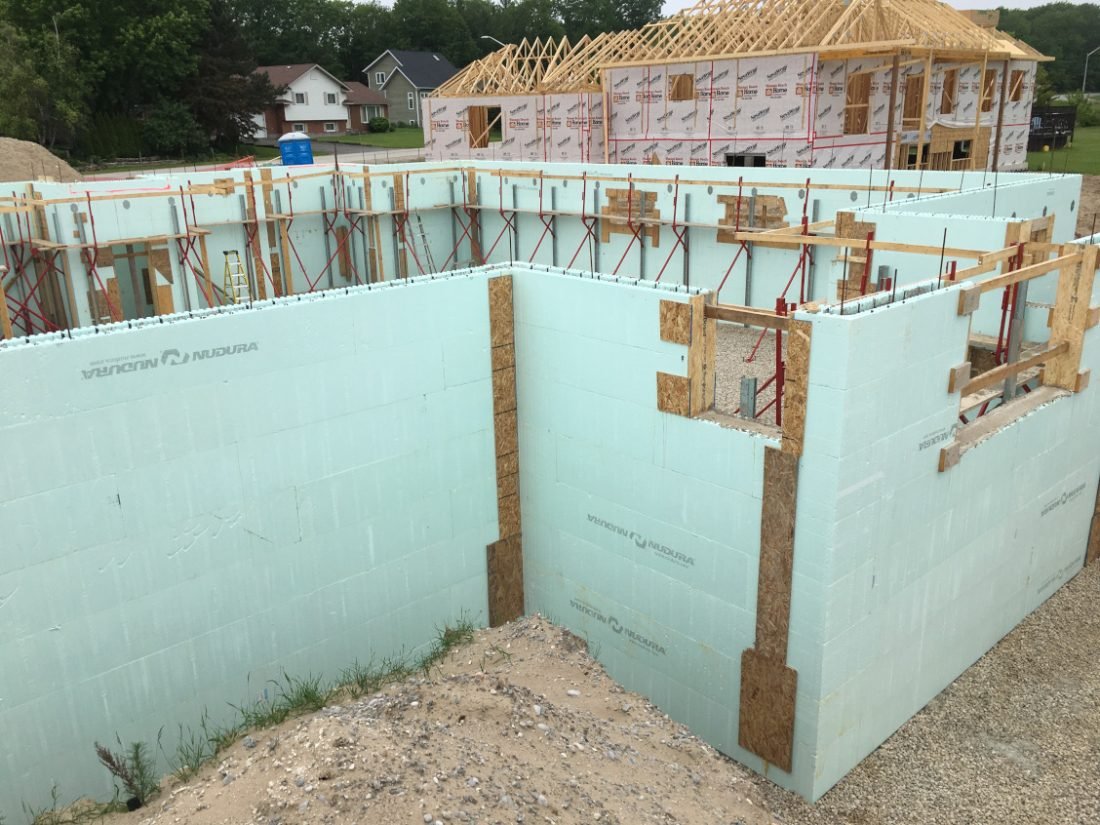
An ICF (Insulated Concrete Form) basement is a foundation wall system built by stacking hollow EPS foam blocks, reinforcing them with rebar inside the cavity, and filling the cavity with structural concrete. When the concrete cures, you’re left with a permanent concrete wall with EPS insulation panels permanently bonded to both faces. The foam isn’t removed after the pour like conventional formwork — it stays in place as the insulation layer for the wall’s entire life.
For a typical Ontario residential basement, the wall is built using 8″ core ICF blocks: 64mm (2.5″) of EPS foam on each side, with a 200mm (8″) concrete core in the middle, giving a finished wall thickness of about 330mm (13″) before any interior or exterior finishes. Reinforced with 10M and 15M rebar per CSA G30.18 Grade 400W, filled with 25-30 MPa concrete per CSA A23.1, and waterproofed on the below-grade exterior face before backfill.
What this means in practical terms for the homeowner:
- The insulation is built into the wall — you don’t need to frame interior walls, install batt insulation, and add a vapour barrier as a separate step. You can drywall directly to the integrated furring strips inside the foam.
- The concrete is structural — it holds back the soil pressure outside the basement, supports the floor system above, and provides the thermal mass that helps stabilize basement temperatures.
- The foam is permanent — it’s closed-cell EPS that doesn’t absorb water, doesn’t support mould growth, and doesn’t off-gas. Its R-value stays consistent for the wall’s service life.
ICF Basement vs Poured Concrete
The honest comparison most Ontario homeowners want: what do you actually get for the ICF premium? Here’s the head-to-head across the criteria that matter:
Criterion 1
Insulation value
ICF
R-22 to R-25 effective built into the wall. Foam on both sides means no thermal bridging, continuous insulation, no batt-installation errors.
Poured concrete
R-0 bare. Adding R-15 with interior 2x4 framing + batt insulation requires a separate trade, separate timeline, and inferior performance (thermal bridges at studs).
Criterion 2
Airtightness
ICF
1.0-1.26 ACH50 (RDH Building Science measured across 49 ICF homes). Foam-to-foam joints are sealed, no penetrations through stud cavities, no air leakage paths into living space above.
Poured concrete
Concrete itself is airtight, but interior framing with batts creates many penetrations and joints — typical wall assemblies test 3-5 ACH50. Junction with floor system above is a common leakage point.
Criterion 3
Sound isolation
ICF
STC 52-55 for 8″ core. Concrete mass plus dual foam layers absorb mid and high frequencies. Significant difference vs typical residential walls.
Poured concrete
STC 50-52 for bare 8″ wall. Adding interior framing with batt and drywall brings it close to ICF performance — but only if the assembly is well-executed without air leaks.
Criterion 4
Moisture and mould
ICF
No organic materials in the wall. EPS doesn’t feed mould or rot. Foam is closed-cell, water-resistant. Provided exterior waterproofing and drainage are correct, the wall stays dry indefinitely.
Poured concrete
Concrete itself is mould-resistant, but interior wood framing with batts is vulnerable if water reaches the cavity. Mould risk on the inside face if vapour drive or condensation occurs. Requires careful detailing.
Criterion 5
Fire resistance
ICF
4-hour fire rating per ASTM E119 with appropriate fire-rated drywall. EPS is fire-retardant treated per CAN/ULC S102. The concrete core is non-combustible.
Poured concrete
4-hour fire rating for the concrete alone. Interior wood framing reduces the assembly rating; drywall thickness and stud spacing become governing factors.
Criterion 6
Build time
ICF
2-3 weeks for typical residential basement from footing to backfill-ready. Insulation, structural wall, and air barrier completed in one operation.
Poured concrete
1-2 weeks for concrete, plus an additional 1-2 weeks if interior framing and insulation are added later as separate steps. Total comparable timeline once finishes are included.
Criterion 7
Cost (Ontario 2026)
ICF
$42-55/sq ft of wall area supplied and installed including insulation. Premium of roughly $7-15/sq ft over a properly insulated poured wall.
Poured concrete
$15-25/sq ft of wall area for the bare concrete wall. Frame, insulate and vapour-control it to the 2024 OBC and you are at $28-38/sq ft — which closes most of the gap.
The real takeaway: compare apples to apples.
Many homeowners look at the raw concrete cost ($15-25/sq ft) and the raw ICF cost ($42-55/sq ft) and conclude ICF is 30-50% more expensive. That’s not the right comparison for a usable basement. A poured concrete wall with no insulation is a code-minimum wall that can’t be finished as living space without adding insulation, vapour barrier, and a frame to attach drywall to.
Once you add those layers to make poured concrete a usable wall, the cost gap narrows significantly — ICF wall comes out about $7-15/sq ft higher, with better thermal performance, fewer trades, and a cleaner air barrier. If you’re going to use the basement, compare ICF vs (poured + interior frame + insulation + drywall), not ICF vs bare concrete.
What an ICF Basement Costs in Ontario 2026
Pricing depends on basement size, wall height, regional labour costs, soil conditions, and whether you’re hiring an ICF specialist crew or asking a generalist to attempt their first build. Realistic Ontario 2026 ranges:
| Basement size | Wall area (typical 2.4m height) | ICF supplied & installed | Poured + insulated to code | ICF premium |
|---|---|---|---|---|
| 1,500 sq ft footprint | ~1,350 sq ft of basement wall | $56,700-$74,300 | $37,800-$51,300 | $9,500-$20,000 |
| 2,000 sq ft footprint | ~1,550 sq ft of basement wall | $65,100-$85,300 | $43,400-$58,900 | $10,900-$23,300 |
| 2,500 sq ft footprint | ~1,750 sq ft of basement wall | $73,500-$96,300 | $49,000-$66,500 | $12,300-$26,300 |
| 3,000 sq ft footprint | ~1,920 sq ft of basement wall | $80,600-$105,600 | $53,800-$73,000 | $13,400-$28,800 |
The numbers above cover the basement wall system only — ICF blocks supplied, rebar, concrete, labour, and waterproofing. They do not include excavation, footings, basement slab, plumbing rough-in, electrical rough-in, interior finishes, windows, or stair systems. Whole-basement build cost including excavation, footings, slab, and all rough-ins typically runs $80,000-$140,000 for a 2,000-3,000 sq ft footprint in Ontario 2026 — ICF or poured.
What pushes ICF basement cost up
- Tall walls (3m+): Standard 8′ basement is most cost-effective. 9′ and 10′ basements add roughly $4-6/sq ft of wall as more blocks per linear metre, more rebar, and more concrete are required.
- Complex geometry: Lots of corners, bay windows, walk-outs, and angled walls slow installation. Add 10-15% over straight rectangular walls.
- Premium ICF brands: NUDURA, AMVIC, and Element ICF sit at the upper end; some Tier 3 brands run 8-15% lower per block but with less Ontario distribution support.
- Specialty applications: Walk-out basements, daylight basements with full windows, or stepped foundations on sloped lots add complexity.
- Snow belt or remote locations: Areas like the Georgian Bay snow belt or Northern Ontario can add 5-10% on labour and delivery costs.
Payback math
For a typical 2,000-2,500 sq ft Ontario custom home with an ICF basement, the wall-system premium of roughly $10,000-$25,000 over a properly insulated poured basement pays back through:
- Energy savings: $300-$700/year compared with a code-built poured basement. On energy alone that is a 20-year-plus payback, so do not buy an ICF basement for the gas bill alone.
- Insurance discount: 5-15% on the home insurance policy with many Ontario insurers, reflecting fire and durability advantages. On a $2,500/year policy, that’s $125-$375/year.
- Resale premium: $5-15K observable on premium homes where the buyer values quality construction. Not a guaranteed return but meaningful for homes targeted at quality-focused buyers.
- Avoided cost: No need to interior-frame, batt-insulate, and drywall the basement walls separately if you ever want to finish them. That avoided cost is roughly $8-14/sq ft of wall — about $20,000 on a typical 1,550 sq ft basement wall.
Thermal Performance and Energy Savings
An ICF basement’s thermal performance comes from three mechanisms working together:
R-value (steady-state insulation)
The 64mm EPS panel on each face of the wall provides about R-24 nominal. Real-world effective R-22 to R-25 after accounting for thermal bridging through the integrated ties (which is minimal compared to wood-frame thermal bridging through studs) and air films. By comparison: bare poured concrete has effectively R-0 thermal value, and a wood-frame interior wall with R-15 batts in a 2x4 cavity delivers about R-12 effective due to stud thermal bridging.
Thermal mass (concrete buffer)
The 200mm concrete core absorbs heat slowly and releases it slowly. This isn’t a magic energy creator — it doesn’t generate heat — but it does dampen temperature swings in the basement. The space stays cooler in summer and more stable in winter compared to a frame-and-batt wall that responds quickly to outdoor temperature changes. For a finished basement used as living space, this translates to a noticeably more comfortable room.
Airtightness (no draughts)
Whole-home ICF builds test at 1.0-1.26 ACH50 per RDH Building Science measurements of 49 ICF homes. The basement contribution is critical because basements are the typical air-leakage zone in wood-frame homes — rim joists, foundation-to-frame transitions, and penetrations all leak. With an ICF basement, these leak paths are largely eliminated.
What this translates to in dollars
Heating energy savings of 25-40% vs comparable wood-frame or uninsulated concrete construction are well-documented for ICF homes. In Ontario, that translates to:
- Climate Zone 5 (Southern Ontario): $250-$500/year from the basement walls on a typical 2,000-2,500 sq ft custom home.
- Climate Zone 6 (Central Ontario including Simcoe County, Georgian Bay): $300-$700/year typical.
- Climate Zone 7 (Northern Ontario): $500-$1,000/year — the absolute dollar value of energy savings increases with colder climate.
Moisture, Mould, and Waterproofing
A common concern with traditional basements is moisture — that musty smell, the dehumidifier running constantly, the dampness on the walls in spring. ICF basements largely avoid these issues, but not because the foam is magic. They avoid them because:
- The foam is closed-cell EPS. Per ASTM testing, EPS has very low water absorption and doesn’t support mould growth. It doesn’t rot, doesn’t feed mould, doesn’t soak up basement humidity.
- There’s no organic material in the wall. Wood-frame basement walls have studs, sheathing, and batt insulation that can hold moisture and support mould. ICF walls have foam, concrete, and steel — none of which support mould or rot.
- The waterproofing layer is properly applied. ICF construction in Ontario always includes a below-grade waterproofing membrane on the exterior face plus a dimple drainage board, plus the OBC 9.14 perimeter drainage system.
- The wall is continuously insulated to the outside. Cold concrete on the warm interior side of a wood-frame basement is a condensation surface in summer. ICF’s exterior foam keeps the concrete warmer, reducing summer condensation risk.
Important caveat: The foam itself is not waterproofing — it’s water-resistant. The exterior waterproofing membrane is still required per OBC 9.12, and the perimeter drainage system per OBC 9.14 is still required. ICF doesn’t skip these requirements. For lot grading and waterproofing details, see the ICF lot grading guide.
Sound Isolation and Quiet
For homeowners planning to use the basement as a home theatre, music room, home gym, teenager’s suite, or work-from-home office, sound isolation matters. ICF basement walls deliver STC (Sound Transmission Class) ratings of 50-52 for 6″ core, 52-55 for 8″ core, and 55-60 for 10-12″ core. By comparison, typical wood-frame interior walls test STC 33-38.
What this means in practice: with an ICF basement, conversation at normal volume in the basement is barely audible upstairs, and outdoor noise (traffic, lawn mowers, dogs) is significantly reduced inside the basement. The Ontario Building Code requires STC 50 minimum for sound separation between dwelling units in multi-unit buildings; ICF basements naturally exceed this threshold.
2024 OBC Basement Requirements
The 2024 Ontario Building Code (O. Reg. 163/24, in force January 1, 2025) introduced changes that directly affect basement construction. The good news: standard ICF basements meet or exceed all the new requirements without modification. The relevant updates:
Full-height basement insulation
Previously, basement insulation could stop above grade or partway down the wall in some compliance paths. 2024 OBC SB-12 now requires full-height basement wall insulation for new construction. Wood-frame builds with poured concrete foundations must add interior insulation from slab to ceiling. ICF foundations meet this requirement inherently — the insulation is the wall.
Radon rough-in
All new residential construction with basements requires a radon rough-in: a sealed PVC pipe extending from below the basement slab through to roof level, ready for activation if radon testing later shows elevated levels. This is independent of ICF vs poured choice but is a permit-stage requirement to verify.
Continuous insulation
Above-grade wall compliance paths often require continuous exterior insulation in 2024 OBC. ICF inherently provides continuous insulation by design — foam panels are uninterrupted on both faces of the wall. No additional exterior foam layer needed.
Mechanical ventilation
Tighter envelopes (ICF measures 1.0-1.26 ACH50) require mechanical ventilation per SB-12. The Mechanical Ventilation Design Summary (MVDS) is now required at permit stage. For an ICF home, plan for an HRV or ERV with proper duct distribution including the basement — the basement should be on the ventilation circuit, not isolated.
Frost depth
Footings must extend below frost line per OBC 9.12.2.1 and Supplementary Standard SB-1. For Ontario regions: 1.2m minimum (OBC base), 1.2-1.4m typical for Central Simcoe, 1.4-1.5m for Georgian Bay snow belt, and 1.5-1.8m for Northern Ontario. This is the same for ICF or poured concrete — it’s about the footing, not the wall.
Who an ICF Basement Is Right For
Honest framing — ICF isn’t the right answer for every Ontario homeowner. Here’s where it makes obvious sense and where poured concrete still wins:
ICF makes obvious sense if you...
- Plan to use the basement as finished living space. Family room, in-law suite, home office, gym, theatre. The thermal and sound advantages compound over decades of daily use.
- Want lower utility bills long-term. The $300-$700/year heating savings shows up every winter. Over a 30-year mortgage, that’s $9,000-$21,000 from the basement walls alone, plus a basement that is warm and dry from day one.
- Have moisture-sensitive uses planned. Wine cellar, music studio, home gym, woodworking shop. ICF’s consistent humidity and no-organic-material wall make these uses much easier.
- Are building in a colder climate zone. Zone 6 (Central Ontario) and Zone 7 (Northern Ontario) see larger absolute dollar savings from ICF’s thermal performance.
- Value quality construction over lowest first cost. The premium pays back, but slowly. If you’re going to live in the home long-term, the math works.
- Are doing whole-home ICF. The crew is already onsite, the build process is set up for it, and economies of scale apply.
Poured concrete may still make sense if you...
- Are building tight to budget. The $10,000-$25,000 wall-system premium is real money that competes with kitchen, flooring, or windows allocation.
- Don’t plan to use the basement as finished space. Mechanical room and storage only? Poured concrete handles that just fine. The thermal premium is wasted on unused space.
- Are flipping the home or building spec inventory. ICF’s resale value is real but slow to manifest. Spec builders aiming for fastest sale at market price may not capture the premium.
- Have specific local constraints. Some lots, soil conditions, or neighbourhood expectations make poured concrete more practical. A qualified local builder can advise.
Our honest position: ICF basements are not for everyone.
We’ve built 300+ ICF homes since 1995 because we believe in the system — but we don’t believe it’s a universal answer. If you’re building to occupy long-term and want to use your basement, ICF is the right call. If you’re building tight to budget for a basement that’ll just hold the furnace, poured concrete is the rational choice. We’d rather you build the right wall for your situation than buy a premium product you won’t benefit from.
Related ICFpro deep dives
More references on ICF foundations, basement specifics, costs, and Ontario considerations.
★ Technical
ICF Forms for Basements →
★ FoundationICF Foundation Complete Guide →
★ CostICF Cost Per Sq Ft Ontario 2026 →
DecisionIs ICF Worth It in 2026? →
DrainageICF Lot Grading Ontario →
CodeICF & 2024 Ontario Building Code →
PermitsPermits for ICF Construction →
ThermalICF Thermal Insulation Deep Dive →
SoundSoundproofing with ICF →
CompareICF vs Traditional Construction →
CompareICF Foundation Cost vs Poured →
ServiceICF Foundation Contractor Ontario →
BrandAll 8 Ontario ICF Brands Compared →
ServiceICF Foundations, Pools & Structures →
InstallICF Installation Methodology →
LocalICF Construction in Tiny Township →
LocalICF Construction in Collingwood →
DurabilityDurability and Resilience of ICF →
Thinking About an ICF Basement? We’ll Give You a Straight Answer.
30 years of Ontario ICF foundation work since 1995, across 300+ projects from Tiny Township to Toronto. Send us your floor plans, lot survey, or just a rough idea of what you’re building — we’ll tell you honestly whether ICF makes sense for your project, what it’ll cost, and how it stacks up against poured concrete for your specific situation. Certified ICF Builder, Certified Green Builder and Tarion-approved. 7-year materials and workmanship warranty. Based in Simcoe County, serving Georgian Bay and beyond.
Free 30-second estimate
What Will My ICF Walls Cost?
Punch in rough sizes. You get a real 2026 Ontario range for installed ICF walls, plus what conventional walls would cost for the same job. No phone call, no sales pitch.
Your estimate
Fill in the boxes and hit Show My Estimate. Rough numbers are fine. A tape measure off the drawings is plenty.
Installed ICF walls
-
- Wall area-
- Conventional walls, same job-
- Real ICF premium-
Turn this into a full line-by-line budget: the ICF Build Budget Guide ($29.99) →
Email Me This Estimate
Keep a copy for the bank, your spouse or your designer. I'll send it once, with the numbers and what they include.
FAQ: ICF Basements
How much does an ICF basement cost in Ontario 2026?
$42-55/sq ft of wall area supplied and installed, including insulation. For a typical 2,000 sq ft footprint with ~1,550 sq ft of basement wall at 8′ height, that’s $65,000-$85,000 for the wall system alone — about $11,000-$23,000 more than a poured wall framed and insulated to code. Whole-basement build (excavation, footings, slab, walls, rough-ins) typically $80,000-$140,000 for ICF or poured for a 2,000-3,000 sq ft footprint in Ontario 2026.
Is an ICF basement worth the extra cost over poured concrete?
Depends on how you’ll use the basement. If you plan to finish it as living space (family room, suite, gym, theatre, office), ICF makes obvious sense — you get insulation, air sealing, sound isolation, and a finished interior surface in one wall system, vs needing to add interior framing + batts + drywall separately to poured concrete. If the basement will just hold the furnace and storage, the ICF premium may not be justified.
What R-value does an ICF basement have?
R-22 to R-25 effective for standard 8″ core ICF blocks with 64mm EPS on each face. By comparison: bare poured concrete has effectively R-0, and a wood-frame interior wall with R-15 batts in 2x4 cavity delivers about R-12 effective due to stud thermal bridging. ICF inherently meets and exceeds 2024 OBC SB-12 full-height basement insulation requirement without any additional layers.
How long does it take to build an ICF basement?
2-3 weeks for typical residential from footing to backfill-ready, depending on basement size and crew experience. Poured concrete is 1-2 weeks for the wall itself, but add 1-2 weeks if you’re framing and insulating the interior separately. Total build timeline is comparable once finishes are included. ICF doesn’t add 6+ weeks to your project — that’s a myth.
Are ICF basements actually dry?
Yes — provided exterior waterproofing and drainage are done correctly. ICF foam itself is closed-cell EPS that resists water absorption and doesn’t support mould growth. There’s no organic material in the wall to feed mould or rot. But the foam is water-resistant, NOT waterproof — the exterior waterproofing membrane required by OBC 9.12 is still essential, as is the perimeter drainage system per OBC 9.14.
What about radon in an ICF basement?
2024 Ontario Building Code requires a radon rough-in for all new residential construction with basements — a sealed PVC pipe extending from below the basement slab through to roof level, ready for activation if radon testing later shows elevated levels. This requirement applies equally to ICF and poured concrete. ICF’s tight envelope is sometimes raised as a concern, but with the radon rough-in and proper ventilation per the Mechanical Ventilation Design Summary (MVDS), radon is well-managed.
Can I finish an ICF basement easily?
Yes — easier than poured concrete. ICF blocks include integrated furring strips (usually plastic or steel) at regular spacing inside the foam, designed for drywall attachment. You drywall directly to the wall without needing to frame interior 2x4 walls first. Electrical and plumbing can be run in chases cut into the interior foam face (with code-compliant detailing). The wall is already insulated and air-sealed when delivered.
How quiet is an ICF basement?
STC 52-55 for standard 8″ core walls, vs STC 33-38 for typical wood-frame interior walls. In practice: conversation in the basement is barely audible upstairs, outdoor noise is significantly reduced inside, and the basement works well for home theatre, music room, home gym, or work-from-home spaces. For dedicated music or home theatre rooms, 10″ or 12″ core blocks push STC to 55-60 with no additional acoustic treatment.
What about insurance and resale value?
Insurance discount of 5-15% available from many Ontario insurers for ICF construction, reflecting fire (4-hour ASTM E119 rating) and durability advantages. On a $2,500/year home policy, that’s $125-$375/year savings. Resale premium of $5-15K observable on premium homes where buyers value quality construction — not a guaranteed return, but meaningful for homes targeting quality-focused buyers. Both effects compound over decades of ownership.
Is ICF basement construction common in Ontario?
Yes — ICF has been a recognized residential construction method under the Ontario Building Code since the 1990s. Major Ontario centres (Toronto, Mississauga, Brampton, Ottawa, Hamilton) see ICF basement permits routinely. In Simcoe County and the Georgian Bay area, ICF is common for custom homes and increasingly used in production homes. The 2024 OBC’s full-height basement insulation requirement is accelerating the shift.