ICFPro.ca is a division of ICFhome Ontario - Direct Line 1 705 533-1633 - Email: info@icfpro.ca

From Basics to Brilliance: How to Build with Insulated Concrete Forms Made Easy

ICFpro.ca · ICF Build Process for Homeowners
Building with Insulated Concrete Forms 2026: Plain English Ontario Guide
Thinking about building with ICF (Insulated Concrete Forms) in Ontario? This is the homeowner-friendly walkthrough of what the process actually looks like, what each stage involves, what the real performance numbers are, and what to expect when you sign on. Written from 30 years of pouring ICF in Ontario (since 1995, 300+ projects) — in plain English with no marketing inflation.
Plain English process
Real performance numbers
2024 OBC compliant
Ontario homeowner perspective
Building with ICF in 30 seconds
Foam blocks stack like oversized building blocks to form wall cavities, then get filled with concrete and rebar. The result is a reinforced concrete wall with foam insulation permanently bonded on both sides. The blocks become the formwork (which stays in place) and provide R-22 to R-25 effective insulation. The whole thing is mature technology that’s been refined since the 1980s — not revolutionary, just well-engineered.
- Stages: Site prep → footings → stack blocks → reinforce with rebar → brace and align walls → pour concrete → cure → continue with conventional construction (floors, roof, finishes).
- Real performance: 25-40% heating energy savings vs comparable wood frame, STC 50-55 sound rating (8" core), 4-hour ASTM E119 fire resistance, 1.0-1.26 ACH50 airtightness verified by RDH Labs.
- Cost: 3-7% premium on wall portion of build, 3-8% on full custom home. For 2026 Ontario custom builds: $325-$600+/sq ft depending on tier.
- Timeline: Above-grade ICF walls take 4-6 weeks plus pour cure. Total ICF construction is similar to wood frame (not faster, not significantly slower) once you factor in the trades that follow.
25-40%
Real heating energy savings vs wood frame
R-22 to R-25
Effective wall R-value for standard 8" core blocks
STC 50-55
Sound rating with 8" concrete core
4-hour
Fire rating per ASTM E119
What ICF Actually Is
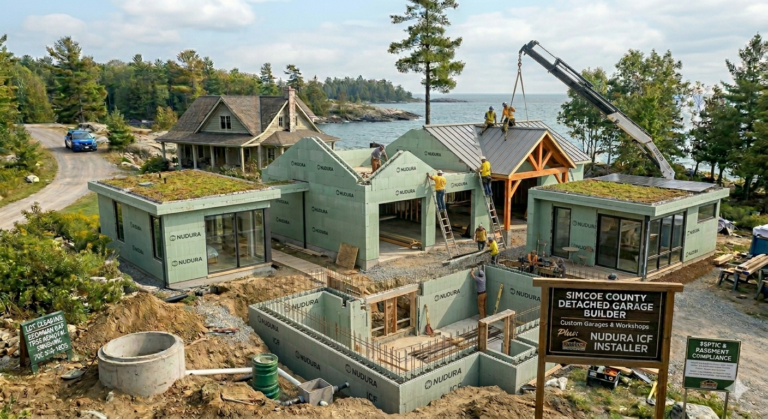
An Insulated Concrete Form is a hollow modular block made primarily of expanded polystyrene (EPS) foam. The blocks stack to form the outline of a wall. Once stacked and braced, the hollow centre is filled with reinforced concrete. After the concrete cures, the foam blocks stay in place permanently, providing insulation on both sides of the structural concrete core.
So when finished, an ICF wall is three layers:
- Outer foam layer (2.5-3 inches typical) — provides exterior-side insulation and serves as a substrate for siding, brick, or stucco.
- Reinforced concrete core (4, 6, 8, 10, or 12 inches typical) — the structural element, with rebar reinforcement to resist tension and seismic forces.
- Inner foam layer (2.5-3 inches typical) — provides interior-side insulation and accepts drywall via integrated fastening strips.
Total wall thickness: typically 11.5 to 14 inches finished, depending on concrete core thickness. Compare to wood frame at 6-8 inches total. The thicker wall costs you 1-3% of floor space in exchange for the performance characteristics. For deeper technical detail see our ICF blocks reference and ICF wall systems primer.
The Honest Cost Picture
Most ICF cost articles either understate the premium (selling the technology) or overstate it (selling alternatives). The honest 2026 Ontario numbers:
| Cost element | ICF | Wood frame | Difference |
|---|---|---|---|
| Wall portion of build | $42-$55/sq ft (basement) / $40-$50/sq ft (above-grade) | $28-$38/sq ft | +30-50% on walls alone |
| Full custom home (per sq ft) | $340-$640/sq ft 2026 Ontario | $325-$600/sq ft 2026 Ontario | +3-8% full build |
| 2024 OBC compliance work | Inherent — no upgrade needed | $4K-$12K upgrades (continuous exterior insulation, advanced air sealing) | ICF saves $4K-$12K here |
| HVAC equipment sizing | Smaller equipment (lower heating load) | Larger equipment | ICF saves $2K-$5K |
| Annual operating cost | $1,400-$1,800/yr typical Ontario home | $2,000-$2,800/yr typical Ontario home | ICF saves $600-$1,000/yr |
The honest break-even math: ICF’s ~$15K-$40K premium on a typical custom home pays back in 12-20 years from energy savings alone, or 7-12 years when factoring in lower HVAC equipment cost, lower insurance premiums (5-15% discount typical), and avoided wood-frame OBC upgrade costs. After break-even, savings continue for the structure’s 100+ year service life — vs 60-80 years typical for wood frame.
Detailed cost breakdown: ICF cost analysis per square foot Ontario 2026. For the underlying value calculation: is ICF worth it in 2026?
Real Energy Performance Numbers
ICF energy claims range from realistic to absurd. Some marketing literature claims "up to 50%" or "60%+ savings" — these are inflated. The honest numbers from third-party testing and ICFpro’s own field observations across 300+ builds:
- Heating energy reduction: 25-40% vs comparable wood frame, like-for-like (same floor area, same windows, same air sealing target). The full 40% applies to the most aggressive comparisons; 25-30% is more typical for everyday builds.
- Cooling energy reduction: 15-25% typical. ICF’s thermal mass helps in summer by buffering daily temperature swings, but most Ontario homes use less cooling than heating energy so the absolute dollar impact is smaller.
- Annual operating cost savings: $600-$1,000/year on typical Ontario homes (1,800-2,400 sq ft), with zone 7 Northern Ontario at the higher end ($1,000-$1,800/year) and zone 5 Southern Ontario at the lower end ($450-$650/year).
- Effective R-value: R-22 to R-25 for standard 8" core blocks (NUDURA, AMVIC). Higher-R variants (NUDURA XR35, R-Value Plus) reach R-35 to R-48 if you specify them.
- Airtightness: 1.0-1.26 ACH50 documented by RDH Building Science in a 49-home study — significantly tighter than wood frame typical 3-5 ACH50.
For deeper analysis: ICF energy efficiency deep dive.
Sound Performance and STC Ratings
Sound performance is one of the genuinely impressive ICF features. The STC (Sound Transmission Class) ratings depend on concrete core thickness:
| Concrete core | STC rating | Real-world meaning |
|---|---|---|
| 6″ core | STC 50-52 | Loud conversation in next room becomes a faint murmur. |
| 8″ core (most common) | STC 52-55 | Highway traffic from across the property becomes barely audible inside. |
| 10-12″ core | STC 55-60 | Multi-unit building separation that exceeds OBC requirements for sound isolation. |
| Wood frame for comparison | STC 33-38 | Normal conversation in next room clearly audible; outdoor traffic noticeable inside. |
2024 OBC requires minimum STC 50 between dwelling units in multi-unit buildings. ICF inherently meets this; wood frame requires resilient channels, additional drywall layers, or specialty assemblies to achieve the same. For more detail: soundproofing with ICF.
Practical impact: ICF is meaningfully quieter in homes near highways (Hwy 400, Hwy 11 in Central Ontario), busy arterials, lakefront with summer traffic, urban infill sites, or homes with rooms requiring acoustic separation (home offices, recording spaces, theatres).
Wall Thickness and Core Options
ICF wall configurations refer to the concrete core thickness inside the foam blocks. The foam panels are typically 2.5-3 inches thick on each side regardless of core, so total wall thickness scales with core selection:
| Concrete core | Total wall thickness | Typical applications | Notes |
|---|---|---|---|
| 4″ core | ~9-10″ | Non-load-bearing partitions, sound walls, accessory structures | Not typical for primary residential structural walls in Ontario. |
| 6″ core | ~11-12″ | Above-grade walls on single-story homes, smaller structures | Common for ranch-style homes and lighter loading conditions. |
| 8″ core (most common) | ~13-14″ | Most Ontario custom homes: foundation walls and above-grade | The default specification for Ontario residential ICF unless project requirements push higher. |
| 10″ core | ~15-16″ | Multi-story homes, larger structural spans, taller above-grade walls | Common in three-story residential or commercial Part 9 buildings. |
| 12″ core | ~17-18″ | Commercial, multi-family, retaining walls, demanding loads | Specified per structural engineer’s analysis for specific load conditions. |
Why 8″ core dominates Ontario residential (and why you probably want it)
The 8″ concrete core hits the practical sweet spot for Ontario residential: strong enough for typical 2-3 story custom homes, STC 52-55 sound rating, 4-hour ASTM E119 fire resistance, handles snow loads up to ~3.5 kPa (covers all but the most extreme Northern Ontario snow belt sites), and works with standard ICF blocks without specialty engineering. Going thinner (6″) saves $1,500-$3,000 on a typical home but limits future flexibility. Going thicker (10-12″) costs more without meaningful residential benefit unless your structural engineer specifies it.
Fire Resistance and Safety
ICF wall assemblies achieve 4-hour fire resistance per ASTM E119 when properly constructed with code-compliant materials. This is the certified test rating for the wall assembly — not a marketing claim. Compare to:
- Wood frame typical: 1-hour fire rating with standard drywall assembly.
- OBC minimum residential: 45 minutes typical for single-family homes.
- OBC multi-unit/Part 3: 1-2 hours typical between dwelling units.
- ICF: 4 hours per ASTM E119, well above any Ontario residential code requirement.
The EPS foam in ICF blocks is fire-retardant treated and tested per CAN/ULC S102 (surface burning characteristics). When concrete core is properly poured to specifications, the assembly resists structural failure for up to four hours of direct fire exposure. This isn’t fire-proof (no building is) but represents significantly more time for safe evacuation than typical wood frame construction.
Practical implications for your build:
- Rural wildfire-exposed Ontario sites (lakefront cottage country, Tiny Township woodland properties, rural lots adjacent to forest): The 4-hour rating is genuinely meaningful here. Wildfires are increasing in frequency and severity; structural fire resistance matters more than it did a decade ago.
- Multi-unit buildings: ICF inherently meets OBC sound and fire rating requirements between units, eliminating the need for specialty assemblies wood frame requires.
- Insurance discounts typically 5-15% for ICF homes — ask your insurer for their specific discount on certified fire-resistant construction.
For deeper analysis: ICF fire resistance — 4-hour rating explained.
Construction Stages Walkthrough
What happens at each stage of an ICF build, from breaking ground to occupancy — written from the homeowner’s perspective:
1
Site preparation and excavation
Lot clearing, excavation to frost depth (1.2-1.8m in Ontario depending on region), grading, services rough-in (water, sewer, electrical). Takes 1-2 weeks for typical custom home sites; longer for difficult lots or challenging soil. What you’ll see: Heavy equipment, dirt piles, surveyors marking foundations and lot corners.
2
Footings and foundation prep
Concrete footings poured below frost depth to support the foundation walls above. Vertical rebar (called "dowels") set into footings extends up into where the ICF foundation walls will sit. Takes 3-5 days. What you’ll see: Wooden forms for footings, rebar bent into shape, concrete trucks for the footing pour, then a few days of curing.
3
Stack ICF foundation blocks
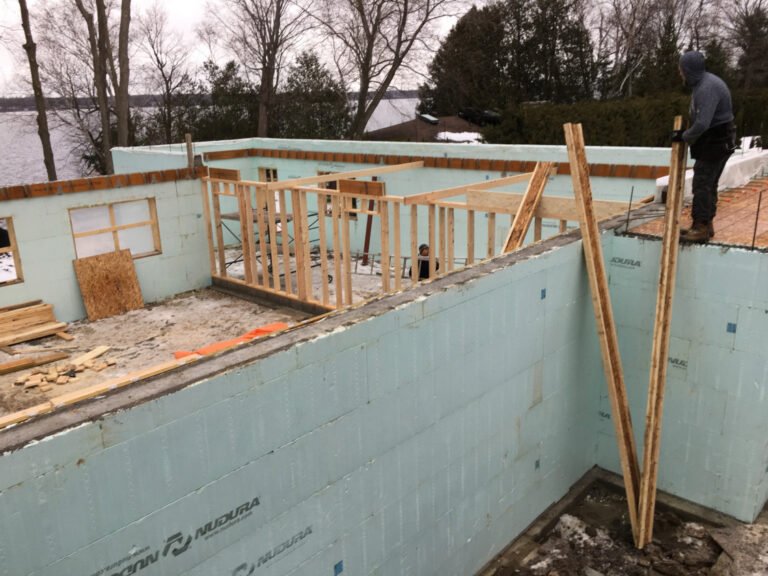
Foam blocks stack onto footings in horizontal courses. Blocks interlock at corners and where walls meet. Vertical rebar from footings runs through alignment slots in blocks; horizontal rebar gets placed at intervals as courses go up. Foundation walls typically stack in 3-5 days depending on home size. What you’ll see: Crews stacking foam blocks like oversized building blocks — the structure visually appears quickly compared to wood frame.
4
Bracing and alignment
Steel or wood bracing systems attached to the outside of the foam walls keep them plumb and aligned during the concrete pour. Window and door bucks (rough openings) get framed in. Service penetrations marked. Takes 1-2 days. What you’ll see: The walls being aligned with laser levels and supported with diagonal bracing — this step is critical to wall straightness and quality.
5
Concrete pour
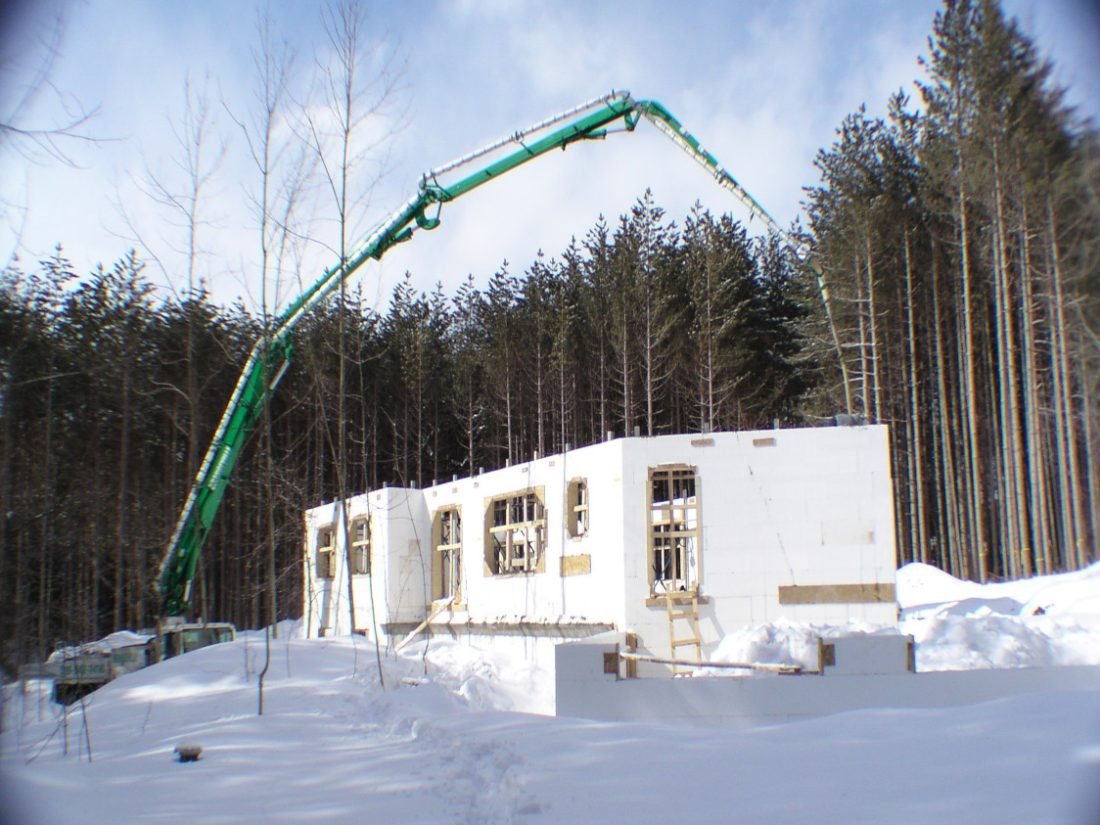
Concrete trucks deliver mix (typically 25-30 MPa with 150-200mm slump). Concrete pumped or chuted into wall cavities in 4-foot (1.2m) lifts — never the full wall height at once, which would risk blowouts. Each lift consolidated to eliminate air voids. Foundation walls typically pour in one day for a custom home. What you’ll see: Concrete trucks, pump trucks with long booms, crews working the concrete down through the blocks.
6
Cure and waterproof
Concrete cures over 3-7 days before bracing can be removed and waterproofing applied. Below-grade walls get waterproofing membrane on the exterior face, drainage board, and weeping tile at the footing. What you’ll see: Walls sitting quietly while concrete cures. Then waterproofing crew applies the membrane, drainage installs, and excavation gets backfilled.
7
Floor framing and above-grade walls
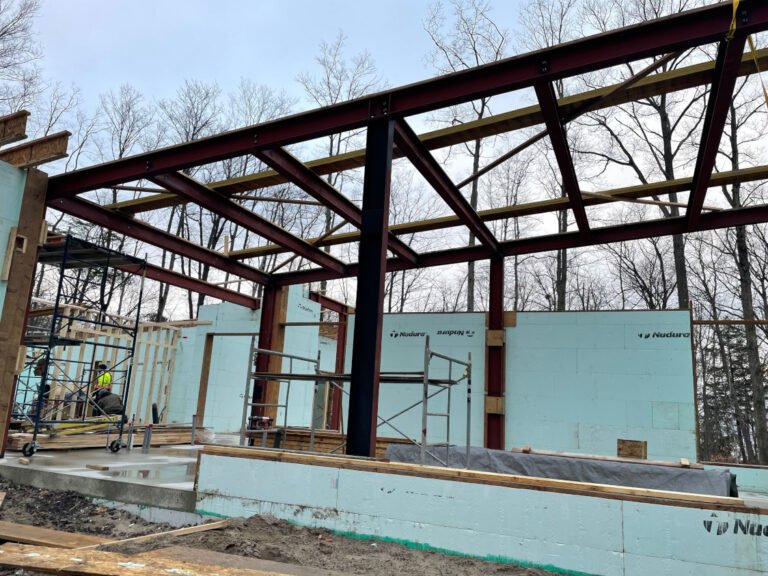
Floor system installs over the foundation walls. Above-grade ICF walls (if specified) continue up using the same stack-brace-pour sequence. For hybrid construction (ICF basement + wood frame above), conventional framing crews take over here. Above-grade ICF takes 4-6 weeks plus pour cure for a typical home. What you’ll see: Either continued ICF stacking, or wood-frame walls being built above the ICF foundation.
8
Roof, exterior, and finishing
Roof structure, exterior cladding (siding, brick, stone), windows and doors installed, then interior trades take over: electrical, plumbing, HVAC, drywall, finishes, kitchen, bathrooms. This phase doesn’t differ much between ICF and wood frame — the same finishing trades work the same way. Takes 4-9 months depending on home complexity and finish level.
9
Final inspection and Tarion PDI
Municipal final inspection. Tarion Pre-Delivery Inspection with the homeowner present, identifying any deficiencies for completion. Occupancy permit issued once deficiencies are addressed. What you’ll see: A walk-through with the builder noting every detail; the PDI list becomes the baseline for Tarion warranty claims.
For more detail on each stage: how ICF construction works and ICF installation methodology.
Disaster Resilience Honestly Assessed
Marketing materials often claim ICF homes "withstand 200 mph winds" or "resist any hurricane." The Ontario reality:
- Wind resistance: Ontario design wind requirements per OBC SB-1 are 80-110 km/h sustained (50-70 mph). ICF walls handle these loads with significant structural margin. Tornado-level winds (200+ km/h) and beyond? ICF is dramatically more resistant than wood frame but no residential structure is fully tornado-proof.
- Earthquake resistance: Ontario is generally low seismic risk (with some exceptions in the Ottawa-St. Lawrence corridor and parts of Northern Ontario). CSA A23.3 reinforcement requirements give ICF walls solid seismic performance for Ontario conditions.
- Fire resistance: 4-hour ASTM E119 rating as discussed above. Significant advantage for rural wildfire-exposed properties.
- Snow load capacity: Ontario snow loads range from 1.3-3.5 kPa (per OBC SB-1). ICF walls have substantial capacity for the highest snow load regions including Georgian Bay snow belt.
- Flood resistance: ICF basement walls don’t rot or grow mould the way wood does. Repair after flooding involves removing damaged drywall and insulation but the structural walls remain sound. For flood-prone lots, this matters.
Honest summary: ICF is genuinely more disaster-resilient than wood frame for Ontario’s actual disaster profile. The marketing claims of "indestructible" overstate this; the reality of "substantial margin over Ontario residential code requirements" is true and useful.
For deeper analysis: durability and resilience of ICF construction.
Foundation and Waterproofing
Foundation work is where ICF often delivers the strongest value-for-cost. Several practical points specific to Ontario builds:
Foundation excavation depth
Ontario frost depth requires footings below: 1.2m minimum per OBC for Southern Ontario, 1.2-1.4m for Central Simcoe County, 1.4-1.5m for Georgian Bay snow belt, 1.5-1.8m for Northern Ontario. Footings extend below this depth regardless of construction type.
Waterproofing membrane
Below-grade ICF walls get a waterproofing membrane applied to the exterior face after concrete cures and bracing is removed. Several systems are code-compliant and proven over time. Don’t skip this step — the foam blocks themselves aren’t waterproof; the foam is closed-cell and water-resistant but not waterproof. The membrane is what keeps your basement dry.
Drainage system
4-inch perforated drainage tile (weeping tile) installed at footing level, surrounded by clean drainage stone (typically 6 inches of 19mm gravel), connected to either a sump pit or daylight drain. The drainage system collects any water that gets past waterproofing and removes it before it can build hydrostatic pressure against the wall. Both belt and suspenders — you want both.
Backfill timing
Don’t backfill before concrete reaches design strength (typically 7 days minimum, sometimes longer in cold weather). Premature backfill can deflect ICF walls before they have full strength. Reputable contractors wait the cure time; pressure to backfill faster is a red flag.
Insulation continuity
One of ICF foundation’s biggest advantages: continuous insulation from footing to roof line, with no thermal break at the foundation-wall transition. This eliminates the cold band at floor level that’s common with wood-frame-over-poured-concrete foundations. The basement is warm and dry; the floor above doesn’t have cold floors where the foundation meets the floor system.
For complete foundation deep-dive: ICF foundation guide and ICF forms for basements.
What goes wellReputable contractor + experienced crew + reasonable timelines + clear communication + adequate cure time + proper waterproofing = a basement and home that performs as designed.
Common problemsRushed timelines, inadequate bracing, premature backfill, skipped or undersized waterproofing, incorrect rebar placement, untrained crews learning on your house.
How to avoid themChoose a Certified ICF Builder with documented project history. Verify rebar placement before pour. Don’t accept pressure to skip cure time. Make sure waterproofing happens before backfill.
Related ICFpro deep dives
More technical references on ICF construction, brands, costs, and Ontario-specific considerations.
★ Primer
Complete ICF Building Primer →
★ ProcessHow ICF Construction Works →
★ InstallICF Installation Methodology →
FoundationICF Foundation Complete Guide →
BasementICF Forms for Basements →
ReferenceICF Blocks: All Types & Variants →
ReferenceICF Wall Systems Primer →
CostICF Cost Per Sq Ft Ontario 2026 →
DecisionIs ICF Worth It in 2026? →
BrandAll 8 Ontario ICF Brands Compared →
CodeICF & the 2024 Ontario Building Code →
DesignICF Design Challenges →
PlansWhere to Get ICF House Plans →
BalanceICF Pros and Cons Honest →
Benefits10 Benefits of ICF Construction →
EnergyICF Energy Efficiency Deep Dive →
SoundSoundproofing with ICF →
DIYICF for Owner-Builders Ontario →
Building with ICF in Ontario? Let’s Talk Specifics.
We’ve been pouring ICF in Ontario for 30 years (since 1995). 300+ projects across Alberta, Croatia, and Ontario, including ~42 custom homes in Tiny Township since 2005. Four certifications (Certified ICF Builder, R2000, Green Builder, Tarion-Approved) and a 7-year materials and workmanship warranty. Send us your plans or just describe what you’re thinking; we’ll tell you honestly what works, what doesn’t, and what it’ll cost.
FAQ: Building with Insulated Concrete Forms
What does ICF construction actually cost in Ontario in 2026?
Wall portion: $42-$55/sq ft for basement walls, $40-$50/sq ft above-grade — about 30-50% more than wood frame on walls alone. Full custom home: 3-8% premium over comparable wood frame, putting total at $340-$640/sq ft for 2026 Ontario custom builds. The premium pays back in 7-12 years all-in or 12-20 years from energy savings alone.
How much energy does an ICF home actually save?
Real numbers: 25-40% heating energy reduction vs comparable wood frame. 15-25% cooling reduction. Annual operating cost savings of $600-$1,000/year on typical 1,800-2,400 sq ft Ontario homes, with zone 7 Northern Ontario at the higher end ($1,000-$1,800/year). Claims of "up to 50%" or "60%+ savings" are inflated marketing numbers.
What sound rating does ICF achieve?
6″ core STC 50-52, 8″ core (most common) STC 52-55, 10-12″ core STC 55-60. Wood frame typical is STC 33-38. 2024 OBC requires minimum STC 50 between dwelling units in multi-unit buildings; ICF inherently meets this.
What ICF wall thickness should I specify?
8″ concrete core is the standard for Ontario residential — sufficient for most 2-3 story custom homes, STC 52-55 sound rating, 4-hour fire resistance, handles all Ontario snow loads except the most extreme. 6″ core saves $1,500-$3,000 for single-story applications. 10-12″ core needed for commercial or high-load conditions.
What is the fire rating of ICF walls?
4-hour ASTM E119 fire resistance for properly constructed ICF wall assemblies — significantly above the 1-hour typical for wood frame. EPS foam is fire-retardant treated and CAN/ULC S102 compliant. Particularly valuable for rural wildfire-exposed properties and multi-unit buildings.
How long does an ICF build take vs wood frame?
Similar total timeline — ICF doesn’t save significant build time vs wood frame. ICF foundation walls stack in 3-5 days and pour in one day; above-grade ICF walls take 4-6 weeks plus pour cure. The trades that follow work similarly in both. Claims that ICF "shaves months" off construction are overstated.
Can ICF be done above-grade or only for basements?
Both. Many Ontario custom homes use ICF only for basements with conventional wood frame above. Hybrid construction is now standard practice — reduces ICF premium from 3-8% full-build down to 2-4% while retaining most performance benefits. Full ICF makes sense for premium custom homes, multi-unit buildings, and lakefront/forest sites.
What about waterproofing ICF foundation walls?
Critical to do this properly. Below-grade ICF walls need waterproofing membrane applied to the exterior face after concrete cures, then drainage board, weeping tile at the footing level, and 6 inches of clean drainage stone. The foam blocks are water-resistant but NOT waterproof; the membrane is what keeps your basement dry.
How disaster-resistant are ICF homes really?
Genuinely more resilient than wood frame for Ontario’s actual disaster profile. Wind: handles Ontario design wind (80-110 km/h sustained per SB-1) with significant margin. Fire: 4-hour ASTM E119 rating. Snow load: handles all Ontario snow load regions. Flood: structural walls don’t rot or grow mould. Marketing claims of "indestructible" overstate this; "substantial margin over Ontario residential code" is accurate.
Is ICF construction sustainable?
Operating-phase sustainability is strong — 25-40% lower heating energy translates to lower lifetime carbon emissions, especially relevant in Ontario where electric grid is largely low-carbon. EPS foam is closed-cell, doesn’t off-gas, and remains stable for 100+ year service life. Concrete production has embodied carbon impact; this gets offset by operating-phase savings over building lifetime. Recycled-content EPS variants now available.