ICFPro.ca is a division of ICFhome Ontario - Direct Line 1 705 533-1633 - Email: info@icfpro.ca

ICF Fire Resistance

ICFpro.ca · Fire Performance Deep Dive
ICF Fire Resistance: The Science, the Real Numbers, and What Actually Matters in Ontario
ICF walls carry a certified 4-hour ASTM E119 fire rating vs roughly 1 hour for wood-frame construction. That’s real, well-documented, and meaningful. But most articles on this topic wrap it in marketing claims that don’t hold up — inflated insurance discounts, exaggerated survival temperatures, fabricated case studies. This article is the science version: what the standards actually mean, what the verified Paradise California 2018 case study really showed, what the 2024 OBC requires for fire safety, and where the ICF fire advantage genuinely matters for Ontario homeowners.
4-Hour ASTM E119
UL 263 Tested
5–15% Insurance Discount
Real Ontario Context
Paradise CA Case Study Verified
The fire performance facts
ICF walls deliver certified 4-hour fire resistance per ASTM E119 — substantially better than wood frame, real-world validated, and meaningful for specific Ontario property types and use cases.
- Fire rating: 4-hour ASTM E119 wall assembly rating (6″ concrete core + 5/8″ Type X drywall) vs ~1 hour wood frame. Confirmed by ICC-ES and CCMC.
- Paradise CA 2018: At least 3 ICF homes survived the Camp Fire that destroyed 18,804 structures. Real case, documented by FEMA, ICF Builder Magazine, and manufacturers (Amvic, Element ICF).
- Insurance discount in Ontario: 5–15% on dwelling portion of home insurance — not the 15–25% some sources claim. Real, but ask your broker specifically.
- Standards that matter: ASTM E119, UL 263, NFPA 268, ULC S101 (Canadian equivalent). These are the certifications worth asking about.
- Why this matters in Ontario: Cottage country fire response times (often 20-40 min vs 8-12 min urban), increasing wildfire smoke events, lakefront and rural properties where structure protection matters most.
- 2024 OBC requirements: Fire separations, compartmentation, residential sprinkler trends — ICF’s inherent fire resistance simplifies compliance.
4 hours
ASTM E119 fire rating 6″ ICF wall + Type X drywall
1 hour
Wood frame rating 2x6 + 5/8″ Type X drywall typical
5–15%
Ontario insurance discount available on concrete construction
3 homes
ICF survivors Paradise CA 2018 Camp Fire (of 18,804 destroyed)
Why Fire Resistance Matters in 2026 Ontario
Most articles about ICF fire resistance lean heavily on California wildfire imagery — understandable but not the whole story for Ontario homeowners. The Ontario fire risk profile is different from the southwestern U.S., but it’s not zero. Here’s what’s actually changed in the last few years:
1. Wildfire smoke is now an annual event
Air quality events from Northern Ontario and Western Canada wildfires have reached Southern Ontario every summer since 2023. While the structures aren’t burning down in Toronto or Barrie, the conversation has shifted — homeowners are thinking about wildfire risk in ways they didn’t five years ago. Properties in rural and cottage areas, especially those bordering Crown land or forested areas, are paying closer attention.
2. Cottage country fire response times
Urban fire departments respond in 8–12 minutes typical. In rural Simcoe County, parts of Muskoka, Haliburton, and other cottage areas, response times are often 20–40 minutes — sometimes longer in shoulder seasons when staffing is reduced. That’s the window where wall fire resistance buys real time for occupant evacuation and prevention of total loss.
3. Insurance is asking harder questions
Ontario insurers have tightened underwriting on wood-frame construction in wildland-urban interface areas. Some carriers now offer the 5–15% concrete construction discount automatically; others require you to ask. Reinsurance pressure from recent Canadian fire seasons has made fire-resistant construction a more relevant conversation than it was pre-2020.
4. The 2024 OBC raised fire requirements modestly
The 2024 Ontario Building Code (O. Reg. 163/24) introduced some changes around fire separations, compartmentation in multi-unit residential, and growing residential sprinkler adoption in certain jurisdictions. ICF’s inherent 4-hour rating means most fire-separation requirements are met without additional buildup — a code compliance simplification.
The Fire Standards That Actually Matter
“Fire resistant” is a marketing term. The standards behind it are specific, tested, and meaningful. When evaluating any wall system’s fire performance, these are the ratings to look for:
| Standard | What It Tests | ICF Performance |
|---|---|---|
| ASTM E119 | Standard fire test of building construction and materials — the primary North American wall assembly fire rating test | 4-hour rating for 6″ concrete core + 5/8″ Type X drywall both sides |
| UL 263 | Underwriters Laboratories equivalent to ASTM E119 — fire tests of building construction | 4-hour certified assemblies available across major ICF brands |
| NFPA 268 | Ignition resistance of exterior wall assemblies (radiant heat test) | ICF assemblies pass with stucco, fiber-cement, brick, or stone exterior |
| ULC S101 | Canadian standard for fire endurance tests (Underwriters Laboratories of Canada) | ICF systems certified for 2-, 3-, and 4-hour ratings depending on assembly |
| CAN/ULC S102 | Surface burning characteristics of building materials — flame spread index | EPS foam in ICF assemblies tested with low flame spread when properly installed behind drywall |
| ICC-ES Reports | Evaluation reports from International Code Council for ICF systems | Major Ontario brands (NUDURA, AMVIC) have current ICC-ES reports referencing fire performance |
Important distinction: The 4-hour rating applies to the complete wall assembly (concrete core + foam + Type X drywall on both sides). It is NOT a claim that bare concrete withstands flames for 4 hours, or that the EPS foam alone is fire-resistant for 4 hours. Some marketing materials conflate these. The certified rating is what matters for code compliance and insurance — and it requires the complete assembly as tested.
How ICF Fire Performance Actually Works
Here’s the real science of why ICF walls perform as they do in fire conditions — not the marketing version:
The reinforced concrete core
Concrete itself is non-combustible (Class A per OBC definitions). The standard ICF concrete core (8″ in most residential walls, 20-30 MPa per CSA A23.1) provides the primary fire barrier. However, concrete is not impervious to high temperatures:
- Up to 300°C (572°F): Concrete loses bound water but retains structural integrity
- 300–600°C (572–1112°F): Progressive loss of compressive strength; surface dehydration
- Above 600°C (1112°F): Spalling risk increases; reinforcing steel begins to lose strength
- Above 1000°C (1832°F): Significant structural degradation possible
This is why the 4-hour rating depends on the protective layers — the EPS foam and Type X drywall — keeping the concrete temperature below critical thresholds during the test duration.
The EPS foam layer
Expanded polystyrene foam used in ICF construction is Type 2 modified with fire retardants. Per CAN/ULC S102 surface burning testing, the treated foam has limited flame spread. Behaviour under fire exposure:
- The foam doesn’t support flame — it chars and softens rather than burning aggressively
- Charring forms an insulating layer that slows heat transfer to the concrete
- The foam is sandwiched between Type X drywall (interior) and exterior cladding (stucco, fiber cement, brick) — not directly exposed to flames in a finished wall
The Type X drywall layer
The 5/8″ Type X gypsum board on the interior surface is what gives the assembly its 4-hour rating in standard test configurations. Type X drywall contains glass fibers and special additives that release water vapour when heated, absorbing energy and delaying heat transfer to the layers behind. Without Type X drywall, the wall rating drops significantly.
The reinforcing steel
Steel rebar (10M, 15M, 20M per CSA G30.18) provides structural strength. Behaviour under fire:
- Up to 200°C: No significant strength loss
- ~500°C: ~25% strength loss
- ~600°C: ~50% strength loss (critical threshold)
- ~800°C: ~80% strength loss
In an ICF wall, the rebar is fully embedded in concrete — protected from direct fire exposure by both the concrete cover (typically 40mm minimum per CSA A23.1) and the EPS foam outside the concrete. Even in a fully developed fire, the rebar stays significantly cooler than ambient flame temperatures.
The honest summary of ICF fire performance
ICF doesn’t make the wall fireproof — nothing residential is truly fireproof. It makes the wall fire-resistant for 4 hours under standardized test conditions, which is roughly 4× the resistance of typical wood-frame construction. In real fire events, that translates to substantially more time for occupant evacuation, fire suppression, and prevention of total structural loss. The Paradise California case study shows what this can mean in catastrophic conditions.
The Verified Paradise California 2018 Case Study
The Paradise California Camp Fire (November 8–25, 2018) is the most-cited ICF wildfire survival case study, and unlike many marketing claims, the core facts are well-documented and verifiable through Cal Fire, FEMA, and ICF industry sources.
Verified case study
What actually happened in Paradise, California
The fire: The Camp Fire ignited November 8, 2018 from a faulty PG&E electrical transmission line. Strong easterly winds drove flames westward into the town of Paradise. Per Cal Fire records, the fire burned for 17 days, consumed 153,366 acres, destroyed 18,804 structures, and killed 85 civilians. It remains the deadliest and most destructive wildfire in California history.
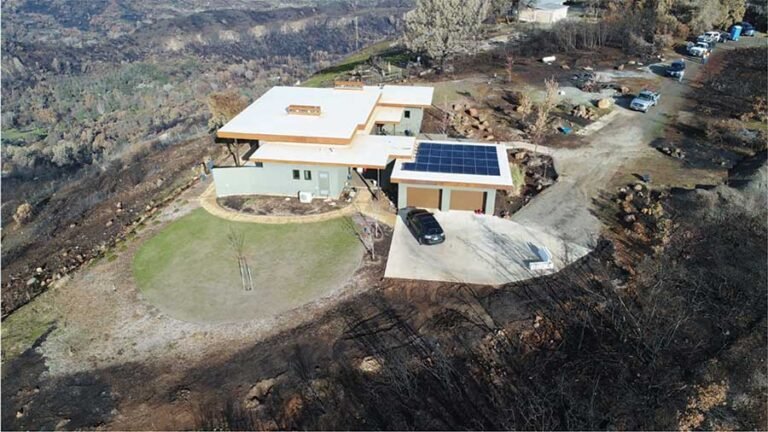
The surviving ICF homes: Multiple ICF industry sources document at least 3 ICF homes that survived the Camp Fire while neighbouring wood-frame structures were destroyed. The most photographed surviving home was built with Amvic ICF (sourced from Alleguard) and finished with stucco exterior — located just west and downwind of the most affected areas of Paradise.
What contributed to survival:
- ICF wall construction — concrete core + EPS + drywall provided structural fire resistance
- Stucco exterior finish — non-combustible cladding prevented ember ignition of wall surface
- Limited vents and small overhangs — reduced ember entry points (a major design factor in WUI fires)
- Defensible space around the building — cleared vegetation reduced direct flame contact
- Concrete or tile roof on at least one of the surviving homes
What the case study shows: ICF walls were necessary but not sufficient on their own. The complete fire-resistant package — walls, cladding, roof, vents, defensible space — created the conditions for survival. ICF alone with a flammable wood-shake roof and dense surrounding vegetation would not have produced the same result.
Where to verify: ICF Builder Magazine’s detailed case study documents the structural performance with PCA references. FEMA’s Paradise rebuild case study mentions ICF as one of the resilient reconstruction materials specified for at least 26 rebuilt homes and one church.
The honest takeaway: Paradise is real evidence that ICF construction performs as designed under catastrophic wildfire conditions. It’s also evidence that building system integration matters more than any single component. A fire-resistant home is the sum of walls + cladding + roof + windows + vents + landscaping — not just one element. For Ontario homeowners considering ICF for fire performance, the lesson is that ICF is the most defensible wall choice, but it works best as part of a complete fire-resilient design.
ICF vs Other Wall Systems on Fire Performance
Honest comparison of certified fire ratings across common Ontario wall systems:
| Wall System | Typical Fire Rating | Behaviour in Fire | Code Compliance Notes |
|---|---|---|---|
| ICF (6″ core + Type X drywall both sides) | 4 hours ASTM E119 | Concrete core remains intact; foam chars but doesn’t support flame | Exceeds most residential fire separation requirements automatically |
| Concrete masonry (CMU block, fully grouted) | 2–4 hours (depends on block thickness) | Non-combustible; long-lasting fire barrier | Meets fire separation requirements; thermal mass similar to ICF without insulation |
| Poured concrete wall (8″ with insulation buildup) | 3–4 hours | Concrete intact; performance depends on insulation type and protection | Similar to ICF for fire; requires separate insulation step |
| Wood frame (2x6 + 5/8″ Type X drywall) | ~1 hour | Drywall protects studs initially; studs eventually ignite | Adequate for typical residential where fire separation not required |
| Steel frame (with required fireproofing) | 1–2 hours (depends on protection) | Steel doesn’t burn but loses strength at ~500°C; collapse possible if unprotected | Requires fire-resistive coatings to achieve rated assemblies |
| Brick veneer over wood frame | ~1 hour (rating is the wood frame behind the brick) | Brick is non-combustible but does not provide structural fire rating | Brick is an ember-resistance benefit but doesn’t change underlying frame rating |
| SIP (Structural Insulated Panels) | ~1 hour (varies by configuration) | OSB skins and foam core combustible; chars from inside out | Lower fire resistance than ICF; comparable to wood frame |
The clearest comparison: ICF gives you roughly 4× the fire endurance of wood frame in a code-tested wall assembly, without requiring separate fireproofing systems. For most residential applications in Ontario, wood frame is adequate; for properties where fire performance is a real priority, ICF is one of the most defensible choices available.
For broader comparison of ICF vs wood-frame on all factors (not just fire), see our ICF vs traditional construction guide.
2024 OBC Fire Requirements for Ontario Homes
The 2024 Ontario Building Code (O. Reg. 163/24) governs fire safety for new construction. Here’s what’s relevant for ICF and how it compares to wood-frame compliance:
Single-family detached homes
For most single-family detached homes, OBC Part 9 fire requirements are minimal — primarily focused on:
- Spatial separation from property lines — limits on unprotected openings (windows/doors) based on distance to lot lines
- Garage-to-house fire separation — typically 1 hour required between attached garage and living space
- Smoke alarms and CO detectors — mandatory placement requirements
- Egress windows in bedrooms — minimum dimensions for escape
ICF construction meets all these requirements without modification. The garage-to-house fire separation is automatic with an ICF garage wall — no additional fire-resistive buildup required.
Multi-unit residential, townhouses, semi-detached
Demising walls (the walls between units) require 1-hour fire separation minimum, and many jurisdictions require STC 50 minimum sound transmission class. Wood-frame construction can meet both with careful detailing (multiple drywall layers, resilient channels, sound-damping insulation). ICF meets both automatically — 4-hour fire rating, STC 50-55 sound rating in one wall assembly.
Larger buildings (Part 3)
Buildings over 600 m² or 3 storeys fall under OBC Part 4 (engineered design). Fire requirements become more substantial: rated assemblies, fire separations between occupancies, compartmentation, and increasingly residential sprinkler requirements. ICF’s inherent fire performance simplifies compliance significantly compared to wood-frame buildings of equivalent occupancy.
Cottage country and wildland-urban interface
Ontario doesn’t have formal Wildland-Urban Interface (WUI) building codes like California’s Chapter 7A, but some Ontario municipalities have introduced fire-resistive recommendations for properties bordering Crown land or in higher fire-risk zones. ICF construction naturally meets these recommendations without additional design work.
For complete OBC compliance detail, see our guide to ICF and the 2024 Ontario Building Code.
Insurance Discount in Ontario (Real Numbers)
Most Ontario home insurers now offer a construction-based discount for concrete and ICF homes — but the marketing claims about “15-25% savings” are typically overstated. Here’s what the discount actually looks like:
The realistic Ontario discount range: 5-15%
The discount applies to the dwelling portion of a home insurance policy (the structure itself, not contents or liability). Specific numbers vary by carrier:
- Tier 1 national insurers (Intact, Aviva, TD, etc.): typically 5–10% on dwelling premium for concrete construction, sometimes higher for fully ICF homes
- Specialty / high-value insurers (Chubb, AIG): often 10–15% with proper documentation
- Regional brokers and mutuals: variable — sometimes excellent discounts (15%+), sometimes none
What the dollar value actually is
For a typical Ontario home insurance policy in 2026:
- Average policy premium: $1,500–$3,500/year depending on dwelling value and location
- Dwelling portion: typically 60–75% of total premium ($900–$2,600)
- 5–15% discount on dwelling portion: $50–$390/year savings
- Compounded over 30 years (current dollars): $1,500–$11,500
How to actually get the discount
- Ask specifically — some carriers apply automatically, others require you to inform them
- Provide construction documentation — ICF system used, certified specifications, ICC-ES or CCMC report
- Get the discount before policy issue if possible — easier than negotiating it later
- Compare quotes from 3+ carriers — ICF discount varies enough between insurers to matter
The honest insurance reality for ICF in Ontario
Insurance discount is a real, measurable benefit — but it’s typically $100–$400/year, not the “25% off your premium” that some sources claim. Over a 30-year ownership it adds up meaningfully ($3,000–$12,000 in current dollars), but it’s one factor among many in the ICF decision, not the deciding one. Energy savings, comfort, sound, durability, and quality-of-life factors typically dominate the ICF cost-benefit calculation.
Where ICF Fire Advantage Matters Most
Honest section: ICF’s fire advantage is real but doesn’t equally apply to every Ontario build. Here’s where it’s most valuable:
Cottage country & rural properties
Fire response times of 20–40 minutes mean wall fire resistance translates directly to time for evacuation and limiting total loss. Lakefront and forested properties especially.
Properties bordering Crown land or forest
Wildland-urban interface zones in Ontario have growing wildfire smoke and ember-storm exposure. ICF + non-combustible cladding + defensible space is the strongest defence.
Workshops with elevated fire risk
Welding, woodworking with finishes, paint storage, fuel storage, hobby chemistry. ICF gives you a building that contains fire rather than feeding it.
Multi-unit residential & townhouses
Where 1-hour demising fire separation + STC 50 is code minimum, ICF delivers both automatically. Significantly simplifies trade coordination.
Homes close to property lines
OBC spatial-separation requirements get triggered when walls are close to lot lines. ICF’s rating reduces the constraint on unprotected openings.
High-value custom homes
Properties where total loss would be catastrophic financially or emotionally. ICF significantly raises the threshold at which a fire becomes total loss.
Where the fire advantage matters less
For comparison — situations where the ICF fire premium is harder to justify on fire grounds alone:
- Urban infill in well-served fire response areas — 8-12 minute response times reduce the time-buying value
- Small accessory buildings — sheds, basic detached garages where fire risk is contained anyway
- Properties planned for short ownership — if you’re selling in 5 years, you won’t accumulate enough insurance savings to recover the premium on fire performance alone
- Builds where wood-frame to current code is adequate for the use case — not every property needs maximum fire performance
Common Misconceptions Corrected
Myth: “ICF homes are fireproof”
Reality: No residential construction is truly fireproof. ICF is fire-resistant for 4 hours under standardized test conditions. Real-world performance depends on the complete building (walls + cladding + roof + windows + vents + landscaping). Use the term “fire-resistant” not “fireproof”.
Myth: “Concrete withstands 2000°F for 4 hours”
Reality: Concrete starts losing strength at ~300°C (572°F) and spalling becomes a serious risk at ~600°C (1112°F). The 4-hour ASTM E119 rating applies to the complete wall assembly (concrete + Type X drywall), where the drywall absorbs heat and protects the concrete from reaching critical temperatures during the test duration. Bare concrete at 2000°F continuously for 4 hours would fail.
Myth: “Insurance discount is 15-25%”
Reality: Ontario insurance discounts for concrete construction are typically 5–15% on the dwelling portion of a home insurance policy. The higher claims either come from older U.S. data or specialty insurer marketing. Real dollar value: typically $100–$400/year. Ask your broker specifically before committing.
Myth: “ICF foam is a fire hazard”
Reality: EPS foam used in ICF is Type 2 modified with fire retardants and tested for surface burning characteristics. In a completed wall assembly, the foam is sandwiched between Type X drywall (interior) and non-combustible cladding (stucco, brick, fiber cement) — not directly exposed to flames. It chars rather than burns aggressively. Decades of certified test data confirm safe performance.
Myth: “All ICF homes survived Paradise California”
Reality: At least 3 ICF homes survived per industry documentation, but it’s not certain how many ICF homes existed in the Camp Fire zone total. The conclusion isn’t “ICF always survives” — it’s that ICF construction, combined with proper cladding, vents, defensible space, and roof systems, provides the most defensible package against extreme wildfire conditions.
Myth: “Texas Chemical Plant Fire 2019 proves ICF survives 1800°F for 6 hours”
Reality: No verifiable source documents an ICF building surviving 1800°F for 6 hours at any 2019 Texas chemical plant fire. The real Texas chemical fires that year (TPC Group Port Neches in November, KMCO in Crosby in April) are well-documented but do not include this ICF survival narrative. This claim circulates in some ICF marketing materials but cannot be substantiated. We’ve removed it from our content because we can’t verify it.
Related ICFpro pages
More on ICF performance, code compliance, and decision-making.
★ Service page
Why ICF? Fire Resistance Overview →
★ Decision guide
ICF vs Traditional Construction →
Durability
ICF Durability and Resilience →
Structural
ICF Structural Strength →
Sound
ICF Soundproofing: STC 50–55 →
Energy
ICF Energy Efficiency →
Code
ICF & the 2024 Ontario Building Code →
Decision
Is ICF Worth It in 2026? →
Cost
ICF Cost Per Square Foot Ontario →
Brands
All 8 Ontario ICF Brands Compared →
Benefits
Benefits of ICF Construction →
Comfort
Health and Comfort with ICF →
Service
ICF Custom Home Building →
Service
ICF Foundations, Pools & Structures →
Want Straight Answers on ICF Fire Performance?
Whether you’re building in cottage country, planning a workshop with elevated fire risk, or just want to understand what the 4-hour rating actually means for your project, we’ll walk through it honestly. 30 years pouring ICF in Ontario, 300+ projects. No-cost initial conversation.
FAQ: ICF Fire Resistance
What is the actual fire rating of an ICF wall?
A standard ICF wall assembly with 6″ concrete core and 5/8″ Type X drywall on both sides carries a 4-hour ASTM E119 fire rating. This is certified and applies to the complete wall assembly — not bare concrete and not the foam alone. The 4-hour rating is the basis for code compliance on fire separations and the 5-15% insurance discount available from most Ontario insurers.
Is ICF really fireproof?
No — no residential construction is truly fireproof. ICF is fire-resistant for 4 hours under standardized test conditions. Real-world fire survival depends on the complete building system: walls + cladding + roof + windows + vents + defensible space. The Paradise California 2018 case study shows that ICF combined with proper non-combustible cladding and defensible space can survive catastrophic wildfire conditions, but ICF alone with a wood-shake roof or untreated foam exposure would not produce the same result.
How does concrete actually behave in a fire?
Concrete loses bound water and begins losing strength at ~300°C (572°F). Spalling risk increases above 600°C (1112°F). The 4-hour ICF wall rating works because the Type X drywall absorbs heat through gypsum dehydration, keeping the concrete below critical temperatures for the test duration. Claims that “concrete withstands 2000°F for 4 hours” misrepresent how the assembly actually performs — the rating is for the complete wall, not for unprotected concrete.
Is the EPS foam in ICF a fire hazard?
No. The EPS foam used in ICF construction is Type 2 modified with fire retardants and tested per CAN/ULC S102 surface burning characteristics. In a completed wall, the foam is sandwiched between Type X drywall (interior) and non-combustible cladding (stucco, fiber cement, brick) — not exposed to direct flames. It chars rather than supporting active flame propagation. Decades of certified test data confirm safe performance in standard residential and commercial applications.
What insurance discount do Ontario insurers actually give for ICF?
Realistic Ontario discount range is 5–15% on the dwelling portion of a home insurance policy. Higher claims (15-25%) circulate in marketing but don’t reflect current Ontario carrier rates. Dollar value typically $100-$400/year. Tier 1 national insurers (Intact, Aviva, TD) offer 5-10%; specialty/high-value insurers (Chubb, AIG) often 10-15% with proper documentation. Always ask your broker specifically — some apply automatically, others require you to inform them.
Did ICF homes really survive the Paradise California 2018 wildfire?
Yes — documented by Cal Fire, FEMA, and ICF industry sources. At least 3 ICF homes survived the Camp Fire while 18,804 surrounding structures were destroyed. The most photographed surviving home was built with Amvic ICF (Alleguard-sourced) with stucco exterior. Key survival factors: ICF walls + non-combustible stucco cladding + limited vents + small overhangs + defensible space around the building. FEMA documents ICF as one of the resilient construction methods used in subsequent Paradise rebuild efforts.
What is the difference between ICF fire performance and concrete block (CMU)?
Both are non-combustible. Concrete block (fully grouted CMU) typically rates 2-4 hours depending on block thickness. ICF’s 4-hour rating is similar, but ICF has the advantage of integrated insulation (the EPS foam adds R-22 to R-25 in one assembly), while CMU requires separate interior insulation buildup to meet 2024 OBC full-height basement insulation requirements. For fire performance alone the two are comparable; for the complete wall system, ICF is more integrated.
Does Ontario have wildland-urban interface (WUI) building codes like California?
Not formally — Ontario does not have a code equivalent to California’s Chapter 7A WUI requirements. However, some Ontario municipalities have introduced fire-resistive recommendations for properties bordering Crown land or in higher fire-risk zones. Cottage country fire response times (often 20-40 minutes) mean wall fire resistance has practical value even without formal WUI code requirements. ICF construction naturally meets the kind of resilience these recommendations target.
Is ICF fire resistance worth the extra cost?
Depends on use case. Fire performance is one factor among many (energy savings 25-40%, sound STC 50-55, durability, insurance 5-15%). For typical Ontario residential builds in urban areas with fast fire response, the fire premium alone is hard to justify. Where it’s clearly worth it: cottage country and rural properties (long response times), workshops with elevated fire risk, multi-unit residential (automatic 1-hour demising wall + STC 50), high-value custom homes where total loss would be catastrophic. See our is ICF worth it analysis for the broader picture.
What about that Texas Chemical Plant Fire 2019 case study I’ve seen referenced?
We’ve removed it from our content. The story circulates in some ICF marketing materials — claiming an ICF office building survived 1800°F for 6 hours at a Texas chemical plant in 2019 — but no verifiable source documents this. The real 2019 Texas chemical plant fires (TPC Group Port Neches in November, KMCO Crosby in April) are well-documented but do not include this ICF survival narrative. We don’t cite case studies we can’t verify. The Paradise California 2018 case is independently documented and is the strongest real-world ICF fire survival evidence available.